
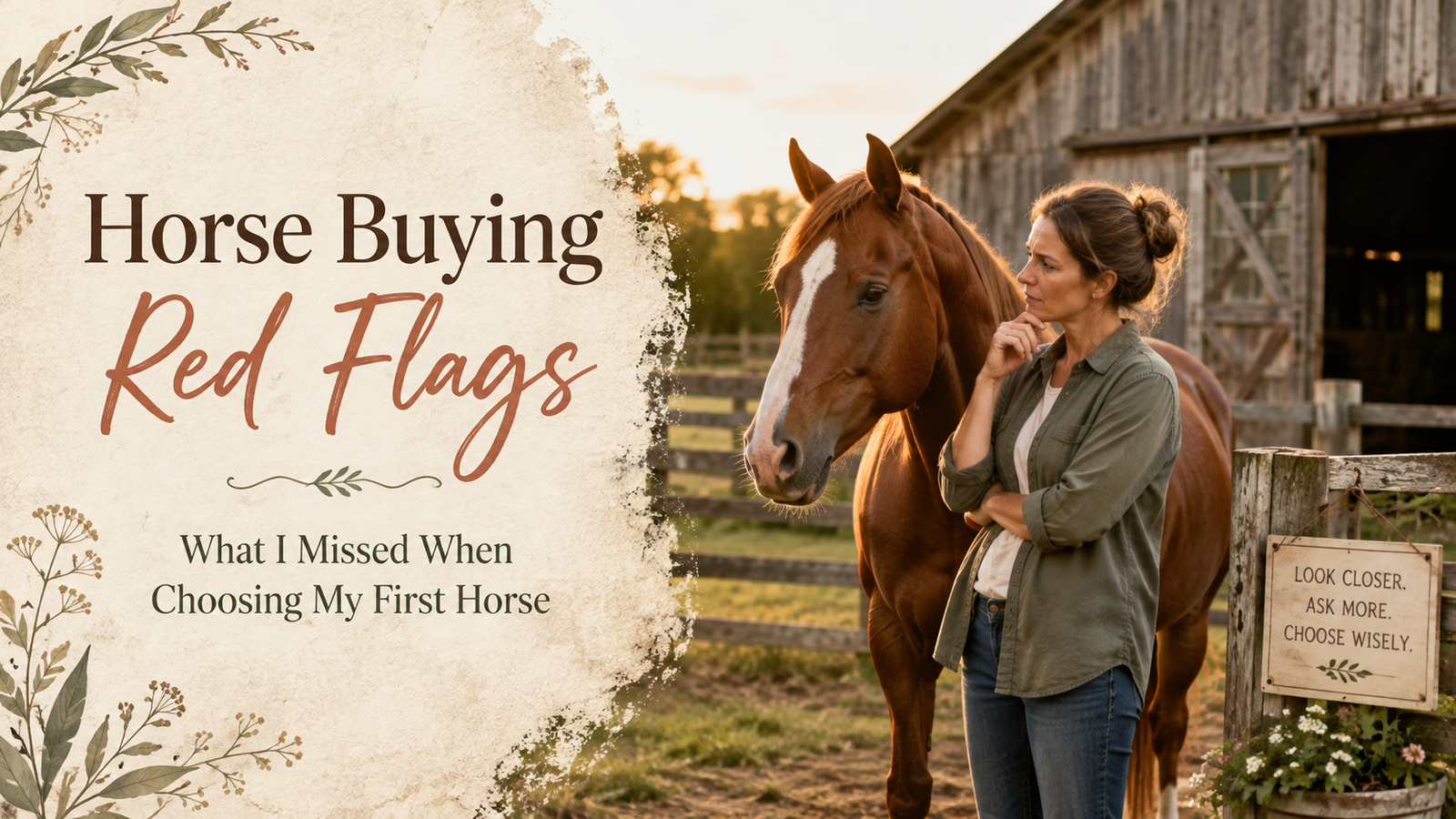
Looking back now, the red flags were everywhere.
The problem was that I didn’t know they were red flags.
This was my first horse, I was excited, and I thought I was doing everything right. I wasn’t just randomly buying the first horse I saw on Facebook. I had talked to different rescues, looked at different horses, told people exactly what I was looking for, and had actually been turned down by several rescues because they didn’t have a horse that fit what I needed.
Which, honestly, I appreciate a lot more now.
Then I called one rescue and they basically said, “We have the perfect horse for you.”
And that is where this story starts.
If you read my other post, I Spent a Year Trying to Make the Wrong Horse Work, then you already know where this ends.
She was not the perfect horse for me.
Not even close.
But now that I have more experience, I can go back through the original listing, videos, conversations, and paperwork and see a bunch of things that should have made me slow down.
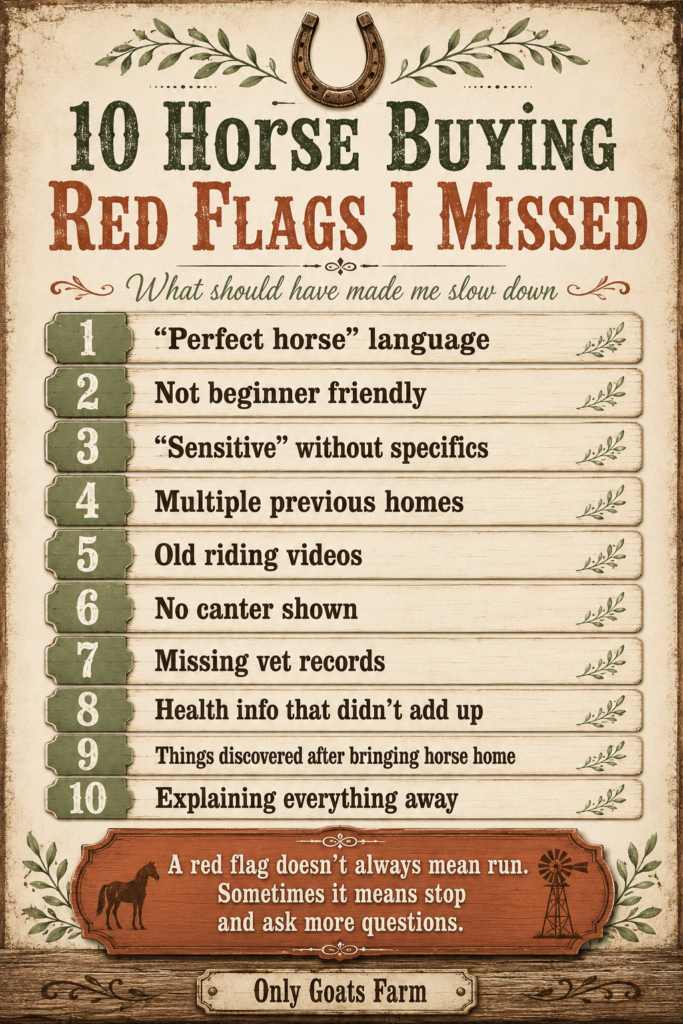
So if you are shopping for your first horse, especially if you are looking at a rescue horse, here are the red flags I missed.
And just to be clear: a red flag does not automatically mean, “Do not buy this horse.”
It means, stop and ask more questions.
I Actually Had a Pretty Specific Horse in Mind
I knew I was a rusty beginner.
I had ridden before, but I had been away from horses for years, and I was never some advanced rider to begin with.
So I was not looking for a green horse.
I wanted something older, preferably 15 or older. Around 15 hands. Something big enough for me and Western tack. Something honest and experienced.
My daughters were also learning how to ride, so I wanted a horse that could safely be around them too.
Eventually I wanted to mess around with things like barrels and mounted shooting. Nothing competitive. I just wanted to have fun with my horse.
That was what I was telling rescues when I called.
A lot of them basically told me, “Nope, we don’t have that.”
Then I called this rescue.
And they got really excited.
Red Flag #1: “We Have the Perfect Horse for You”
At the time, this sounded amazing.
They told me they had this horse that had been sitting there for years and they couldn’t understand why.
She was wonderful.
She had been ridden English.
She had been ridden Western.
Someone had apparently worked on barrels with her.
She had almost done a dressage competition.
She had been through several owners, but nobody could really figure out why because she was supposedly such a sweet horse.
Basically everything I said I wanted, they had a story about how she fit it.
And I ate it right up.
Now?
I don’t think I would want someone telling me a horse is “perfect” for me after one conversation.
I would much rather hear:
“She might be a possibility.”
“Come meet her.”
“Here are the things she’s good at, and here are the things she struggles with.”
Tell me the bad stuff.
Seriously.
If I am horse shopping, I don’t need you to sell me on the horse. I can fall in love with it all by myself.
Tell me why I shouldn’t buy it.
Red Flag #2: She Wasn’t Actually a Beginner Horse
This one was right in front of my face.
They told me she wasn’t a beginner horse.
And I was a beginner.
Hello.
Now, I was honest about my experience. I told them I was a rusty beginner and that I would have help.
The response was basically that it would be fine.
And I believed that.
But when I later went back and looked at her adoption page, it said things like she needed a relaxed rider.
Well, guess who was not relaxed?
Me.
I had not owned a horse before. I was coming back into riding. I had kids involved. I was nervous.
A horse that needs a confident, relaxed, experienced rider is probably not the horse a nervous beginner should be learning on.
That doesn’t make her a bad horse.
It made us a bad match.
And there is a difference.
Red Flag #3: “Sensitive Mare” Meant More Than I Thought It Did
This is another one that makes me laugh at myself now.
Her ad described her as sensitive.
It talked about her being defensive around new people.
There were words like tension, uncertainty and guarded.
It said she had “standards” for how she expected to be treated.
And do you know how I read that?
I basically read it as:
This poor horse has been misunderstood. Nobody has treated her right. I will treat her right. We are going to be best friends.
I did not read that like someone evaluating whether this horse was appropriate for a beginner.
I read it emotionally.
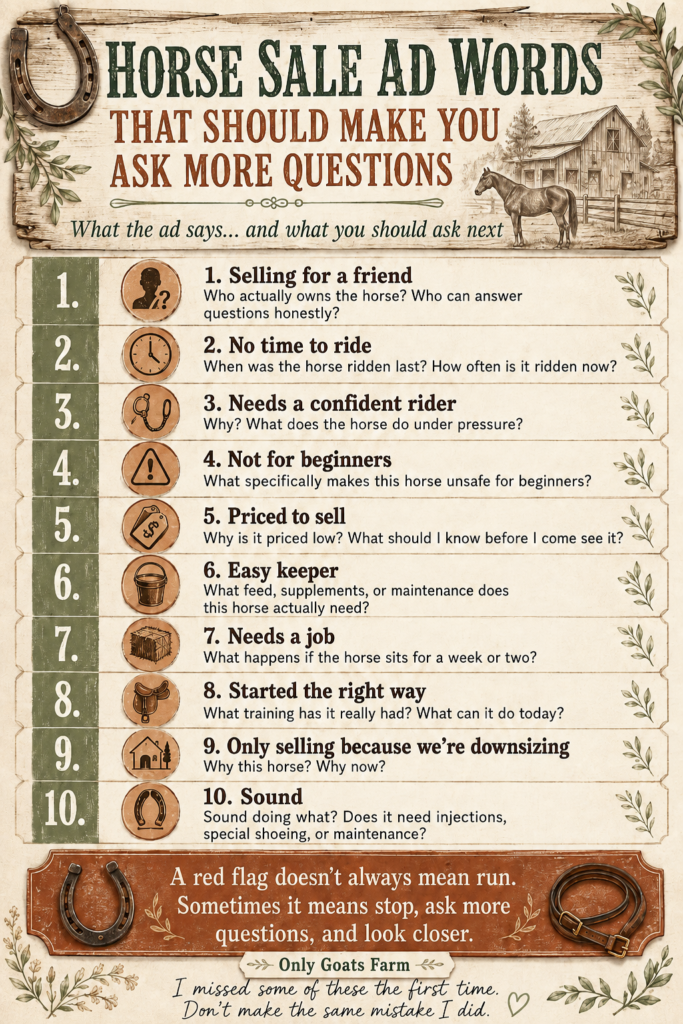
Now, if I see the word “sensitive,” I want details.
Sensitive HOW?
Does she jump when you move too quickly?
Does she panic?
Does she bite?
Does she kick?
Does she buck?
Does she shut down?
Does she become dangerous when she is confused?
Same thing with “defensive.”
What exactly does defensive mean?
Because “she pins her ears” and “she launches a hind foot at your head” are both technically defensive behaviors, but those are two very different horses.
Red Flag #4: She Had Been Through a Lot of Homes
By the time she was around seven years old, she had reportedly already had about five different homes.
Then she spent years at the rescue.
At the time, that fed even more into my whole:
Poor misunderstood horse.
And listen, having several owners does NOT automatically mean there is something wrong with a horse.
People sell horses all the time for perfectly normal reasons.
Money problems.
Moving.
Kids grow up.
People stop riding.
The horse isn’t right for the job anymore.
Whatever.
But if a horse has gone through a lot of homes, I am going to ask more questions now.
Why did each owner get rid of her?
Were they all saying the same thing?
Did anyone return her?
Was there a behavior pattern?
Was there a soundness issue?
I don’t know that you will always get those answers.
But I’m at least asking.
Red Flag #5: The Riding Videos Were TWO AND A HALF YEARS OLD
This one is probably the most obvious to me now.
There were riding videos on her adoption page.
Great.
Except every single one of them was about two and a half years old.
Why did I not ask for a recent riding video?
I have no idea.
This horse had been sitting at the rescue for years, and I was looking at videos that were already years old.
Today, I would want to see the horse being ridden now.
Not when she was in training two years ago.
Not when she was at her best.
Not some polished video from forever ago.
Show me somebody catching her today.
Tacking her up today.
Getting on her today.
Walking.
Trotting.
Cantering.
Both directions.
Stopping.
Standing.
I want the boring stuff.
Boring is good when you’re buying a first horse.
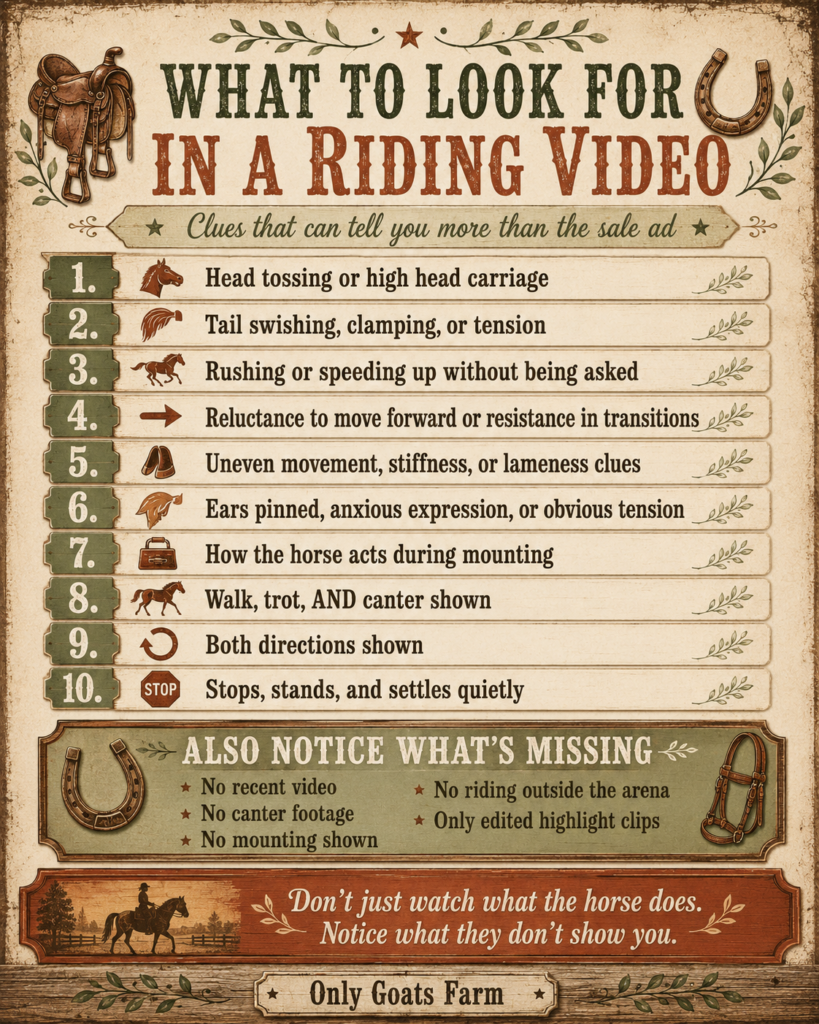
Red Flag #6: The Horse Looked Uncomfortable in the Videos
Once I knew more, I went back and watched those old videos again.
And suddenly I saw things I didn’t understand the first time.
Her tail was going.
Her head was going.
She looked tense.
There were moments where she sped up without really being asked to speed up.
But I had an explanation for all of it.
I knew she had TMJ.
She was being ridden in a bit.
So I thought, Well, maybe the bit is bothering her.
I planned to ride bitless anyway.
Problem solved.
Except maybe it wasn’t.
That was something I did over and over during my year with this horse.
I would see something concerning and immediately find a reason why it probably wasn’t that bad.
That is something I would do very differently now.
Instead of immediately asking:
How can I explain this?
I would ask:
Why is the horse doing this?
Red Flag #7: There Was No Cantering in a 13-Minute Riding Video
This is one of those little things that probably would have meant nothing to me before.
One of the riding videos was something like 13 minutes long.
No cantering.
None.
If you are showing me 13 minutes of a horse being ridden and the horse is supposedly a riding horse, why am I not seeing all three gaits?
Maybe there is a perfectly good reason.
Fine.
Then tell me the reason.
But now I pay attention to what ISN’T shown.
No video of mounting?
Why?
No cantering?
Why?
No riding outside?
Why?
No recent videos?
Why?
No riding away from other horses?
Why?
Again, none of those things automatically mean there is a problem.
But I’m asking.
Red Flag #8: “No Known Health Issues”…Except the Health Issue I Already Knew About
The adoption listing said no known health issues.
But I had also been told she had TMJ.
Those two things don’t really go together.
At the time, I didn’t think much of it.
I just thought, okay, she has TMJ. We’ll deal with that.
Now I would want to know:
Who diagnosed it?
What exactly was diagnosed?
What treatment had been done?
How long had it been going on?
Was she on medication?
Did it affect riding?
Was there imaging?
Were there vet records?
And most importantly:
Can I see the records?
Which brings me to the next problem.
Red Flag #9: I Didn’t Have Her Full Vet Records
When she was dropped off, I did not have a complete medical history.
I had Coggins paperwork.
That was basically it.
Later, I started trying to track down her vet records myself.
She had seen different vets while she was at the rescue, and it took me months to get some of that information.
I got her at the beginning of September 2025.
I finally got previous vet records sent to my veterinarian in January 2026.
And those records included notes about kicking out and behavioral issues under saddle.
That would have been useful information BEFORE I brought the horse home.
So now?
I want medical records when possible.
I want to know who has treated the horse.
I want to know what the horse has been treated for.
I want to know if there is a history of lameness, behavior under saddle, ulcers, neurological concerns, ongoing bodywork, injections, whatever.
Especially if I am buying a horse that is supposed to be safe for riding.
Red Flag #10: I Learned About the Bucking AFTER She Was Mine
This was a big one.
After I got her home, I met someone who had volunteered at the rescue and knew her.
I knew this person rode horses, so I asked if they had ever ridden her.
The reaction was basically:
“No, no, no, no, no.”
Apparently people were not riding her there because she was bucking riders off.
Excuse me?
That is fairly important information when you are adopting a horse out to a BEGINNER as a riding horse.
And because I was a beginner, I was not dumb enough to immediately climb on her after hearing that.
I had a very experienced rider test her.
At the walk, she was tense.
When asked to trot, she started crow hopping and kicking out.
And somehow I still thought:
Okay. Maybe she just needs a relationship with somebody.
Which brings me to probably the biggest red flag of the entire story.
Red Flag #11: I Kept Explaining Everything Away
This was my red flag.
Not hers.
Every time something didn’t make sense, I came up with a reason that made it okay.
She is sensitive because she has been misunderstood.
She tosses her head because of the TMJ.
She bucks because she doesn’t trust people yet.
She is tense because she is in a new place.
She just needs groundwork.
She just needs a refresher.
She just needs ulcers treated.
She just needs EPM treatment.
She just needs chiropractic work.
She just needs the right saddle.
And sometimes those explanations were actually partly true.
That is what made it so difficult.
There really WERE medical problems.
There really WERE things that improved when we treated them.
But that did not automatically mean she was going to become the horse I originally thought I was buying.
I spent almost a year learning that lesson.
Questions I Would Ask Before Buying a Horse Now
I would ask much more direct questions now.
Not:
“Is she safe?”
I would ask:
Has she ever bucked with a rider?
Not:
“Is she beginner friendly?”
I would ask:
What does she do when the rider makes a mistake?
Does she forgive a bad cue?
What happens if the rider gets nervous?
What happens if you lose your balance?
What does she do when she doesn’t understand what you are asking?
I would also ask:
- Has she ever reared?
- Has she ever bolted?
- Has she ever kicked at a person?
- Has she ever bitten anyone?
- Has anyone ever fallen off because of something she did?
- Has anyone ever been injured by her?
- When was she last ridden?
- How often is she currently being ridden?
- What level rider is riding her?
- Why did her previous owners sell her?
- Has she ever been returned?
- Does she have any history of lameness?
- Has she had ulcers?
- Has she ever had neurological issues?
- Does she need regular chiropractic work or other maintenance?
- Can I see her vet records?
- Can I see CURRENT riding videos?
- Can I have my trainer evaluate her?
- Can I have my own vet do a pre-purchase exam?
And one question that I think is really useful:
What does this horse do on her worst day?
Because everybody can tell you how wonderful a horse is when everything is going right.
I want to know what happens when it isn’t.
A Red Flag Does Not Mean the Horse Is Bad
I want to say this because I don’t want this post to come across like every sensitive horse or rescue horse is a disaster waiting to happen.
That is not what I mean at all.
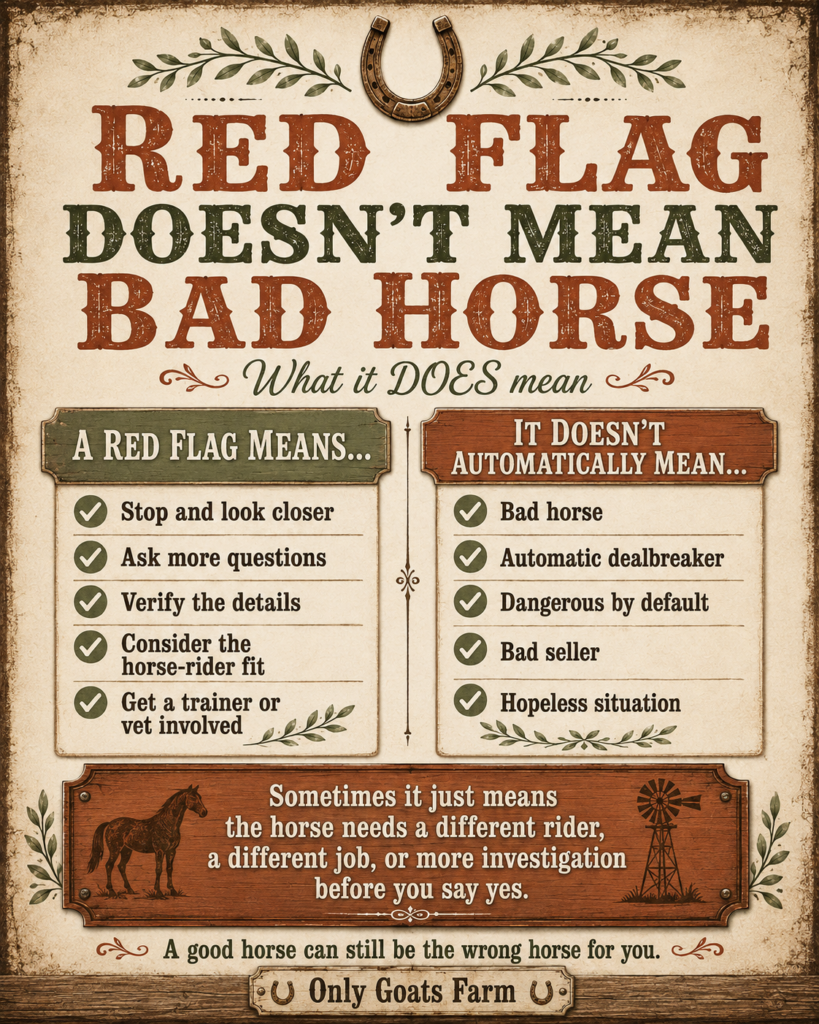
A horse can be sensitive and be an amazing horse.
A horse can have medical problems and be an amazing horse.
A horse can be completely inappropriate for a beginner and still be somebody else’s dream horse.
The issue is the match.
The horse I got was not the horse I needed.
And I was not the owner she needed either.
I wanted a horse I could ride, learn on, enjoy, and eventually involve my daughters with.
What I ended up with was a horse that needed significantly more experience, medical investigation, management, and caution than I was prepared for.
That doesn’t make her bad.
It made her wrong for me.
The Biggest Thing I Learned
If you are looking for your first horse, please be picky.
Annoy people.
Ask questions.
Ask the same question three different ways if you have to.
Ask for another video.
Bring someone more experienced than you.
Have your own vet look at the horse.
And if something feels weird, don’t talk yourself out of noticing it.
I wish I had understood that a red flag doesn’t always mean:
RUN.
Sometimes it just means:
STOP. Ask more questions.
Because looking back now, I can see the red flags all over my horse-shopping story.
I just didn’t know enough yet to understand what I was looking at.


Post your Comment About This Product