
Introduction
There is a video going around the horse world right now that I honestly had a hard time watching.
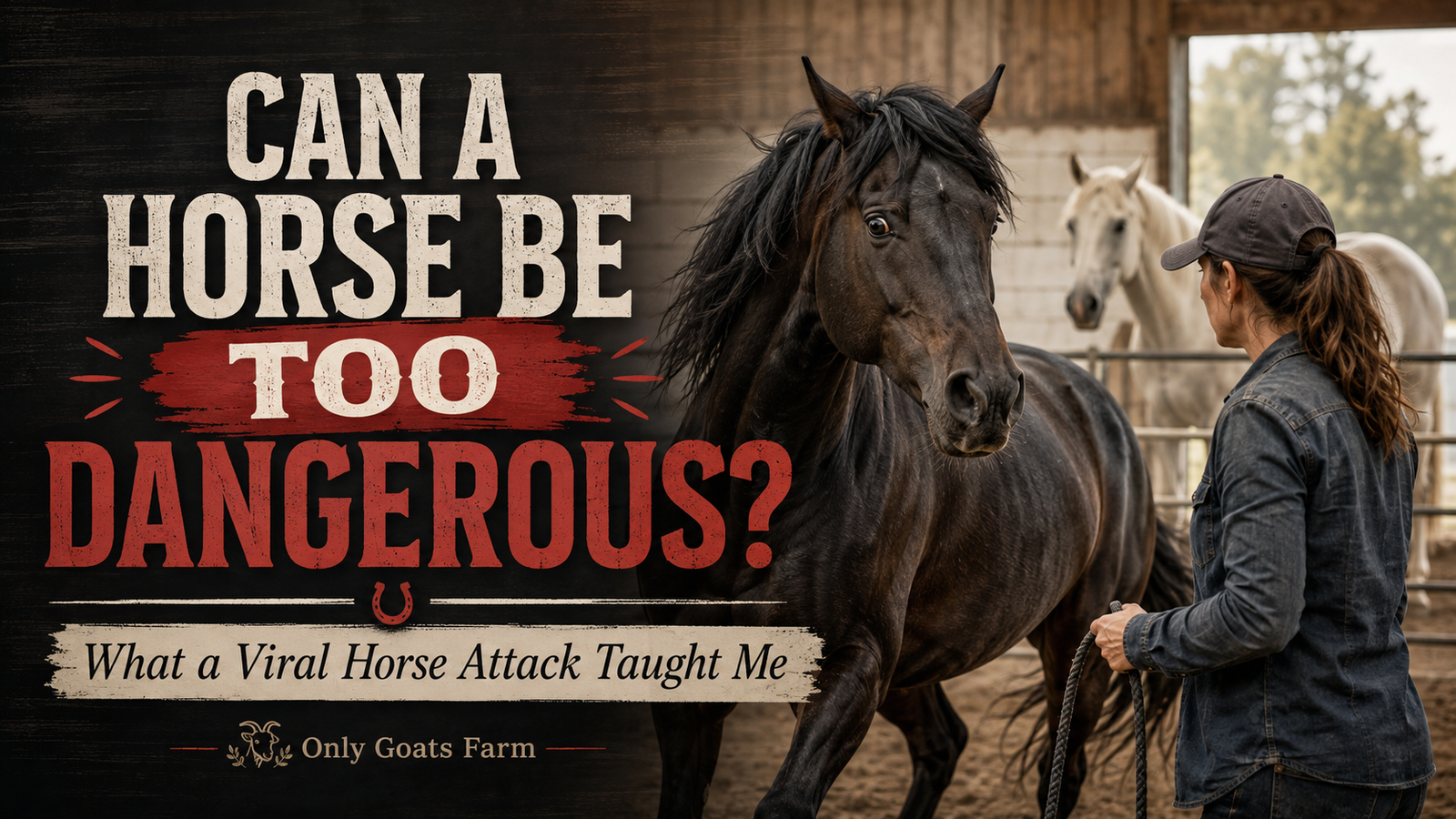
It shows a horse trainer being brutally attacked by a mare she had recently started working with.
And watching it gave me chills.
Not just because of how violent the attack was, but because so many of the behaviors being discussed around this mare reminded me of the rescue horse I recently returned.
If you have followed my horse journey, you probably already know the story.
I adopted a black mare from a rescue as my first horse. I knew she had some issues. I knew she needed work. What I did not fully understand at the time was how dangerous those issues had the potential to become.
I spent months trying to help her.
I worked with trainers. I worked with veterinarians. I spent money, time, energy, and a ridiculous amount of emotional bandwidth trying to figure out what she needed.
Eventually, I returned her to the rescue.
At the time, that decision was incredibly difficult.
After watching this viral horse attack, though?
I don’t regret it.
In fact, it made me realize just how lucky I am that my story ended the way it did.
Important: I am not a veterinarian or professional horse trainer. This is my personal experience as a horse owner. I am also not diagnosing the mare involved in the viral attack. Any discussion of hormones or medical causes in this post is simply about possibilities that can sometimes contribute to behavioral changes in horses.
Key Takeaways
- Dangerous behavior in horses should be taken seriously, even when we desperately want to understand or “fix” the horse.
- The trainer involved in the viral attack says the mare already had a history of difficult handling and had bitten a handler before the attack.
- Pain, reproductive problems, neurological issues, hormones, training history, fear, and learned behavior can all be things professionals may investigate when a horse’s behavior changes.
- Some ovarian tumors in mares can produce testosterone and cause stallion-like behavior, including aggression—but there is currently no evidence that this explains the mare in the viral video.
- Returning or rehoming a horse that is unsafe for you is not automatically a failure.
- A horse does not have to be “evil” for the risk it presents to be unacceptable.
What Happened in the Viral Horse Attack?
The trainer in the video is Bella Boe.
According to Bella’s own account, the attack happened on July 21, 2026, during only her second session with the mare.
Bella says she already knew the mare could be dominant and difficult to handle. She had also been told that the horse had bitten a handler and that several veterinary or chiropractic professionals had previously declined to work with her because of her behavior.
Bella’s goal was actually to establish safer handling so the horse could eventually receive a more thorough veterinary evaluation.
During their second session, Bella says the mare had begun settling and responding to her.
Then Bella asked her to back out of her space.
According to Bella, the mare suddenly lunged into her chest and face, knocked her to the ground, bit underneath her rib cage, held onto her and flung her around while striking her head and face with her front feet.
Bella suffered a dislocated shoulder, elbow fractures, a serious scalp wound, significant bite injuries and other trauma.
It is one of those videos that demonstrates just how quickly a situation involving a horse can become catastrophic.
And that was the part that got me.
Because I kept thinking:
That could have been me.
Why This Video Hit So Close to Home
My mare never attacked me like the horse in that video attacked Bella.
I want to make that very clear.
But there were enough similarities in the warning signs that watching it was uncomfortable.
My mare would threaten to bite people.
She could become aggressive toward other people handling her.
She was difficult for veterinary care.
She could kick.
She became increasingly possessive and aggressive around other horses.
There were even times when she kicked toward a person’s head.
And somehow, because none of those incidents resulted in somebody being seriously injured, I kept moving forward.
That is one of the dangerous things about repeated near misses.
Eventually, they start feeling normal.
The horse missed.
Nobody got bitten.
Nobody got kicked.
Nobody went to the hospital.
So you convince yourself that you’re making progress.
But a near miss doesn’t necessarily mean the danger wasn’t real.
Sometimes it just means you got lucky.
I Originally Assumed My Rescue Horse Had Been Abused
When I adopted my mare, I knew she had been through multiple homes.
Like a lot of people would, I immediately created a story in my head about why.
Maybe somebody had mistreated her.
Maybe people had failed her.
Maybe she had been bounced around because nobody had taken the time to understand her.
And maybe some of those things were true. I will never know everything that happened before she came to me.
But there is another possibility we do not talk about nearly as comfortably in the rescue world:
Sometimes a horse moves from home to home because the horse is extremely difficult or unsafe to manage.
That doesn’t mean the horse is malicious.
It doesn’t mean the horse wakes up in the morning plotting how to ruin someone’s day.
Horses aren’t people.
But it does mean that sometimes the horse is the common denominator in a long string of unsuccessful placements.
That was a difficult possibility for me to accept.
When I Started Wondering Whether the Horse Was the Problem
People kept telling me:
“There are so many good horses out there. Why are you doing this?”
And I hated hearing it.
Because I had made a commitment.
I adopted this horse. I wanted to help her. I didn’t want to become another person in a long line of people who had given up.
I think sometimes animal people can get trapped by that mentality.
We believe that loving an animal means never giving up under any circumstances.
But there is a difference between giving an animal a fair chance and repeatedly putting yourself—or everyone around you—in danger.
I didn’t understand that difference as well then as I do now.
My Mare’s Aggression Started Escalating
Toward the end of the time I owned her, things became stranger.
She became extremely possessive around other horses.
If I interacted with another horse, she might lash out at that horse or behave aggressively toward me.
Her behavior started looking increasingly stallion-like.
That was when my trainer suggested something I hadn’t considered.
She told me to have her hormones investigated.
So I did.
And my mare had elevated testosterone.
Suddenly, we had another piece of the puzzle.
It did not magically explain every behavior she had ever displayed.
But it did tell us that there could be a physiological component contributing to what we were seeing.
The Hormone Problem We Eventually Discovered
This is why I think medical investigation can be so important when a mare suddenly begins displaying unusual reproductive, aggressive or stallion-like behavior.
Veterinary sources recognize that certain ovarian conditions can cause significant behavioral changes.
For example, granulosa cell tumors are ovarian tumors that can occur in mares. Some produce testosterone, and mares affected by testosterone-producing tumors may exhibit stallion-like behaviors such as aggression, mounting, flehmen and urine marking.
Testing and diagnosis are obviously much more complicated than simply saying:
“My mare is aggressive, therefore she has an ovarian tumor.”
Aggression by itself does not diagnose a hormone disorder.
But when my trainer noticed the combination of behavioral changes occurring in my mare, checking her reproductive hormones gave us useful information.
And it is one of the reasons the viral attack immediately made me curious about whether the mare involved has received a full veterinary and reproductive workup.
Could Hormones Explain the Viral Horse Attack?
Maybe.
Maybe not.
And this is where I want to be extremely careful.
I have seen no evidence that Bella’s mare has elevated testosterone, an ovarian tumor, or any other specific hormonal disorder.
Bella herself says part of the reason she was working with the mare was to get her manageable enough for further veterinary evaluation.
Because of my experience, though, I would personally be very interested to know what that veterinary investigation finds.
Could there be pain?
A reproductive disorder?
A neurological problem?
A hormonal abnormality?
A learned behavioral problem?
Something else entirely?
I don’t know.
And unless those results are eventually released, the internet doesn’t know either.
The similarities simply reminded me of questions that were eventually important in my own horse’s case.
My Trainers Saw the Danger Before I Did
Looking back, one of the most important lessons from my mare was that the experienced horse people around me were seeing risk differently than I was.
One of my trainers kept emphasizing that this horse needed to become incredibly soft and reliable on the ground before I should even think about riding her.
I misunderstood what she meant.
When I saw improvement, I thought:
She’s doing better. We’re ready for the next step.
My trainer’s standard was different.
With an ordinary horse, maybe “pretty good” groundwork is enough to progress.
With a horse that has already demonstrated potentially dangerous behavior, “pretty good” may not be enough.
The margin for error becomes much smaller.
My cousin, who also trains horses, was even more direct.
Essentially, her position was:
I am not helping you convince yourself that continuing this is a good idea. This horse could hurt you.
At the time, that was frustrating.
Now?
I understand it.
Why I Shouldn’t Have Ridden My Mare
This is another thing I can admit now.
I probably should never have gotten on that horse.
There were warning signs on the ground that I did not fully appreciate because I was inexperienced.
And I was a first-time horse owner.
That combination scares me now.
I don’t think a horse with that level of unpredictability and aggression should have been placed with someone with my experience level.
I was learning horses while simultaneously trying to rehabilitate a complicated horse.
Those are two very different jobs.
When you’re new, you don’t know what you don’t know.
You don’t always recognize the difference between:
“This horse needs training.”
and
“This horse could seriously hurt someone.”
That distinction matters.
Sometimes There Are Too Many Good Horses to Risk Your Life
This may be an unpopular thing to say in some corners of the horse world.
But there really are good horses out there.
Safe horses.
Kind horses.
Forgiving horses.
Horses that allow inexperienced owners to learn without every mistake potentially becoming an emergency.
That does not mean those horses never spook.
It doesn’t mean they never bite, kick, bolt or make a bad decision.
Every horse is capable of hurting someone.
They are large animals with their own brains and instincts.
But there is a difference between the inherent risk of owning horses and repeatedly managing a horse that has demonstrated serious aggression toward humans.
You are allowed to decide that the second category is beyond what you can safely manage.
Returning My Horse Was the Right Decision
I struggled tremendously with returning my mare.
I felt like I had failed.
I had promised myself I was going to help her.
But keeping a horse because you’re afraid of feeling guilty isn’t necessarily doing right by the horse—or by the people who have to be around her.
My children were around this horse.
Other boarders were around this horse.
Veterinarians had to handle this horse.
Trainers had to handle this horse.
Visitors could potentially be around this horse.
The consequences weren’t limited to me.
Watching Bella’s attack drove that home in a way nothing else has.
When a horse is capable of causing catastrophic injury, your decision to continue working with that animal can affect far more people than just you.
Returning my mare was hard.
But I believe it was the right decision.
I actually wish I had made it sooner.
What My New Standardbred Taught Me
And then I got my new horse.
A retired Standardbred.
The difference is almost ridiculous.
He is basically a giant puppy dog.
I can enjoy him.
I can learn with him.
I don’t walk into every interaction wondering what fresh crisis we’re going to have today.
And I hadn’t realized how much stress I had been carrying until suddenly it wasn’t there anymore.
Horse ownership is inherently risky.
Of course it is.
But I don’t think it is supposed to feel like you’re constantly negotiating with an animal that might seriously hurt you.
Having a horse I trust has changed the entire experience for me.
It has been better for my confidence.
Better for my ability to learn.
Better for my family.
And frankly, better for my mental and physical well-being.
I don’t miss wondering whether today’s barn adventure is going to be the one that finally sends me to the emergency room.
FAQs About Dangerous Horses
Can a horse really be too dangerous to keep?
Yes. While the specific risk depends on the horse, handler and environment, repeated serious aggression toward humans can create a situation that an individual owner or facility is not equipped to manage safely.
That doesn’t require labeling the horse as “bad.”
It simply means the risk may exceed what that particular owner can reasonably handle.
Does aggression automatically mean a horse was abused?
No.
Past mistreatment can certainly influence behavior, but aggression can have many possible contributors. Pain, fear, poor training, learned behavior, reproductive problems, neurological disease, environmental stress and other factors may need to be considered.
A difficult history should be investigated rather than assumed.
Can hormones make a mare aggressive?
Certain reproductive disorders can contribute to behavioral changes.
Some granulosa cell tumors produce testosterone, and veterinary references specifically note that affected mares can display stallion-like behaviors including aggression.
That does not mean every aggressive mare has a hormone problem.
A veterinarian should determine what testing or examination is appropriate for an individual horse.
Did the mare in the viral attack have high testosterone?
There is currently no reliable evidence that she did.
That is something I wondered about because of my own mare’s experience, but it should not be repeated as a fact unless veterinary findings are eventually released.
Was Bella warned that the mare was dangerous?
Bella says she knew during her initial evaluation that the mare could be dominant and difficult to handle. She also says she had been told the mare had previously bitten a handler and that multiple veterinary and chiropractic professionals had refused to work with her because of her behavior.
Her work with the horse was intended in part to make handling safer so veterinary concerns could be evaluated.
Is returning a horse the same as giving up?
I don’t think so.
Sometimes changing a horse’s placement is the most responsible decision available.
The right horse for an experienced professional may be completely inappropriate for a beginner, a family with children or a busy boarding facility.
Acknowledging that isn’t failure.
It’s risk management.
Final Thoughts
There is a line we hear constantly in the animal world:
They aren’t bad. They were failed by humans.
Sometimes that may be true.
But I think we have to be careful about allowing that belief to make us ignore dangerous behavior.
A horse does not have to be evil for a horse to be dangerous.
A horse doesn’t even need to understand that what it is doing could kill someone.
Intent doesn’t change the size of the animal standing in front of you.
I loved my mare.
I wanted desperately for our story to work.
I spent money.
I hired professionals.
I pursued veterinary answers.
I tried.
And eventually I had to admit that wanting something badly enough wasn’t going to make it safe.
Watching Bella’s attack reminded me how small the distance can sometimes be between a scary horse story and a life-changing injury.
My story could have ended differently.
One of my kids could have been hurt.
My trainer could have been hurt.
Someone else at the barn could have been hurt.
I could have been hurt.
Instead, I returned the horse.
And now I have a horse that I absolutely adore—a big, sweet retired Standardbred who lets me enjoy horses instead of constantly trying to survive them.
Sometimes walking away isn’t the failure.
Sometimes walking away is the lesson.


Post your Comment About This Product