
Most of us don’t start keeping chickens with a breeding program in mind. We pick a few breeds we like, bring home chicks, and look forward to collecting eggs.
But once you start hatching your own birds, the questions change.
Which rooster should you keep? Which hens should become the mothers of your next generation? And if you want to raise meat for your family, can you develop a flock that keeps producing useful birds year after year?
That last question is what really interests me.
In a recent livestream, I sat down with Kenny from Breeders Academy to talk about chicken genetics and what intentional breeding can look like on a homestead. We covered choosing foundation birds, finding a mentor, keeping records, and the challenges of breeding your own meat chickens.
My biggest takeaway: the birds you choose to breed shape the flock you’ll have in the future.
Start With What You Want Your Flock to Do
Before choosing breeding birds, decide what you’re working toward.
Maybe you want dependable egg production. Maybe you want a dual-purpose flock that provides eggs and meat. You might care about preserving a particular breed or improving the consistency of the birds you hatch.
Those goals give you something specific to select for.
“Better chickens” can mean different things on different farms. A bird that fits someone else’s priorities may not fit yours. If you’re still building your first flock, my guide to raising chickens for beginners is a good place to start.
For me, the conversation kept coming back to independence. I’m interested in chickens that can contribute to the homestead over multiple generations, including producing replacement breeding stock.
That means thinking beyond the chicks I’m raising this season.
Choose Your Foundation Birds Carefully
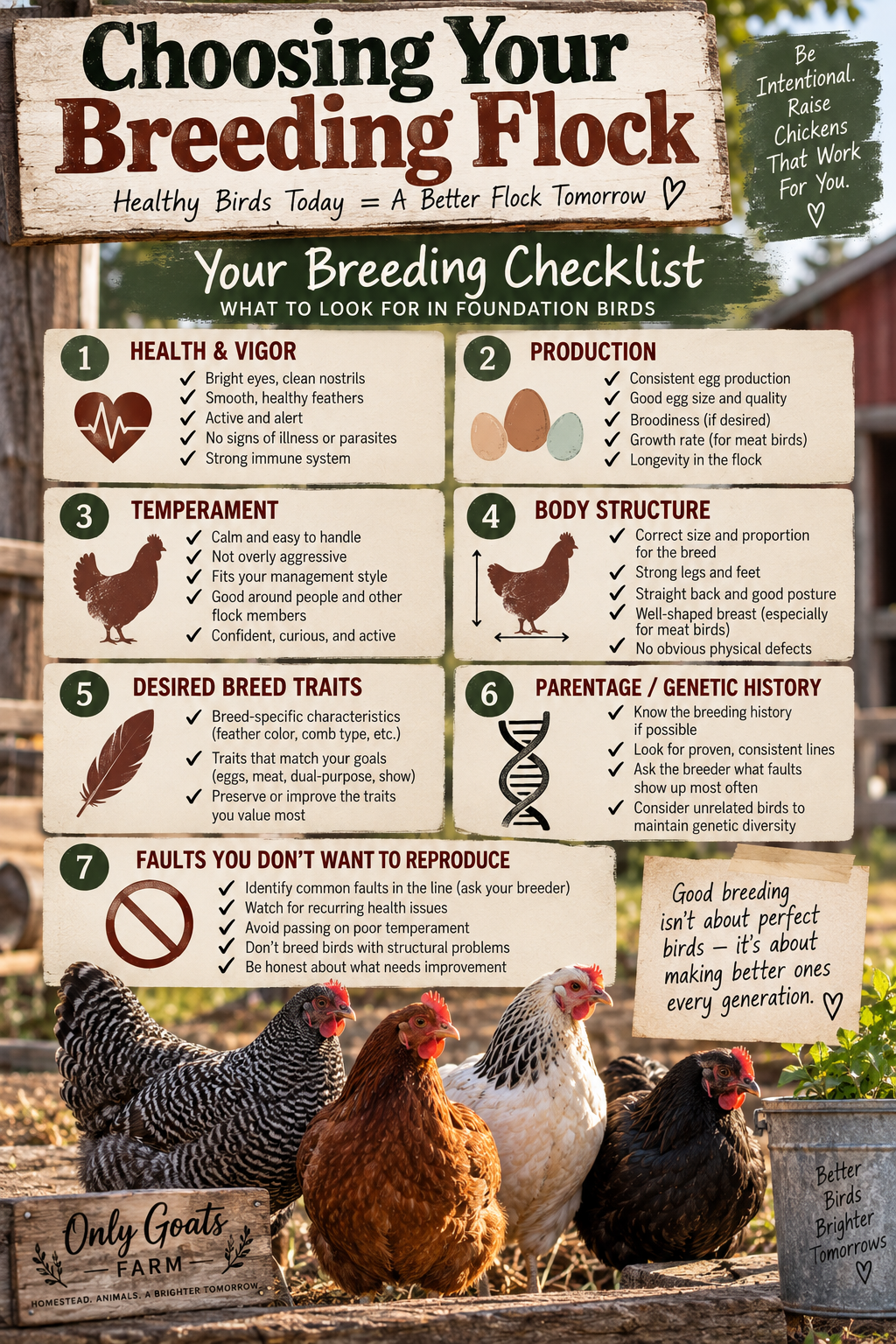
Kenny’s first piece of advice was to start with the best birds you can find for your goals.
That sounds obvious, but finding them takes research. A breed name or a beautiful photograph only tells you so much.
One of the most useful questions he suggested asking a breeder was:
What faults show up most often in your birds?
That opens a much more informative conversation than simply asking whether the birds are good quality.
Other questions worth asking include:
- What traits have you been selecting for?
- How long have you worked with this family of birds?
- What do you track about their production?
- What are you still trying to improve?
- Can you explain why you chose your current breeding birds?
Kenny prefers starting with carefully selected birds from an established breeder when possible. He also acknowledged that people sometimes have to start with what they can find, including hatchery birds.
The practical lesson is to understand your starting point. Birds that need more improvement may require more time, selection, and patience.
Combining Good Birds Doesn’t Guarantee Better Offspring
One idea from our conversation really stuck with me: collecting birds from several respected breeders and putting them together doesn’t automatically create the best flock.
It sounds logical. Get the best birds from everywhere, then combine them.
But each family brings a different genetic background, including traits you may not see immediately. You may get desirable characteristics alongside faults that take generations to understand.
Kenny shared a story about a breeder who introduced a rooster to improve egg color and then began seeing an unwanted feather-color trait in the offspring.
The lesson was simple: selecting for one improvement means paying attention to everything else that comes along with it.
In his own approach, Kenny uses a separate experimental line when testing an outside bird, preserving the established family while evaluating the results.
That idea makes sense to me. Give yourself a way to assess a change before it becomes part of your whole breeding flock.
Chicken Genetics Goes Beyond Feather Color
When we hear “genetics,” it’s easy to think about visible traits: feather patterns, combs, or egg color.
But breeding decisions also matter for the practical qualities we care about on a homestead.
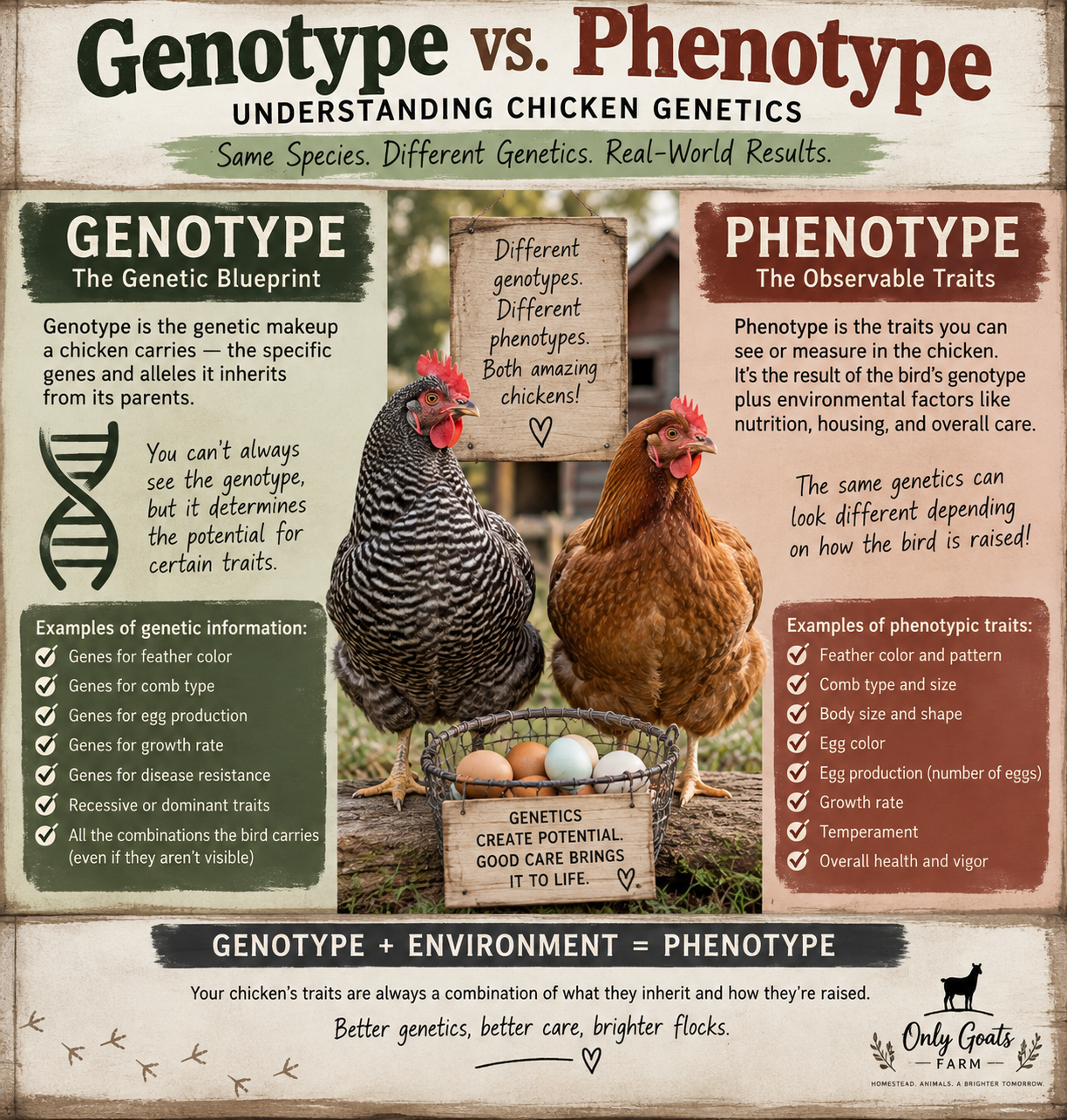
Two useful terms are:
- Genotype: the genetic makeup a bird carries.
- Phenotype: the characteristics the bird expresses—the things you can observe or measure.
Appearance doesn’t reveal every genetic variant a chicken carries. And traits such as growth and egg production involve multiple genes as well as environmental influences. That makes them more complicated than a simple dominant-or-recessive example. If you also raise quail, you may find my practical guide to Coturnix quail breeding genetics useful for seeing how selection applies to another homestead poultry species.
For a backyard breeder, that’s a reason to watch what your birds actually do.
Which birds consistently meet your goals? What happens when you breed them? Do their offspring show the qualities you hoped to keep?
Those observations become more useful with every generation.
You Can’t Select Your Best Layers Without Knowing Who’s Laying
During the livestream, I asked a very practical question: how do you know which hens are your best layers?
In a shared coop, you may know how many eggs you collect without knowing which hen laid each one.
Kenny’s answer came back to records and finding a way to identify individual production.
That’s an important point. If egg production is your goal, choosing a hen because she looks nice or happens to be your favorite doesn’t tell you whether she’s your best breeding candidate.
A simple record system could include:
- Bird identification and parentage, when known.
- Hatch dates.
- Egg production attributable to individual hens.
- Growth measurements taken at consistent ages.
- Health observations.
- Breeding pairings and results.
You don’t have to start with an elaborate system. You need information you can use when deciding which birds become the next generation.
Why Commercial Meat Chickens Complicate the Picture
This was the part of the conversation I was especially interested in.
I had looked into Freedom Rangers because I wanted a meat-bird option I could continue breeding myself. During the livestream, I shared a conversation with the hatchery that made me reconsider whether those birds fit that goal.
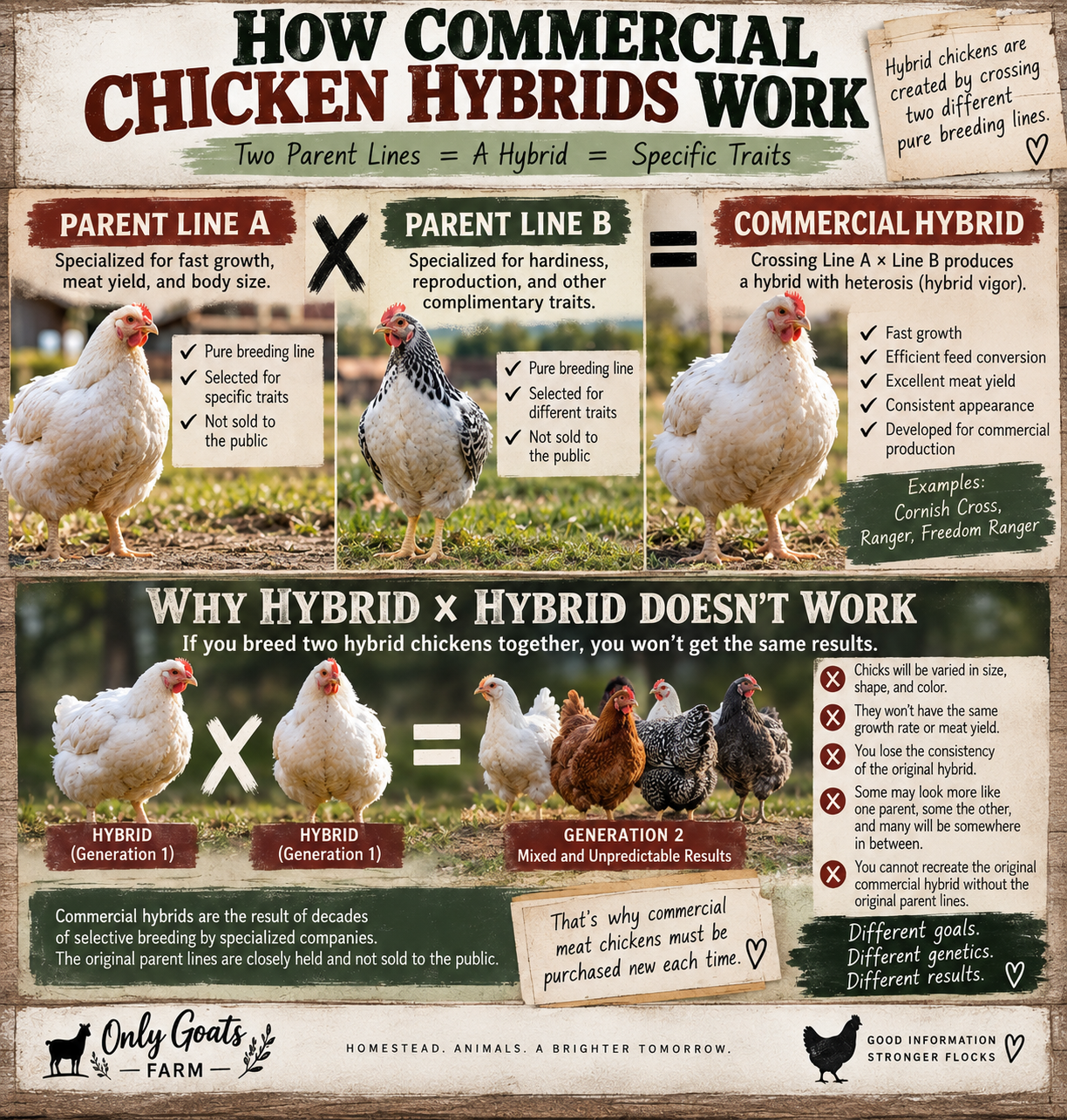
Kenny explained the distinction between a commercial hybrid and the breeding lines used to produce it.
Commercial broilers are developed from selected breeding flocks for meat production. Keeping a rooster and hens from the resulting hybrid does not reliably recreate the original cross in their offspring. Hybrid chickens can reproduce; reproducing the same predictable combination of traits is the challenge.
For comparison, I’ve also written about raising Cornish Cross chickens for homegrown meat and about my experience testing an Amerirock meat-bird cross.
For my homestead, that distinction matters.
I want to understand both what a bird can produce now and what I can expect from the next generation.
Two Approaches to Raising Your Own Breeding Flock
We discussed two broad possibilities for someone interested in producing meat birds at home.
Improve a dual-purpose family
One approach is to choose a breed you enjoy and work toward better performance through selection.
Kenny discussed Delawares, New Hampshires, and Welsummers during the conversation, including his own experience with Welsummers that had useful meat qualities.
His larger point was that the particular family of birds matters. The breed name alone doesn’t tell you how well your starting stock will meet your goals.
Maintain separate lines for a planned cross
Another approach is to maintain two breeding families and cross selected birds to produce meat offspring.
That involves more than keeping the offspring and repeating the process. You also need to maintain and evaluate the parent families that produce the cross.
Listening to that explanation made the space and management requirements much clearer to me. It’s a larger project, with more birds, more records, and more separate breeding decisions.
There wasn’t a promised shortcut or fixed timeline. Progress depends on the birds you start with and the results you get.
Give Yourself Room to Focus
Kenny also talked about how much his own progress improved when he reduced the number of varieties he was working with.
That’s easy to understand—and probably hard for anyone who loves chickens to hear.
Every additional breeding group needs space, time, and attention. Focusing on one project gives you more opportunity to learn that family, compare offspring, and make thoughtful choices.
He also emphasized learning from an experienced mentor. I agree with that. Online groups can introduce you to people and ideas, but a collection of conflicting comments can leave you more confused than when you started.
Look for someone who can explain their decisions, discuss their setbacks, and show what they’ve accomplished over multiple generations. You can learn more from Kenny at Breeders Academy.
Build Toward the Flock You Want Next Year
This conversation made me think differently about the chickens we keep and the birds we choose to reproduce.
For me, the appeal is a homestead flock that becomes more useful and more predictable over time. A flock I understand because I’ve watched it, kept records, and made deliberate breeding choices.
You can begin with a few practical steps:
- Define what you want your flock to produce.
- Learn about the birds you already have.
- Choose one manageable breeding project.
- Record the traits that matter to your goal.
- Evaluate the offspring before choosing your next breeders.
There’s a lot more to learn, but those are meaningful first steps.
What would you most like to improve in your flock: egg production, meat qualities, or the ability to hatch your own replacement birds?
This article grew out of my livestream conversation with Kenny from Breeders Academy, “Breeding Better Chickens: Genetics Every Backyard Keeper Should Know.”


Post your Comment About This Product