
Introduction
Winter can sneak up on even the most prepared goat owners. One minute your herd is happily grazing; the next, the pasture is buried under snow and suddenly you’re wondering if you’ve stacked enough hay to get everyone through until spring. Goats rely heavily on you during the colder months—not just for warmth and shelter, but for the steady nutrition that keeps them healthy, energetic, and thriving.
In this guide, we’ll walk through everything you need to know about feeding goats in winter: how much hay to buy, what quality to look for, how to store it, and ways to reduce waste (because goats LOVE wasting hay). We’ll also talk about supplemental feeds, minerals, and smart hydration tips so you feel confident heading into the cold season.
With a little planning, winter feeding doesn’t need to feel overwhelming—consider this your roadmap to smooth, stress‑free winter nutrition.
This post contains affiliate links. If you purchase through these links, I may earn a small commission at no extra cost to you. Thank you for supporting my farm + content
Why Winter Feeding Matters
When winter sets in, your goats lose access to fresh forage and must rely on stored feed to stay healthy. Cold temperatures increase their energy needs, meaning they burn more calories just to maintain body temperature. Without enough high‑quality hay and proper nutrition, goats can quickly lose condition—especially pregnant does, seniors, and growing kids.
A solid winter feeding plan helps your goats:
- Maintain body weight
- Stay warm and energetic
- Support pregnancy and milk production
- Avoid nutritional deficiencies
Planning ahead ensures you have enough hay and supplements on hand to support your herd through the coldest months.
Understanding Hay Basics
Not all hay is created equal, and understanding the differences can help you choose what works best for your herd.
Types of Hay:
- Grass Hay (Timothy, Orchard, Bermuda): Great for maintenance; provides steady nutrition without excess calcium.
- Alfalfa: Higher in protein and calcium; ideal for pregnant or nursing does and growing kids.
- Mixed Hay: A balance of grass and alfalfa—great for most herds.
Key Nutritional Points:
- Fiber is crucial for rumen health.
- Protein supports growth, milk production, and overall condition.
- Alfalfa offers a boost when higher nutrition is needed; grass hay works well for maintenance.
When Alfalfa Helps:
- Pregnant or lactating does
- Growing kids
- Underweight goats needing nutritional support
Hay Quality — What to Look For
Choosing high‑quality hay can make all the difference in your goats’ health through winter. Look for:
✅ Color – Bright green suggests good nutrient retention; avoid brown or sun‑bleached bales.
✅ Leafiness – Leaves hold most of the nutrition. Excessive stems = lower quality.
✅ Smell – Fresh, sweet, grassy scent. Musty or sour smell can signal mold.
✅ Texture – Soft and pliable is best; overly stemmy hay is hard to digest.
✅ Cleanliness – Minimal weeds, dust, or debris. Dusty hay can irritate lungs.
🚫 Avoid:
- Moldy hay (white/gray fuzz, clumps)
- Hay that feels hot inside (possible fermentation)
- Hay with excessive sticks or weeds
Pro Tip: If you can, ask your supplier about hay analysis—it’s inexpensive and offers a full nutritional profile.
How Much Hay Do Goats Need?
Goats typically eat 2–4 pounds of hay per day. However, size, breed, age, weather, and life stage all affect how much they need.
🐐 Full‑Sized Goats (Alpine, Nubian, Saanen, etc.)
- Average: 3–4 lbs/day per goat
- Cold snaps or wind exposure can increase needs
🐐 Mini Goats (Nigerian Dwarf, Pygmy)
- Average: 1–2 lbs/day per goat
- Still require good quality hay for rumen function
- Don’t assume “tiny goat = tiny feeder”—they waste hay just like the big ones!
Rule of Thumb:
Plan for 3–4 lbs/day for standard goats and 1–2 lbs/day for minis. Add extra for very cold climates.
Pregnant or lactating does and growing kids may need higher‑nutrient hay (often some alfalfa).
Hay Planning
Bale Conversion Estimates:
- Standard square bale: ~40–60 lbs
- Round bale: ~700–1,200+ lbs
Example:
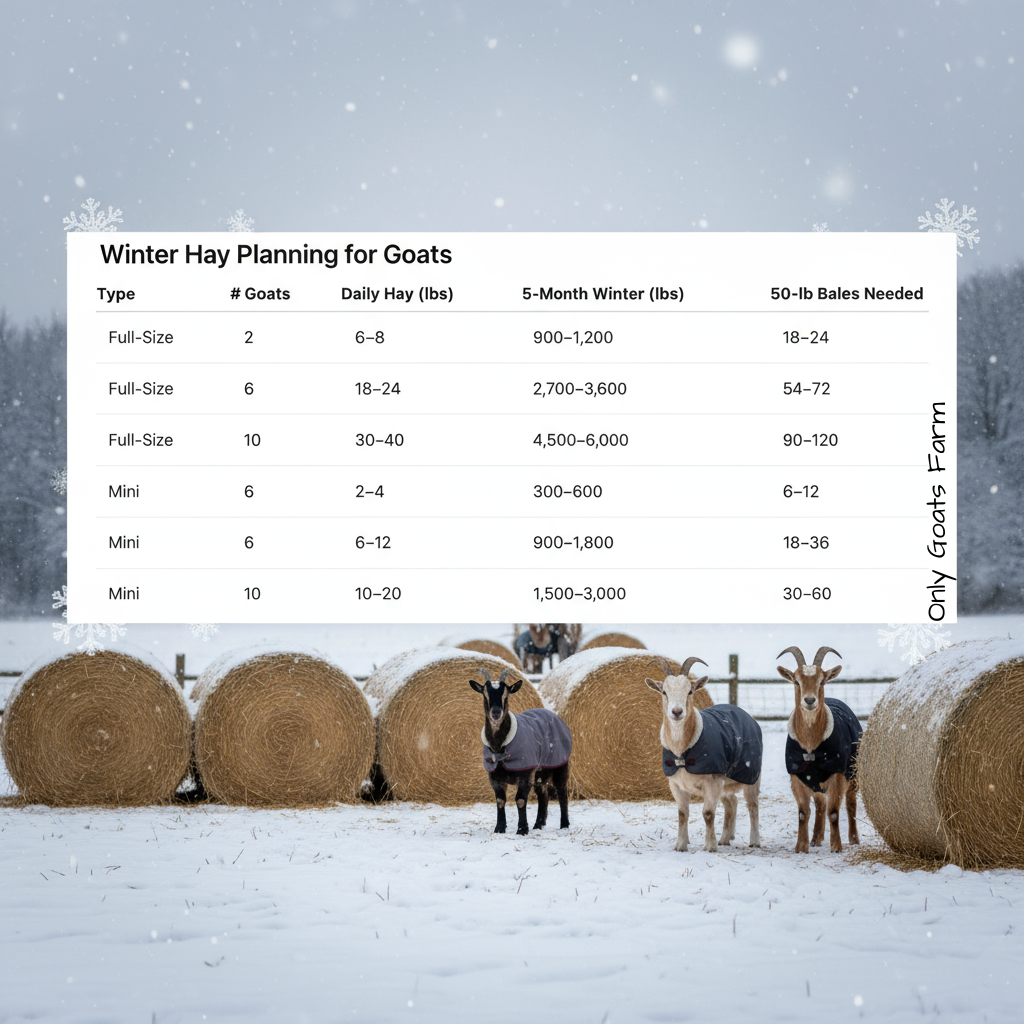
- 900–1,200 lbs (2 full‑size goats, 5‑month winter) = 15–30 square bales OR 1–2 round bales (depending on weight)
Note: Pregnant or lactating does, growing kids, and goats exposed to extreme cold may require 10–25% more hay and/or richer hay (such as alfalfa).
How Much Hay to Store
Short answer: calculate your winter total, then add a waste/safety buffer.
Formula:
(# goats × daily hay per goat × # winter days) × (1 + waste buffer)
Defaults to use:
- Winter length: 5 months (150 days) for most northern climates; in snowy regions plan 5–6 months.
- Daily hay: 3–4 lb for full‑size; 1–2 lb for minis.
- Waste/safety buffer: +20% (use +10% with excellent slow‑feeder nets; +30% if ground‑feeding or windy/very cold).
Example A — 4 full‑size goats (use 3.5 lb/day)
- Base: 4 × 3.5 × 150 = 2,100 lb
- With 20% buffer: 2,100 × 1.2 = 2,520 lb
- 50‑lb bales: ~50 bales (2,520 ÷ 50)
Example B — 8 mini goats (use 1.5 lb/day)
- Base: 8 × 1.5 × 150 = 1,800 lb
- With 20% buffer: 1,800 × 1.2 = 2,160 lb
- 50‑lb bales: ~43 bales
Round vs. Square Bales (quick guide)
- Small squares: 40–60 lb each → easy to ration, stack indoors, higher price per lb.
- Round bales: 700–1,200+ lb → cost‑effective per lb; require good round‑bale feeders or nets to prevent waste. If stored outside, expect extra weather loss (plan +10–15% more).
Region & Herd Factors
- Buffalo/Northern NY winters: budget 5–6 months of hay (Nov–Mar/Apr).
- Pregnant/lactating does, kids, seniors: plan 10–25% more intake and/or richer hay (alfalfa mix).
- Extreme cold/wind exposure: increase the buffer to +25–30%.
Pro Tip: If you’re buying once for the season, round up to the next bale and keep a two‑week reserve. If spring grass is late, you’re covered.
Hay Storage Tips
Storing hay correctly protects your investment and keeps your goats healthy.
Keep Hay Dry:
- Store under cover: barn, shed, or loft
- Never store directly on the ground—use pallets or a raised platform
- Wet hay is a fire hazard. Hay stored or baled above ~16–20% moisture can overheat and spontaneously combust. Keep hay protected from snow, leaks, and ground moisture to prevent dangerous heat buildup.
- Between 2018–2021, the U.S. saw over 300 major barn fires resulting in nearly 3 million animal deaths; hay is a common fuel source in these fires. (Source: Farm Bureau Financial Services)
- North Dakota State University notes that high‑moisture hay can self‑heat and combust due to microbial fermentation.
Allow Airflow:
- Ventilation prevents moisture buildup and mold
- Leave space between walls and hay stacks to encourage airflow
Stack Smart:
- Stack bales loosely to improve circulation
- Rotate older hay to the front so it’s used first (FIFO method)
Protect from Weather:
- If outdoor storage is your only option, use a quality tarp and elevate hay on pallets
- Ensure tarps don’t trap moisture—leave ventilation gaps
Rodent Control:
- Keep feed away from walls
- Use barn cats, secure containers, and traps as needed
- Sweep regularly to reduce nesting spots
Round Bale Tips:
- Use a feeder or hay net to reduce waste
- If storing outside, keep bales covered and off the ground—expect slightly higher waste
Reduce Hay Waste
Goats are professional hay wasters, but with a few strategic choices, you can stretch your hay supply further.
Use Hay Nets or Slow Feeders
- Slow feeders and nets prevent goats from yanking out big mouthfuls and dropping it on the ground.
- Great for both small square flakes and round bales.
- ⚠️ Not recommended for horned goats. Horns can become tangled in hay nets, posing a serious risk of injury or strangulation. If you have horned goats, choose solid‑panel slow feeders instead.
Safe Alternatives for Horned Goats:
- Solid‑panel slow feeders (wood/metal)
- V‑shaped hay mangers with slats
- Trough feeders with hay racks above
- Covered wall‑mounted hay boxes
Choosing the Right Feeder
✅ Remember: Hay nets are NOT recommended for horned goats. Choose safer solid-panel options instead.

- Solid-panel slow feeders prevent horn entanglement.
- Mangers with slats allow controlled access while keeping hay off the ground.
- Troughs offer safe access but may have moderate waste.
- Avoid ground feeding—while goats will still eat hay on the ground, doing so increases the risk of parasite exposure and contamination.
Feed Smaller Amounts More Often
- Offering smaller portions limits the amount that can be wasted.
Keep Hay Off the Ground
- Once hay hits the ground, goats often refuse it.
- Use pallets, mats, or feeders to keep hay clean.
Strategic Round Bale Feeding
- Use round‑bale nets to cut waste dramatically.
- Place round bales on pallets or gravel pads to reduce moisture wicking.
Pro Tip: What goats waste can become bedding—so it’s not a total loss!
Additional Feed Options
Winter nutrition doesn’t stop at hay. While quality hay should make up the bulk of your goats’ diet, supplemental feeds can be helpful depending on their age, production stage, and body condition.
✅ Grain (Use Sparingly)
- Grain is not necessary for most goats when good quality hay is provided.
- Best for pregnant/lactating does, growing kids, and underweight goats.
- Not recommended for bucks or wethers, as it increases their risk of urinary calculi (UC), a potentially life‑threatening condition.
- Stick to goat‑specific grain when possible.
- Overfeeding grain can cause bloat or acidosis, so introduce slowly.
✅ Beet Pulp
- Beet pulp adds extra calories and fiber.
- Can be fed dry or soaked; soaking helps prevent choke.
- Great for goats who need to gain weight.
✅ Alfalfa Pellets or Hay Cubes
- Good substitution when you can’t find high‑quality alfalfa hay.
- Pellets are easy to portion and reduce waste.
- Soak cubes for seniors or goats with dental issues.
✅ Browse & Evergreen Branches
- Pine, spruce, and fir branches provide enrichment and trace minerals.
- Avoid yew and other toxic ornamentals.
✅ Minerals & Supplements
- Free‑choice loose minerals made for goats are essential.
- Consider copper and selenium supplementation based on your region.
- Baking soda can be offered free‑choice to support rumen health.
Note: Treats like carrots, apples, and pumpkin are fine in moderation but shouldn’t replace quality hay.
Water & Hydration
Fresh, clean water is essential year‑round, but especially in winter. Goats will often eat less hay when they’re not drinking enough, which can lead to digestive issues.
Heated Water Options
- Heated buckets or tank heaters prevent ice
- Place cords safely out of reach; use GFCI outlets
Warm Water Helps
- Offering slightly warm water encourages better intake in cold weather
- Improves digestion and reduces risk of impaction
Keep It Clean
- Dump and refresh daily to prevent algae, manure, or bedding buildup
- Scrub waterers weekly
Placement Matters
- Keep water accessible but protected from wind
- Avoid steep or icy paths to the water source
Pro Tip: Goats drink more when minerals are balanced—make sure free‑choice minerals are always available.
Minerals + Salt
Proper minerals are essential for healthy goats year‑round, and winter is no exception.
Loose Minerals (Goat‑Specific)
- Offer free‑choice loose minerals formulated for goats.
- Loose minerals are easier for goats to intake than blocks.
- Look for balanced copper and selenium levels suited to your region.
Selenium + Vitamin E
- Many northern regions (including NY) have selenium‑deficient soils.
- Supplement with a quality mineral; avoid over‑supplementation.
Salt
- Some goat minerals include salt; if not, provide a separate plain white salt source.
- Salt encourages water intake, which supports rumen health.
Tip: Avoid mineral blocks—goats can’t lick enough from a block to meet their needs.
Monitor Body Condition
Assess your goats weekly throughout winter to ensure they’re maintaining a healthy weight.
How to Check:
- Feel over ribs, spine, and hips
- You should feel ribs easily but not see them
- Thick coats can hide weight loss — hands are more reliable than eyes
What to Watch For:
- Weight loss → increase hay or offer higher‑quality forage (alfalfa)
- Weight gain → reduce supplements if needed
- Seniors, pregnant does, and high‑producers may need extra monitoring
Tip: Keep notes or photos so you can track subtle changes over time.
Leave a Reply