
If you own goats—or really any kind of livestock—there is a story in the news right now that is worth paying attention to.
At the end of August 2026, North Carolina health officials announced that multiple baby goats associated with a mobile petting zoo had rabies.
And when I first saw the story, I had pretty much the same questions I think a lot of goat owners probably had:
Wait. How common is rabies in goats?
Can goats really get rabies?
How would a goat even be exposed?
Should goats be vaccinated for rabies?
And, if a goat at a petting zoo has rabies, does everyone who touched that goat need rabies shots?
The good news is that rabies in goats is very rare.
But rare doesn’t mean impossible.
And what happened in North Carolina is a really interesting—and important—example of how one unusual livestock disease case can turn into a much larger public-health issue when those animals regularly interact with people.
So, let’s talk about what happened, how often rabies actually occurs in goats and other livestock, and what livestock owners can learn from it.
Note: The North Carolina investigation is ongoing. Information about that case in this article is current as of September 1, 2026.
What Happened at the North Carolina Petting Zoo?
The North Carolina Department of Health and Human Services announced on August 28 that several baby goats associated with Farm Adventures, a mobile petting zoo based in Iredell County, had tested positive for rabies.
Officials released additional information the following day.
There were four baby goats involved.
Three were laboratory-confirmed positive for rabies by the North Carolina State Laboratory of Public Health. The fourth wasn’t tested but is also presumed to have been infected.
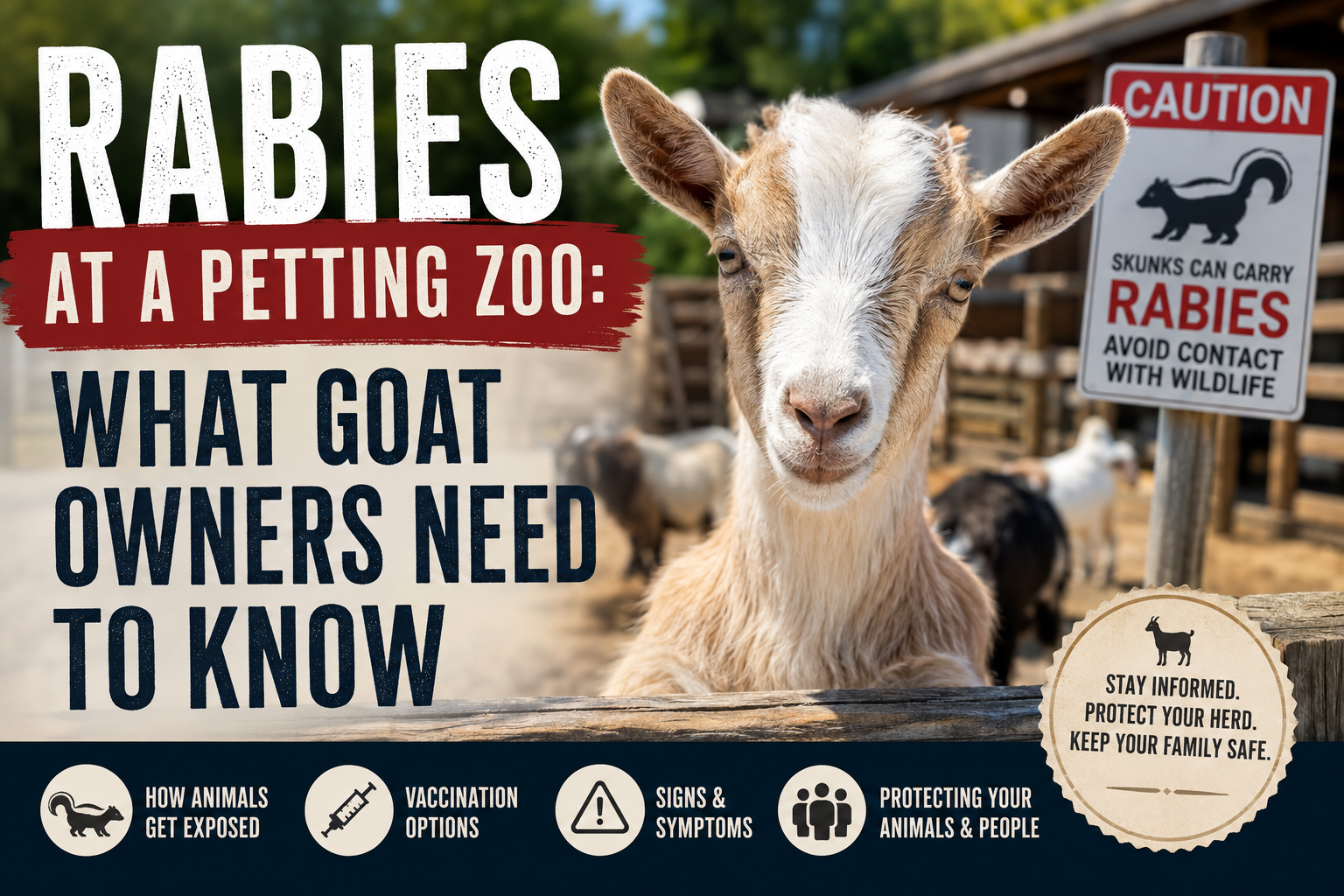
Investigators believe the goats were most likely exposed when a skunk entered the pen where the baby goats were being kept in late July.
And honestly, that is probably the part of this entire story that sticks with me the most as a livestock owner.
A skunk getting into an animal pen is not some unbelievable freak occurrence.
It’s a farm.
Wildlife happens.
You could have a skunk come through at night, have some sort of interaction with your animals, disappear, and have absolutely no idea that anything happened.
The problem in this situation was that these weren’t goats that stayed home on a private farm.
They were part of a mobile petting zoo.
The goats were at the main farm and traveled to multiple off-site events, including events attended by children and older adults. North Carolina officials identified potential human contacts between July 28 and August 27, 2026.
That meant public-health officials then had to start figuring out who interacted with the goats and whether any of those interactions actually qualified as a rabies exposure.
It’s a perfect example of how one sick farm animal can become a much larger issue when that animal regularly interacts with the public.
Can Goats Get Rabies?
Yes.
Goats can get rabies.
Rabies can infect mammals, which means it isn’t limited to dogs, raccoons or bats.
Farm animals that can develop rabies include:
- Goats
- Cattle
- Horses
- Sheep
- Llamas and alpacas
- Pigs
- Other mammalian livestock
But that doesn’t mean rabies is common in these animals.
Far from it.
In the United States, rabies is overwhelmingly a wildlife disease.
The CDC lists bats, raccoons, skunks and foxes among the wild animals most frequently found with rabies in this country. More than 90% of reported U.S. animal rabies cases occur in wildlife.
Livestock generally aren’t maintaining their own cycle of rabies.
Your goat isn’t part of some giant population of goats spreading “goat rabies” to each other.
Instead, livestock are typically spillover hosts.
Basically, they’re in the wrong place at the wrong time and encounter a wild animal carrying the virus.
How Common Is Rabies in Livestock?
This was one of the statistics that surprised me the most when I started digging into the research.
A study published in 2025 looked at 10 years of U.S. livestock rabies surveillance data, covering 2012 through 2021.
During those 10 years, the United States reported:
947 cases of rabies in livestock.
That works out to an average of about 95 reported rabid livestock animals per year.
Again, considering the enormous number of livestock animals in the United States, that’s not a lot.
Rabies in livestock is rare.
But 95 animals per year also isn’t zero.
And one livestock species accounted for the majority of cases:
Cattle.
65.9% of the reported livestock rabies cases were cattle.
So roughly two out of every three livestock rabies cases involved a cow.
The researchers also found something particularly relevant to the current North Carolina goat situation:
53.5% of the livestock cases involved skunk rabies virus variants.
More than half.
And more than half of all the livestock cases in that 10-year study came from just five states: Texas, Oklahoma, Kansas, Virginia and North Carolina.
So geography definitely matters.
The wildlife species carrying rabies—and the risk to livestock—varies depending on where you live.
How Many Goats Get Rabies?
Okay, but what about goats specifically?
This is probably the number most goat owners want to know.
In 2022, there were only:
8 reported rabid goats in the entire United States.
Eight.
That same year, livestock rabies cases included:
| Livestock species | Reported rabies cases in 2022 |
|---|---|
| Cattle | 42 |
| Horses | 18 |
| Goats | 8 |
| Sheep | 4 |
| Llama | 1 |
Those numbers help put this North Carolina situation into perspective.
In total, the United States reported 3,579 rabid animals in 2022, and 3,234—or 90.4%—were wildlife.
The additional livestock breakdown included 42 cattle, 18 horses, eight goats, four sheep and one llama.
So no, rabies is not running rampant through goat herds.
Eight reported goats nationwide in an entire year is very, very few.
But it also proves that goat rabies isn’t just theoretical.
It happens.
And having three laboratory-confirmed rabid baby goats in one group—plus another presumed infected goat—is obviously unusual enough to get people’s attention.
How Do Goats and Other Livestock Get Rabies?
Rabies is transmitted primarily through infected saliva.
A bite is the classic way an animal becomes infected.
Rabies can also potentially be transmitted when infected saliva or other infectious material enters broken skin or a mucous membrane, such as the eyes, nose or mouth.
So imagine this scenario:
A skunk gets into your goat enclosure during the night.
Your goat—being a goat—goes over to investigate.
There’s some sort of confrontation.
The goat gets bitten.
Maybe that bite is under its hair and you don’t notice it.
The skunk leaves.
You walk into the barn the next morning and everything appears completely normal.
You may never even know the skunk was there.
That’s part of what makes diseases involving wildlife exposure so difficult to prevent completely.
Rabies Isn’t Just a Goat Problem
There was another livestock rabies situation in Minnesota in 2024 that shows how this can play out in a completely different species.
A group of 35 steers apparently experienced a common rabies exposure.
Over several weeks, five cattle developed neurological signs consistent with rabies, and three were laboratory-confirmed.
Investigators believed a rabid skunk was the likely source of exposure.
Five people involved with those animals were eventually recommended to receive rabies post-exposure prophylaxis.
Again, the likely scenario was incredibly ordinary for a farm:
Rabid wildlife gets into an area containing livestock.
And that’s why cattle, horses, sheep and goat owners all need to at least know that this is possible.
What Are the Signs of Rabies in Goats and Livestock?
One reason livestock rabies can be difficult to recognize is that it doesn’t always look like the movie version of rabies.
We tend to picture a vicious animal foaming at the mouth.
That can happen.
But rabies affects the nervous system and can present in several different ways.
According to the CDC, signs in animals can include:
- Sudden abnormal behavior
- Lethargy
- Loss of appetite
- Poor coordination or stumbling
- Weakness
- Paralysis
- Seizures
- Difficulty swallowing
- Excessive salivation
- Aggression
Merck Veterinary Manual notes that two particularly important signs across animal species are acute behavioral changes and unexplained progressive paralysis.
And here’s the problem for goat owners:
Those symptoms aren’t exclusive to rabies.
If you’ve raised goats for very long, you already know there are multiple illnesses that can cause neurological symptoms, weakness, trouble standing or strange behavior.
So a stumbling goat does not mean you should immediately assume rabies.
Rabies is rare.
But the animal’s history matters.
If you’ve got neurological symptoms plus a potential encounter with a skunk, raccoon, fox or bat?
Now I would absolutely be getting a veterinarian involved.
Be Careful Around the Mouth of a Neurologically Sick Animal
This is something livestock owners really need to think about.
What do we do when our animals are sick?
We get right in their faces.
We pull down their lips.
We check gums.
We open mouths looking for something stuck.
We give oral medication.
We syringe fluids.
We wipe drool away.
Merck specifically warns that owners can expose themselves to rabies when examining the mouth or administering medication to an animal with the paralytic form of the disease because these animals may be drooling and unable to swallow.
So if an animal has unexplained neurological symptoms and rabies is even remotely on the differential because of a possible wildlife exposure, this isn’t the time to stick your bare hands in its mouth.
Call your veterinarian.
Does Petting a Rabid Goat Mean You Were Exposed to Rabies?
No.
This is another really important distinction.
Simply being near an animal with rabies does not automatically qualify as a rabies exposure.
CDC guidance specifically notes that physical proximity alone isn’t considered an exposure. Public-health officials look at the actual circumstances.
The questions become:
Did the animal bite you?
Did it scratch you?
Did infected saliva contact broken skin?
Did saliva get into your eyes, nose or mouth?
That is very different from simply touching an animal’s back.
For this specific North Carolina outbreak, NCDHHS is asking anyone who had contact with the affected baby goats between July 28 and August 27 to contact their local health department for an individual risk assessment.
Officials are specifically asking people to call before going to an emergency department or urgent care clinic, so health-department staff can first determine whether rabies post-exposure treatment is necessary and where it should be obtained.
If you believe you have had a potential rabies exposure somewhere else, contact your local or state health department and seek medical guidance promptly. Rabies is preventable after an exposure when appropriate treatment is given before symptoms begin.
Should Livestock Be Vaccinated Against Rabies?
This gets a little more complicated.
The CDC recommends talking with your veterinarian about appropriate livestock vaccinations and specifically includes rabies among vaccines available for livestock. It also recommends keeping farm animals in appropriately enclosed areas at night when possible to reduce exposure to wildlife.
But not every livestock species has a rabies vaccine specifically licensed for that species.
U.S.-licensed rabies vaccines are available for livestock including cattle, horses and sheep.
Goats are different.
There currently isn’t a U.S.-licensed rabies vaccine specifically labeled for goats.
However, national guidance for animals used in public settings specifically addresses this situation.
The National Association of State Public Health Veterinarians recommends that mammals used in public-contact settings be appropriately vaccinated against rabies. When no licensed rabies vaccine exists for the particular species—including goats—the guidance recommends consulting a veterinarian about extralabel vaccination.
In other words:
If you have goats that regularly interact with the public, this is a conversation worth having with your veterinarian.
Don’t simply assume you should buy a vaccine and administer it yourself.
State laws, vaccine labeling and the legal/public-health status of an extralabel vaccination can matter tremendously if your goat is later involved in an exposure.
While there is no goat rabies vaccine, goats can use the sheep version (again- not medical advise, this is something you need to talk to your vet about).
Vaccination Can Matter After an Exposure, Too
Here’s something else livestock owners may not realize.
Vaccination status can drastically change what happens after your livestock is exposed to a rabid animal.
Current CDC guidance says livestock that are appropriately up to date on rabies vaccination and are exposed should generally be revaccinated and observed for 45 days, with public-health officials involved in determining management.
For unvaccinated livestock, CDC guidance says animals exposed to rabies should either be euthanized or kept under strict quarantine for four to six months.
That’s a huge difference.
There is an additional complication for goats because rabies vaccination is extralabel rather than a licensed goat indication. CDC guidance notes that animals vaccinated off-label can be treated differently after a rabies exposure, so owners need to involve both their veterinarian and public/animal-health officials rather than assuming the goat will automatically be considered legally vaccinated.
That is another excellent reason to have this conversation before something happens.
How Can Livestock Owners Reduce Rabies Risk?
There is no way to make a farm completely wildlife-proof.
If someone figures that one out, please let the rest of us know.
But there are reasonable things livestock owners can do.
1. Talk to Your Veterinarian About Vaccination
Your veterinarian can help evaluate:
- What species you own
- Whether licensed vaccines are available
- Local rabies risk
- Your animals’ value
- How much contact your animals have with people
- Whether extralabel vaccination makes sense for goats or other species without a labeled product
Public-contact animals deserve particular consideration.
2. Pay Attention to Wildlife
Don’t ignore a skunk, raccoon, fox or bat behaving strangely around your livestock.
And if you know your livestock had direct contact with a potentially rabid animal, call your veterinarian and appropriate animal-health or public-health officials.
Don’t wait for symptoms to show up.
3. Reduce Wildlife Access Where Reasonable
CDC recommendations include keeping farm animals in appropriately sized enclosed areas at night to reduce contact with potentially infected wildlife.
You can also:
- Secure livestock feed
- Remove obvious wildlife attractants
- Repair openings that allow larger wildlife into barns
- Monitor livestock sleeping areas
- Address wildlife encounters when you notice them
Will that guarantee a skunk never gets onto your farm?
Of course not.
But reducing opportunities helps.
4. Have a Bite and Scratch Protocol if Animals Interact With the Public
If you operate a petting zoo, attend fairs, offer farm visits or bring livestock to events, have a plan before someone gets nipped or scratched.
Know:
- Which animal was involved
- The animal’s veterinary history
- Vaccination records
- The person’s contact information
- Exactly what happened
- Whether skin was broken
- Whether saliva was involved
- Who you will contact if a concern develops
A goat accidentally catching someone’s finger while taking a treat doesn’t automatically mean there’s a rabies emergency.
But having accurate records can make an enormous difference if a health question comes up later.
5. Know Your Animals
You know your livestock better than most people do.
You know which goat screams constantly.
You know which doe doesn’t want anyone touching her feet.
You know which horse makes faces at everyone.
You know what’s normal.
A sudden and unexplained personality change doesn’t automatically equal rabies—but it deserves attention.
Should People Be Afraid of Petting Zoos?
No.
That’s not what I take away from this story.
Remember the numbers:
In 2022, there were only eight reported rabid goats in the entire United States.
Rabies in goats is very rare.
The North Carolina situation is noteworthy precisely because it is unusual.
But when something rare happens to an animal that has interacted with potentially hundreds of people, the consequences become much larger.
One sick goat on a private farm might involve an owner, veterinarian and a few family members.
One sick goat traveling to public events can create an investigation involving multiple counties and potentially many human contacts.
That’s why prevention matters more for public-contact animals.
The Biggest Lesson From the North Carolina Petting Zoo Rabies Case
For me, the most important part of this story isn’t that goats can get rabies.
We already knew mammals could get rabies.
It’s how ordinary the suspected exposure was.
A skunk apparently entered a goat enclosure.
That’s it.
And from that one wildlife encounter came three laboratory-confirmed rabid baby goats, another presumed infection and a large multi-county public-health investigation.
That’s why I don’t think goat owners should panic about rabies.
But I do think we should know about it.
Know what wildlife carries rabies where you live.
Pay attention to suspicious wildlife encounters.
Know the warning signs.
Talk to your veterinarian about vaccination—especially if your livestock regularly interact with people.
And have a plan for what you would do if one of your animals were potentially exposed.
Hopefully, you’ll never need that plan.
But this North Carolina case is a pretty good reminder that rare isn’t the same thing as impossible.
And I’d much rather know what I’m going to do before the skunk gets into the goat pen.
Do you vaccinate your goats or other livestock against rabies?
Was rabies vaccination already something you’d discussed with your veterinarian, or did this North Carolina petting-zoo case make you start thinking about it?
Let me know in the comments.


Post your Comment About This Product