
Who are the most popular horse trainers on YouTube? Names like Clinton Anderson, Warwick Schiller, Pat Parelli, and Monty Roberts probably come to mind. They’ve been familiar names in the horse world for years, and in some cases, decades.
But being a household name doesn’t necessarily mean a trainer is attracting the most views right now.
I wanted to find out which horse training channels were actually drawing an audience, so I used vidIQ to compare recent long-form video views. The results include some familiar names, some much smaller channels, and a pretty striking gap between first and second place.
This is a ranking of recent popularity, not training quality. It’s a way to discover different approaches to horsemanship, not a verdict on whose methods are best for you or your horse.
How I Ranked the Horse Training Channels
For this comparison, I looked at the long-form views that channels received during the previous 30 days. The figures are an October 2026 snapshot, so they may change.
Here’s what the ranking includes, and what it doesn’t:
- Recent long-form views: The order reflects views received during the comparison period, rather than lifetime totals.
- No Shorts: I wanted to focus on longer horse training content.
- No subscriber-based ranking: A smaller channel can place above a much larger one if its videos attract more recent views.
- English-language channels found during my research: This is a curated list, not an exhaustive survey of every horse training channel on YouTube.
- No endorsement of training methods: Popularity and suitability are two different things.
That distinction about subscribers matters. Subscriber counts can build up over years, while recent views give us a different picture of where attention is going during a particular period.
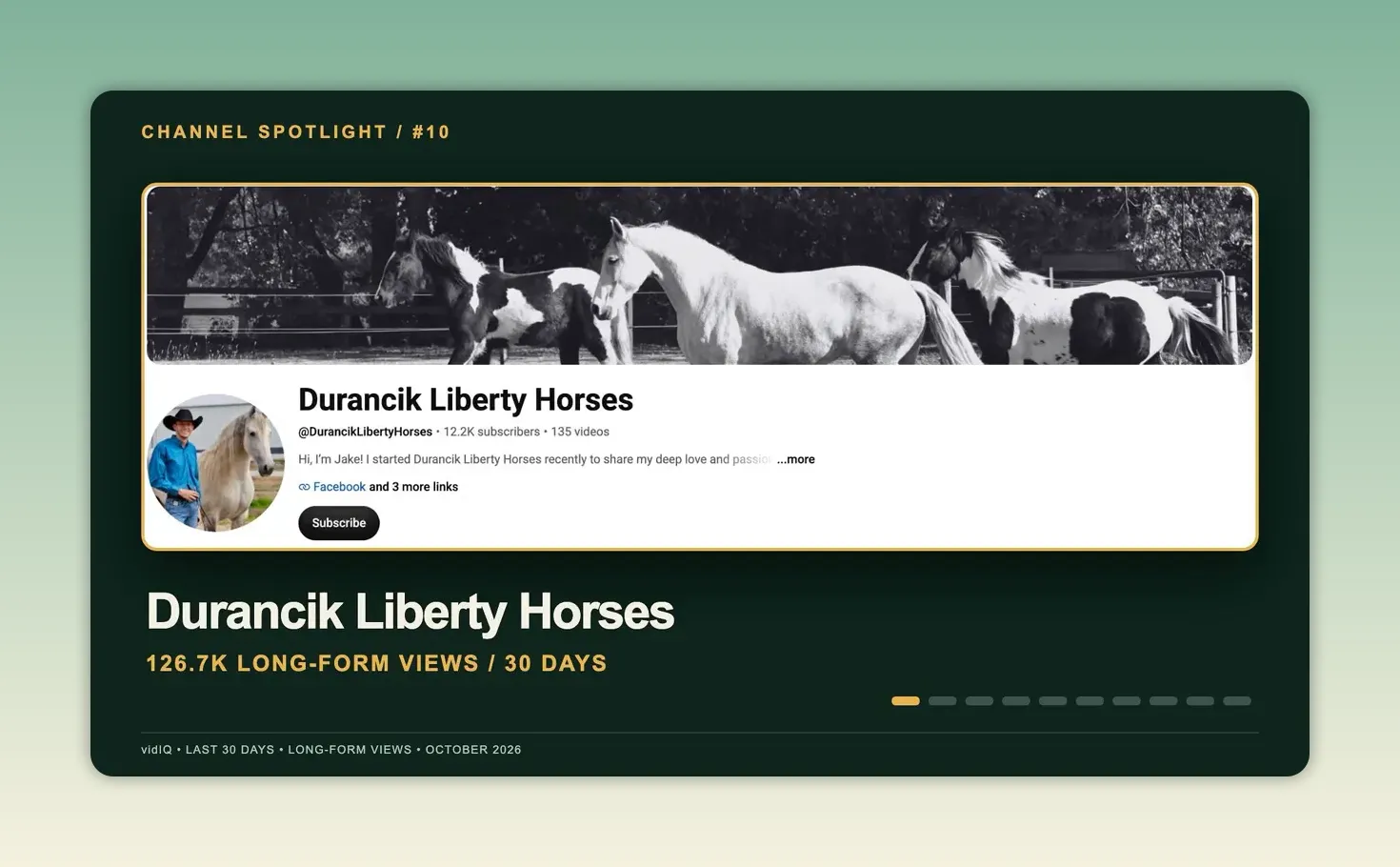
10. Durancik Liberty Horses
Durancik Liberty Horses starts the countdown with approximately 12,200 subscribers. It’s one of the smaller channels on the list, but its reach is substantial enough to earn a place here.
As the name suggests, the focus is liberty work. This kind of training develops communication without relying on the same physical equipment used in conventional riding or groundwork. Horses respond to body language and cues while working freely with their handlers.
What makes liberty work interesting is how much of the interaction depends on communication. The handler’s movement and the horse’s response become central to the exercise.
Durancik’s position is also our first reminder that a channel doesn’t need hundreds of thousands of subscribers to attract meaningful attention. A smaller subscriber base doesn’t automatically mean a small audience for its videos.
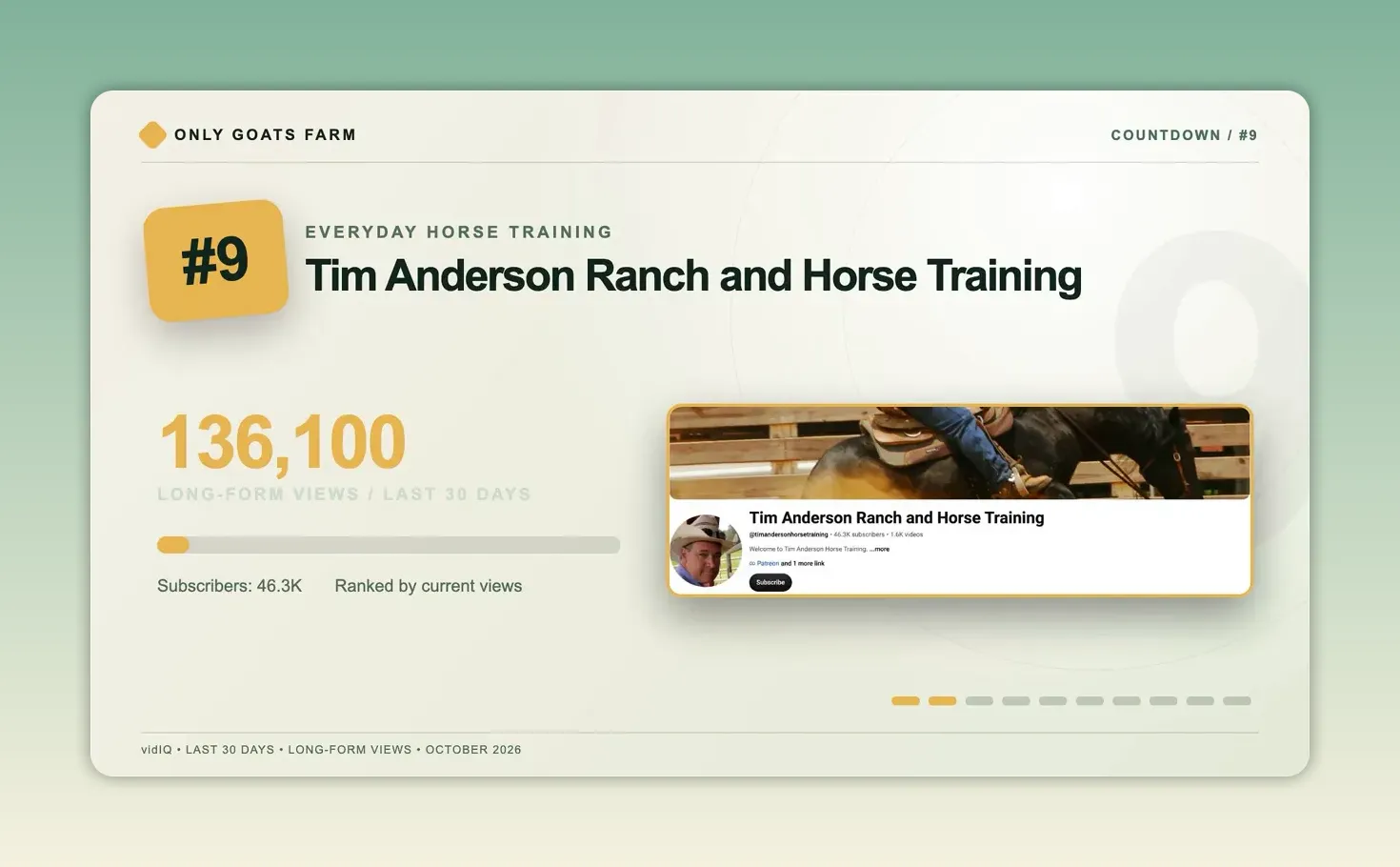
9. Tim Anderson Ranch and Horse Training
Tim Anderson Ranch and Horse Training has approximately 46,300 subscribers and received more than 136,000 long-form views during the comparison period.
Tim’s content centers on practical horse training and the challenges everyday owners encounter. And let’s face it: most horse owners aren’t preparing for the Olympics. They’re trying to get their horse to stand still, respond to cues, behave on the ground, and become a safe, reliable riding partner.
That gives this kind of channel a very clear purpose. Demonstrating an exercise and explaining how to work through a problem can be incredibly useful when someone is dealing with that same issue at home.
The appeal isn’t necessarily a spectacular finished performance. It’s the opportunity to understand the work that helps make ordinary interactions with a horse more manageable.
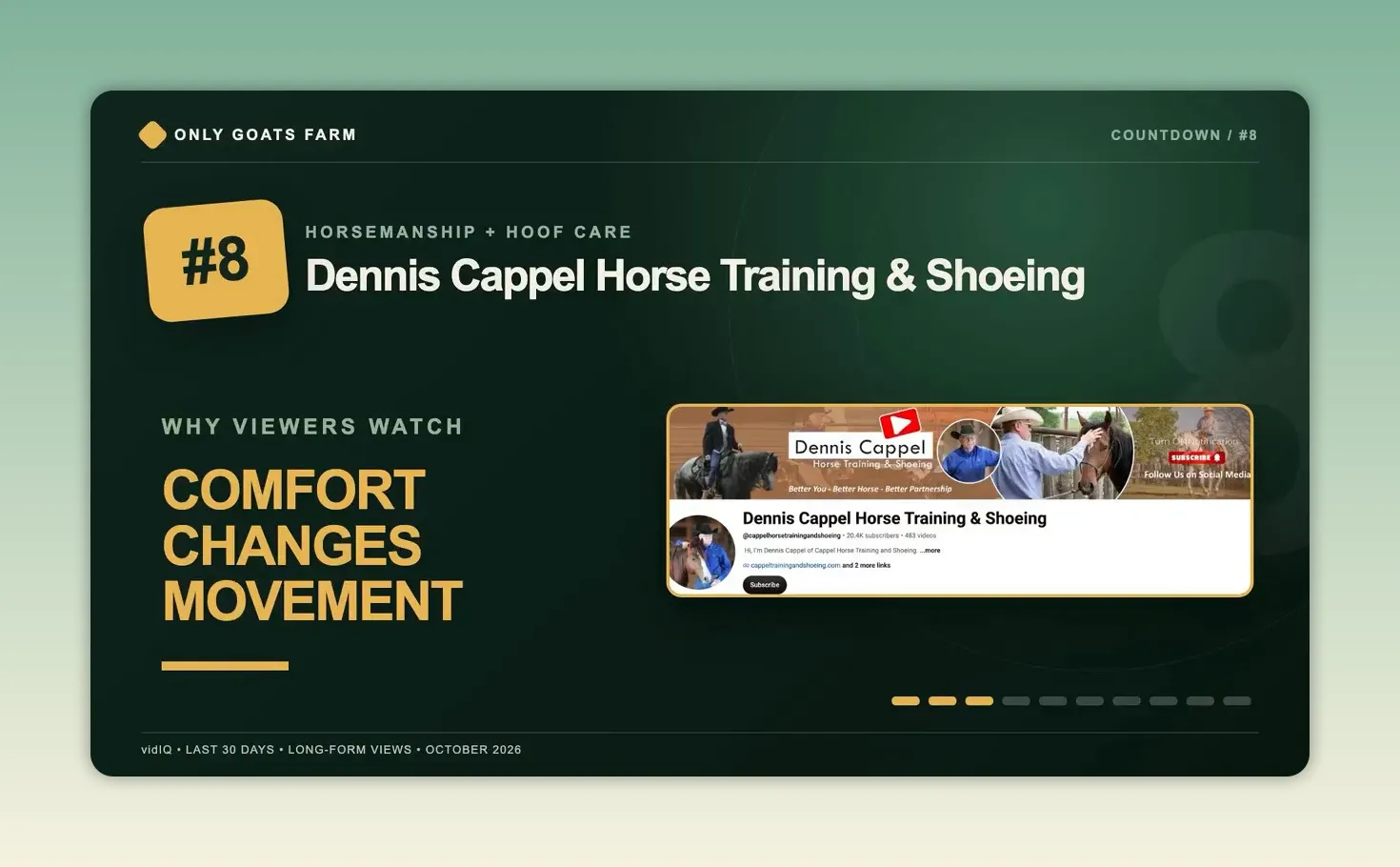
8. Dennis Cappel Horse Training & Shoeing
Dennis Cappel Horse Training & Shoeing received more than 170,000 long-form views over the 30-day period, putting it in eighth place.
This channel brings together horse training and another essential part of horse ownership: hoof care and shoeing.
That’s an interesting combination because a horse’s comfort and performance are closely connected to what’s happening with its feet. A channel that addresses both subjects offers a different emphasis from one devoted entirely to groundwork or riding.
Whether the interest is general horsemanship or the relationship between hoof care and movement, these are subjects with practical relevance for horse owners. It’s another example of a channel attracting considerable monthly attention without having one of the biggest subscriber bases in the countdown.
7. Michael Peace: Think Equus
Michael Peace’s Think Equus channel has around 7,200 subscribers, yet recorded approximately 179,000 long-form views during the comparison period.
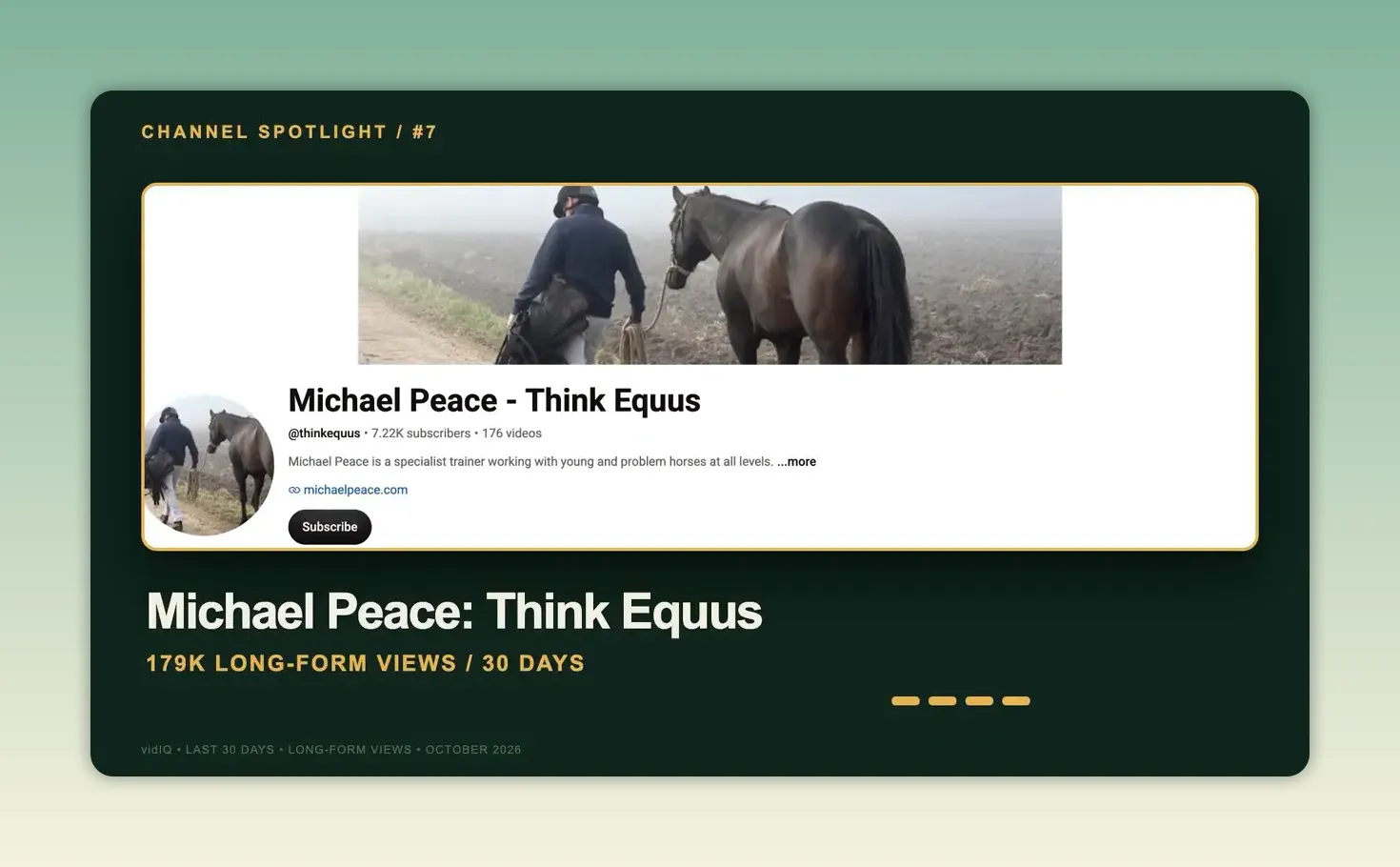
Michael’s approach emphasizes understanding horse behavior and improving communication between horses and people. Rather than focusing only on stopping an unwanted behavior, the emphasis is on understanding why it happens.
That changes the questions an owner might ask:
- Why is my horse nervous?
- Why does my horse resist this request?
- How is the environment influencing the response?
- Am I communicating clearly enough for my horse to understand?
I think that distinction matters. Trying to control a response and trying to understand its cause aren’t quite the same task. Michael’s content encourages owners to consider how horses learn and react to the situations around them.
His results also make the subscriber-versus-views distinction especially clear. A relatively small channel can still attract a large amount of recent attention.
6. Amelia Newcomb Dressage
Amelia Newcomb Dressage has approximately 352,000 subscribers, making it one of the largest channels in this comparison by subscriber count. Its long-form videos received approximately 213,000 views over the 30 days.
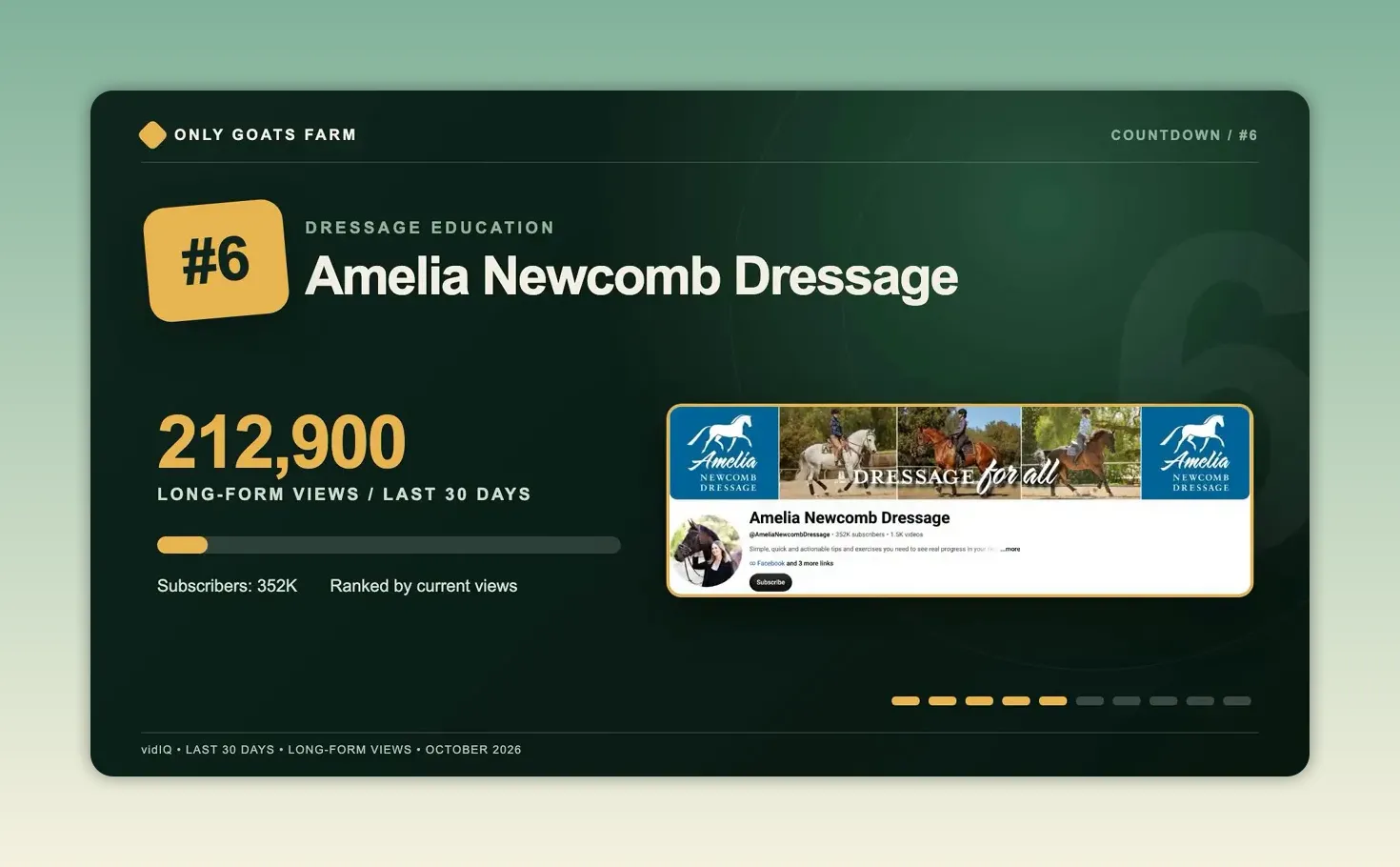
Amelia focuses primarily on dressage and riding education. Now, the word dressage can make people think immediately of high-level competition horses performing complicated movements. But many of its foundations are relevant well beyond the competition arena.
Those fundamentals include:
- Balance.
- Transitions.
- Responsiveness.
- Clear communication between horse and rider.
Amelia’s riding lessons and exercises are designed to help riders develop those skills. That’s why dressage education can have value for people in other disciplines, too. The basics don’t stop being useful simply because someone’s goals are different.
Her sixth-place position also illustrates why this list looks different from a subscriber ranking. A large established audience doesn’t automatically translate into the highest recent view count.
5. Shelby Dennis
Shelby Dennis breaks into the top five with approximately 105,000 subscribers and more than 218,000 long-form views during the comparison period.
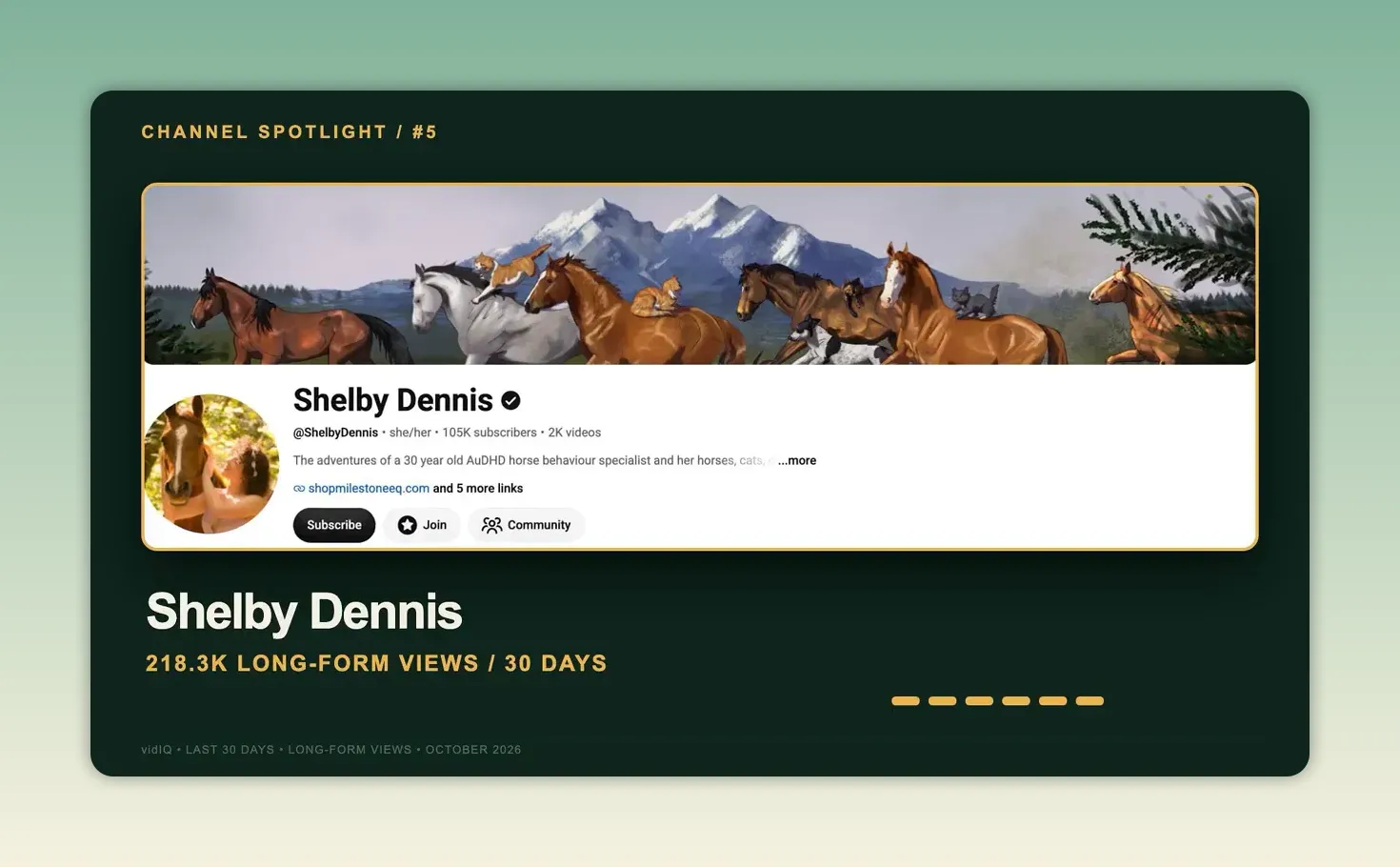
Her content combines horse training, riding education, and discussions about horse welfare and training practices.
One of the interesting things about Shelby’s channel is that she doesn’t just demonstrate training. She also discusses and evaluates different approaches to working with horses. That provides an opportunity to consider not only how a method is used, but why someone chooses it.
Horse training is a subject people can have very strong, very different opinions about. When a trainer explains the reasoning behind an approach, it gives owners more to think about than a set of instructions alone.
For someone trying to decide which practices feel appropriate for their own horse, that explanation can be an important part of the learning process.
4. Hanging With Horses
Hanging With Horses has approximately 58,400 subscribers and generated nearly 242,000 long-form views in the 30-day period.
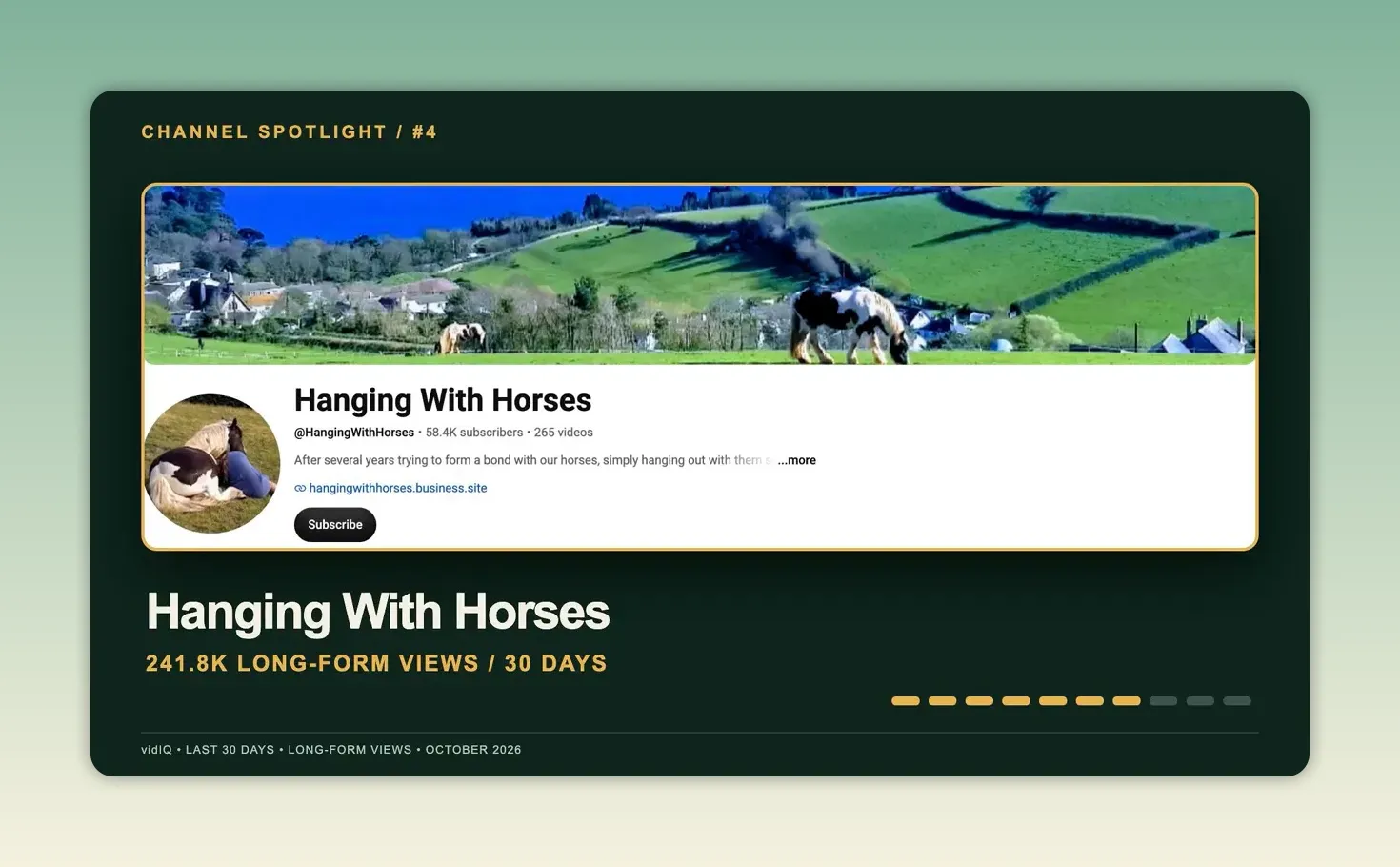
The channel focuses on horsemanship and the relationship between horses and humans. I think that highlights something important about the interest in horse training content: people aren’t only looking for ways to teach a new exercise.
They also want to understand their horses.
That means learning how horses communicate, how they respond to their environment, and how a person can build a better partnership with them. It’s a broader interest than simply getting a horse to perform a particular task.
With nearly a quarter of a million long-form views in a month, Hanging With Horses is clearly reaching an audience interested in that relationship-focused side of horsemanship.
3. DUHorseman
DUHorseman takes third place with approximately 289,000 subscribers, more than 71 million lifetime views, and nearly 270,000 recent long-form views.
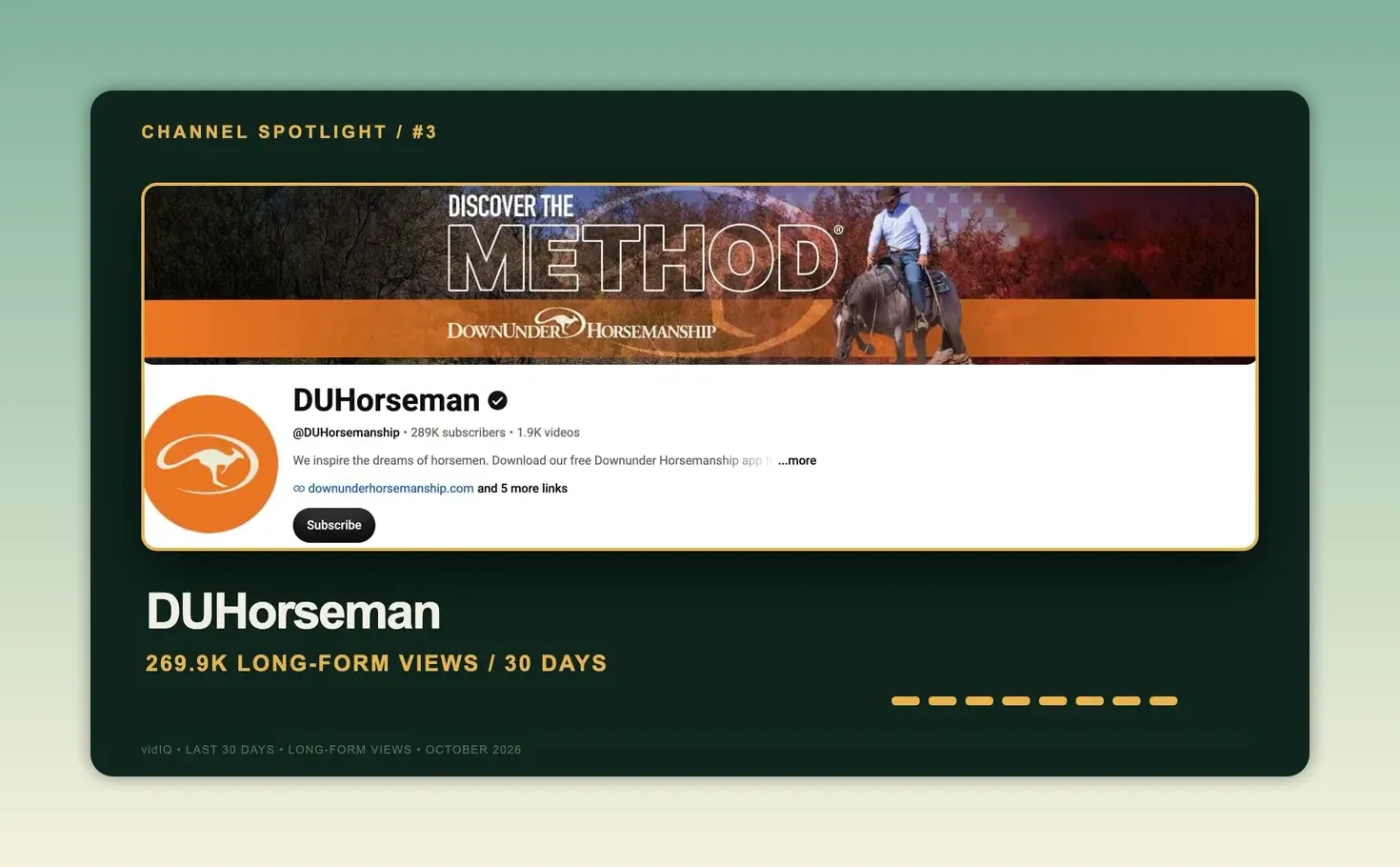
The channel produces equestrian and horsemanship content with a strong visual element. That’s a natural fit for a subject where seeing an interaction can help explain something that is difficult to put into words.
DUHorseman’s place in the countdown also raises an important point about educational content on YouTube: older videos can keep attracting attention.
A useful training demonstration doesn’t necessarily lose its relevance after a few weeks. If it answers a question horse owners continue to ask, it can remain helpful years after publication.
That means a large library of instructional videos can contribute to current views. Recent channel activity isn’t only about the newest upload; earlier material can continue reaching people who need it.
2. Ryan Rose Horsemanship
Ryan Rose Horsemanship has approximately 264,000 subscribers and more than 80 million lifetime views. During this comparison, the channel received approximately 786,000 long-form views.

That’s a considerable jump from the channels we’ve covered so far.
Ryan is a familiar name to many people interested in natural horsemanship. His content focuses on practical training, groundwork, communication, and working through common problems.
These are exactly the kinds of questions that send horse owners searching for help:
- Why won’t my horse stand still?
- How do I work through trailer-loading difficulties?
- Why isn’t my horse responding to groundwork cues?
- How can I handle a difficult situation more effectively?
I think that problem-solving focus helps explain the channel’s appeal. When training content addresses an issue someone is actively trying to resolve, there’s an immediate reason to seek it out.
And those questions don’t disappear. A video that answers them clearly has the potential to keep attracting an audience over time.
1. Steve Young Horsemanship
Steve Young Horsemanship takes the number one spot with approximately 1.94 million long-form views during the 30-day comparison, according to vidIQ.
His subscriber count was approximately 125,000. Several channels on this list had significantly more subscribers, but none of the channels identified in my research matched his recent long-form views.
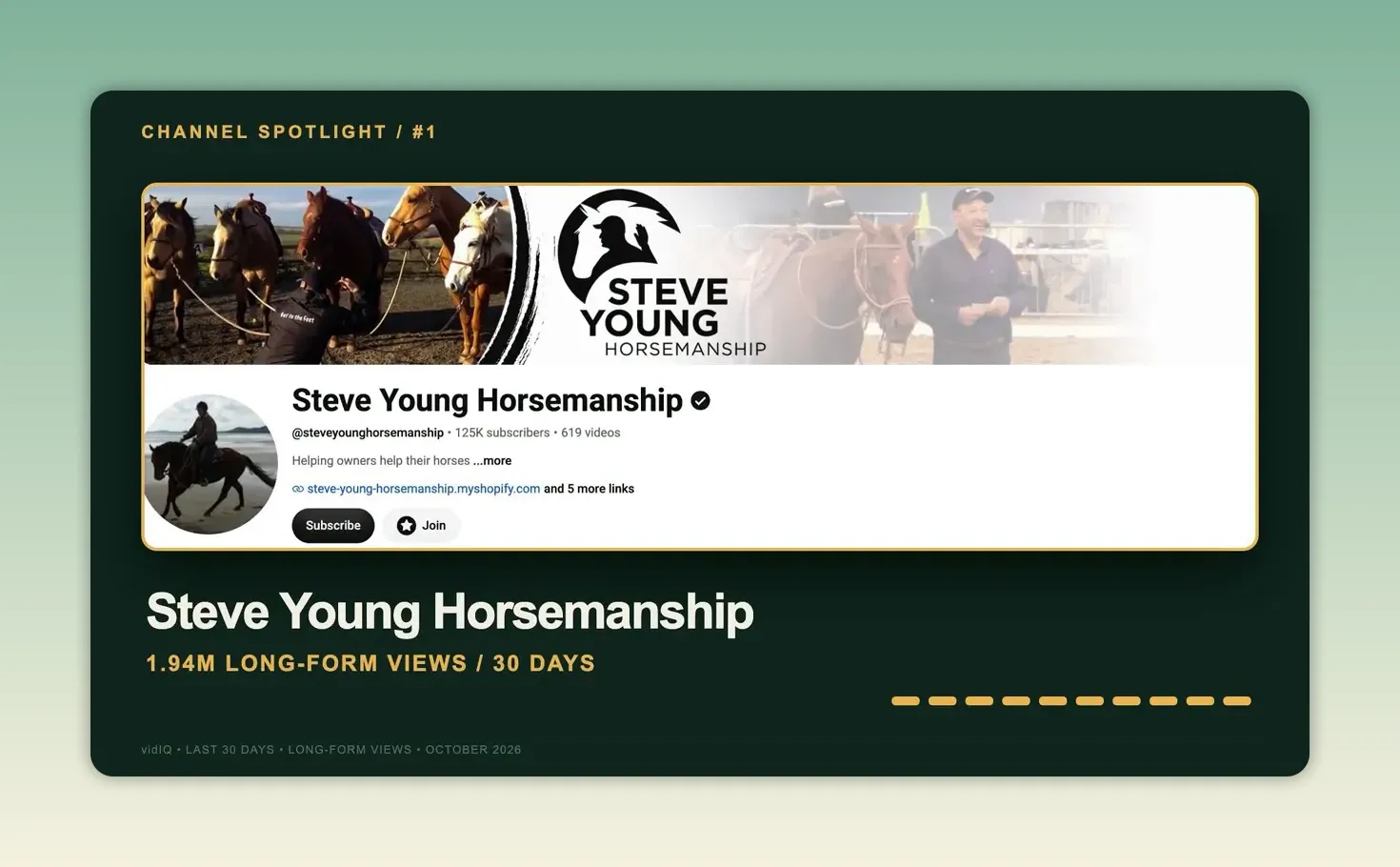
Steve’s total was more than double Ryan Rose’s approximately 786,000 views. That’s a substantial difference, and it makes him the clearest example here of why subscriber counts don’t tell the whole story.
His content focuses on working with horses, understanding behavior, and developing better communication through training. A major part of the value is seeing the training process in action.
So much of horsemanship comes down to timing, body language, and recognizing how a horse responds. Those details can be hard to explain through words alone. A demonstration lets someone see the interaction between the trainer’s actions and the horse’s reaction.
Within this particular group of English-language horse training channels, Steve attracted the most long-form views during the research period. That’s what earns him first place, rather than a claim that his approach is universally the best.
What These Rankings Tell Us About Horse Training on YouTube
The biggest takeaway is how different popularity looks depending on how we measure it. Some trainers have enormous subscriber bases built over years. Others have smaller channels but attract hundreds of thousands, or even millions, of recent views.
There’s also more than one reason people seek out horse training content. Across this list, the subjects range from liberty work and everyday handling problems to hoof care, dressage fundamentals, welfare, and understanding behavior.
But a popular trainer isn’t automatically the right fit for you or your horse. A view count can’t make that decision.
Personally, I think there’s real value in learning from different trainers, considering how they approach different problems, and listening to the reasoning behind their choices. The useful question isn’t simply who ranks highest. It’s which ideas help you better understand your horse and make sense for your own situation.


Post your Comment About This Product