
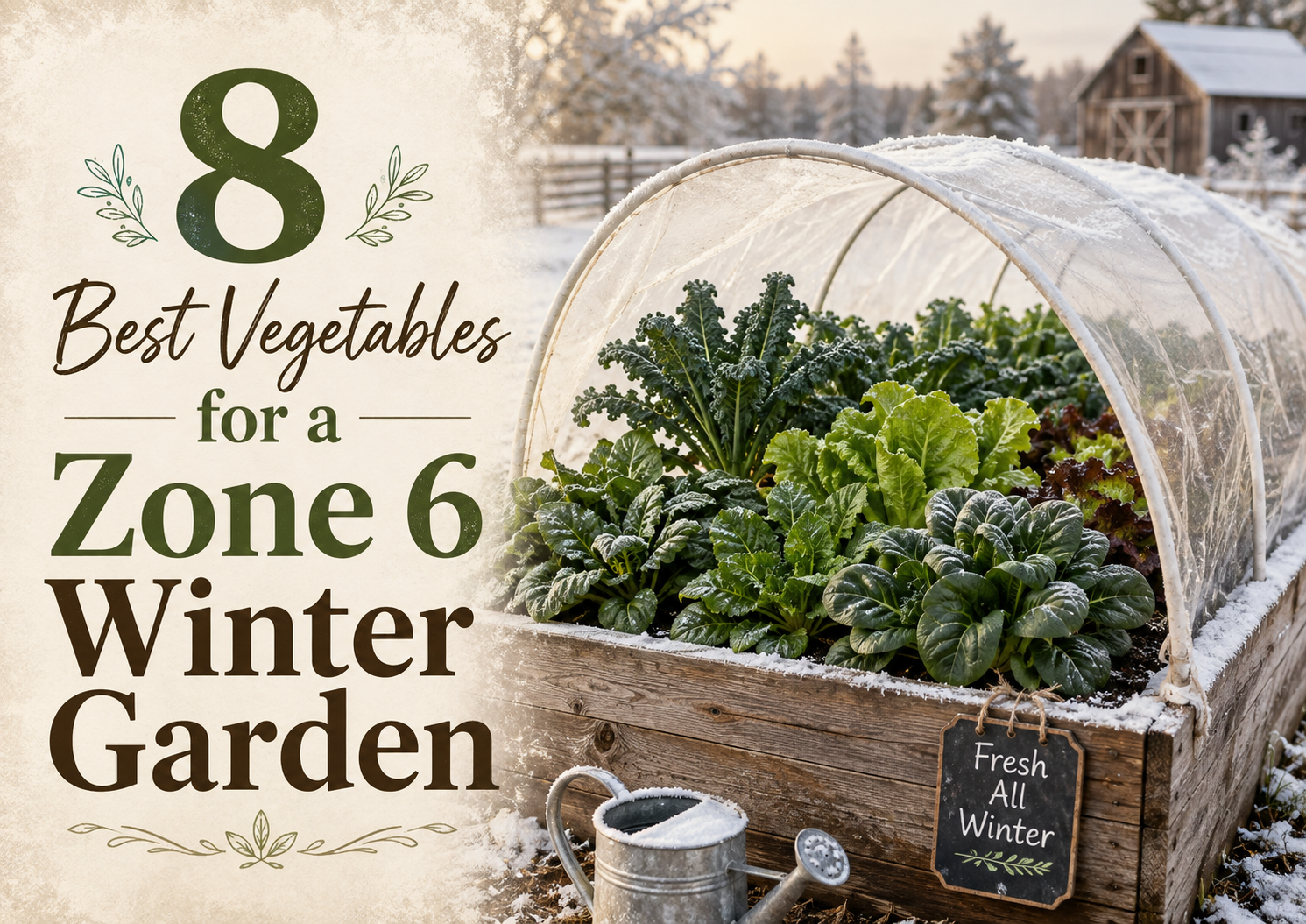
When the first hard freeze hits in Zone 6, the vegetable garden doesn’t necessarily have to close for the year.
With a cold frame, low tunnel, hoop house, or other simple unheated cover, it’s possible to keep harvesting certain cold-hardy vegetables during the winter months.
But there is one big catch:
Not every vegetable described as “cold hardy” is actually a good winter-garden vegetable.
There are plenty of crops that will survive a frost in October or November but won’t happily sit beneath a hoop house through December, January, and February.
For this list, I’m skipping those.
Instead, these are the vegetables I’d choose if I were deliberately planting a protected Zone 6 winter garden with the goal of harvesting during the actual winter.
This post may contain affiliate links, in which I may earn a small income from qualifying purchases.
First: What Does a Zone 6 Winter Garden Look Like?
I’m not talking about a heated greenhouse.
A winter garden can be as simple as a raised garden bed covered with hoops and greenhouse plastic or a small cold frame built over the soil.
You may also hear these called:
The idea is to create a protected pocket around cold-hardy plants.
The cover reduces exposure to winter wind and weather and can keep conditions around the plants considerably better than they would be in the completely exposed garden.
Adding floating row cover inside the tunnel or cold frame provides another layer of protection. Heavy row cover can provide several degrees of additional frost protection.
That extra protection is especially useful during the coldest stretches of a Zone 6 winter.
One thing these structures do not do, however, is turn January into June.
Your vegetables are still growing in cold soil with very short days.
Once daylight becomes very limited, plant growth slows dramatically. University of Minnesota Extension notes that winter crops need to become established before the period when days drop below about 10 hours of sunlight because growth slows substantially after that point.
That’s why winter gardening is really about doing two things correctly:
Planting the right vegetables and planting them early enough.
Ideally, your crops enter winter already established and large enough to harvest. During the darkest part of winter, think of your covered garden as a combination of a very slow-growing garden and a living refrigerator.
Then, as daylight begins increasing again, growth starts picking up.
So what should you actually plant?
1. Spinach
If you’re going to try only one vegetable in your Zone 6 winter garden, I’d choose spinach.
Spinach is one of the most reliable vegetables for protected winter growing.
University of Maine Extension describes spinach as a cold-tolerant crop that can be grown under row cover nearly all winter, and University of Minnesota Extension specifically discusses growing winter spinach in unheated high tunnels.
That makes it exactly the type of vegetable we’re looking for here.
For winter growing, don’t wait until November to plant it.
You want healthy, established spinach plants before your days become extremely short.
You can harvest individual outer leaves while leaving the center of the plant intact, or grow spinach densely and harvest it as baby greens.
Inside a cold frame or low tunnel, spinach can tolerate conditions that would have ended most of the summer garden months earlier.
It’s also one of the crops most likely to reward you again when sunlight increases toward the end of winter.
Winter garden rating: Excellent
2. Kale
Kale deserves its reputation as a cold-weather vegetable.
It’s extremely useful in the winter garden because you don’t have to harvest the entire plant at once.
Instead, pick mature outer leaves and allow the center to remain.
Kale is among the crops University of Maine Extension classifies as very cold tolerant, and UNH specifically recommends kale as one of the cold-tolerant crops that can be planted beneath small greenhouse-style structures for harvesting late into winter and potentially longer with additional protection.
Smaller plants can also be grown for baby kale.
That may actually be particularly useful inside a low tunnel because you aren’t trying to fit enormous mature plants underneath a relatively short structure.
For additional protection during severe cold, place floating row cover directly over the kale inside your hoop house or cold frame.
Now you’ve created two layers between the vegetable and the outdoor weather.
Winter garden rating: Excellent
3. Mâche
If you’ve never grown mâche, winter gardening is a good reason to start.
Mâche is also called:
- Corn salad
- Lamb’s lettuce
It produces small, mild leaves that can be used fresh in salads.
Unlike vegetables that merely tolerate a few frosts, mâche is genuinely useful as a winter green. University of Maine Extension specifically lists mâche among greens that can extend the garden harvest into winter when grown with row cover.
It’s also compact, which makes it perfect for the limited vertical space inside a cold frame.
If your vision for a winter garden includes walking outside in January and coming back with something green for a salad, mâche belongs on the planting list.
Winter garden rating: Excellent
4. Claytonia
Claytonia is another vegetable that doesn’t get nearly as much attention as spinach and kale.
You may also see it called miner’s lettuce.
It produces tender green leaves and does especially well in cool conditions.
More importantly for our purposes, it’s actually grown as a winter crop.
University of Minnesota Extension includes claytonia among winter crops that can be planted in unheated high tunnels, recommending that it be established before the darkest period of the year just like full-size spinach and baby kale.
Claytonia is another great cold-frame vegetable because it stays relatively low to the ground.
That means you can grow quite a bit of it without needing a tall tunnel.
Winter garden rating: Excellent
5. Tatsoi
If you want your winter garden to contain more than spinach and lettuce, plant tatsoi.
Tatsoi is a cold-hardy Asian green that forms clusters of dark green, spoon-shaped leaves.
Penn State Extension specifically describes tatsoi as a great winter green and discusses growing it beneath a low tunnel.
The leaves can be eaten raw while young or cooked as they mature.
Tatsoi is also compact, making it another good choice for a cold frame or low hoop structure.
I’d definitely include this one if I were planting several different winter greens.
You can have:
Spinach for salads and cooking.
Mâche for salads.
And tatsoi for salads, stir-fries, soups, and cooked greens.
Suddenly the winter garden starts getting a little more interesting.
Winter garden rating: Excellent
6. Collard Greens
Collards are another vegetable capable of handling serious cold.
They’re often associated with warmer Southern gardens, but their cold tolerance makes them useful much farther north as well.
UNH Extension specifically names collards alongside spinach and kale as cold-tolerant crops suitable for growing inside small protected greenhouse structures into winter.
Because collard plants can become large, I’d give them more space than the smaller salad greens.
They’re probably better suited to a taller hoop tunnel than a very shallow cold frame unless you’re harvesting the leaves young.
Like kale, you can harvest outside leaves rather than taking the entire plant.
Winter garden rating: Very good
7. Winter-Hardy Lettuce
This one needs an important disclaimer.
Not every lettuce is a winter lettuce.
Some varieties handle cold much better than others.
That’s why simply grabbing whatever packet of lettuce is left over from your summer garden isn’t necessarily going to give you great results.
University of Maine Extension includes certain lettuces among greens suitable for extending harvest into winter with protection, but specifically notes that cold tolerance varies by variety.
Look for seed descriptions containing terms such as:
- Winter
- Cold hardy
- Overwintering
- Frost tolerant
- Suitable for tunnels
Then grow your winter lettuce inside a protected structure.
I especially like the idea of growing it as loose-leaf or baby lettuce rather than waiting for enormous heads to form.
That lets you harvest leaves as they’re ready without requiring as much growing time during winter’s short days.
Winter garden rating: Very good — with the right variety
8. Arugula
Arugula is another green worth trying in a protected winter garden.
It thrives in cool weather and gives you a completely different flavor from spinach, lettuce, or mâche.
University of Maine Extension includes arugula among cold-hardy greens and notes that these greens can tolerate snow and cold conditions with protection.
I wouldn’t expect arugula to be quite as indestructible as your best winter spinach, but beneath a cold frame or low tunnel it gives you another crop to experiment with.
And that’s one of the things I love about winter gardening.
Your goal doesn’t have to be massive production.
Even having a handful of different fresh greens available in January feels pretty amazing when the rest of the outdoor vegetable garden is buried under snow.
Winter garden rating: Good with protection
What About Carrots, Beets, Radishes and Turnips?
You’ll often see root vegetables included on lists of winter vegetables.
There’s nothing wrong with growing them for cold-weather harvests, but I’m leaving most of them off this particular list intentionally.
There’s a difference between a vegetable that grows well as part of a protected winter garden and one that simply tolerates cold long enough to extend your fall harvest.
For example, University of Maine Extension recommends harvesting most root crops such as carrots and beets before the ground freezes. Parsnips are an exception and can be overwintered with mulch.
You can certainly experiment with carrots inside a cold frame where the soil is better protected from freezing, but if I’m dedicating limited hoop-house space specifically to winter production, I’m putting greens there first.
That’s where the real winter-garden magic happens.
The Best Beginner Winter Garden
If this is your first time growing vegetables through a Zone 6 winter, don’t plant eight different crops just because you can.
Keep it simple.
I’d start with:
Spinach
Kale
Mâche
Tatsoi
Winter lettuce
Those five vegetables give you a good mix of extremely hardy greens and crops that benefit from the protection of your winter structure.
You could dedicate one section of the bed to each.
Then keep notes.
Which varieties lasted longest?
Which ones actually grew during warm winter stretches?
Which tasted best?
Which survived your coldest temperatures?
Winter gardening is extremely dependent on your individual microclimate, the type of protection you’re using, snow cover, wind exposure, and the particular winter you happen to get.
After one season, you’ll know much more about what works in your own garden.
Cold Frame or Hoop House?
Either can work.
A cold frame is essentially a small box with a transparent top that captures solar energy and protects the plants inside.
A low tunnel or hoop house uses hoops covered in greenhouse plastic or another protective material over the garden bed.
Cold frames are especially convenient for:
- Spinach
- Mâche
- Claytonia
- Lettuce
- Other low-growing greens
Want some DIY cold frame ideas? Check here
A taller hoop structure gives you more room for:
- Kale
- Collards
- Larger Asian greens
You can also place floating row cover over your vegetables inside either structure when particularly cold weather arrives.
I’ll go into the differences much more deeply in my guide to cold frames vs. low tunnels vs. greenhouses for winter gardening.
And if you’re trying to build one without spending a fortune, I’m also putting together some of my favorite DIY cold frame ideas and cheap DIY hoop house ideas for raised beds.
Don’t Make This Winter Gardening Mistake
The biggest mistake would be building your hoop house in November and then deciding it’s time to plant your winter vegetables.
That’s too late for most of them.
Your structure protects your plants from the weather.
It doesn’t create summer sunlight.
Plants need time to develop before the darkest portion of winter arrives.
University of Minnesota Extension explains that winter vegetables slow substantially during the period when daylight drops below approximately ten hours per day.
That means your winter-garden planning actually begins during summer.
While tomatoes, cucumbers, peppers, and zucchini are still producing, you should already be thinking about which beds you’ll use for winter.
I’ll cover the timing separately in my guide to when to plant a winter garden in Zone 6, because spinach, kale, mâche, lettuce, and the other crops don’t all need to be started on exactly the same date.
You Don’t Need a Heated Greenhouse to Garden in Winter
I think this is what makes winter gardening so interesting.
You don’t necessarily need a giant greenhouse.
You don’t need grow lights covering your entire garden.
And you don’t have to spend the winter paying to heat an outdoor structure.
You can start with one garden bed.
Add hoops.
Cover it.
Plant genuinely cold-hardy vegetables.
Add floating row cover inside when temperatures really drop.
Then see what happens.
Extension guidance from both Maine and New Hampshire supports using cold frames, row covers, and small unheated greenhouse-style structures to push cold-hardy vegetables well into winter.
Your January garden won’t look like your July garden.
That’s not the goal.
Winter gardening is about choosing vegetables that actually like the cold, protecting them from the worst winter weather, and getting them established before the days become too short for significant growth.
Start with spinach.
Add kale.
Try a few winter greens you’ve never grown before.
Then when everything outside your hoop house is brown, frozen, or covered in snow, you can lift the cover and find something green underneath.
That’s the kind of winter garden I’m building.
Read more:


Post your Comment About This Product