
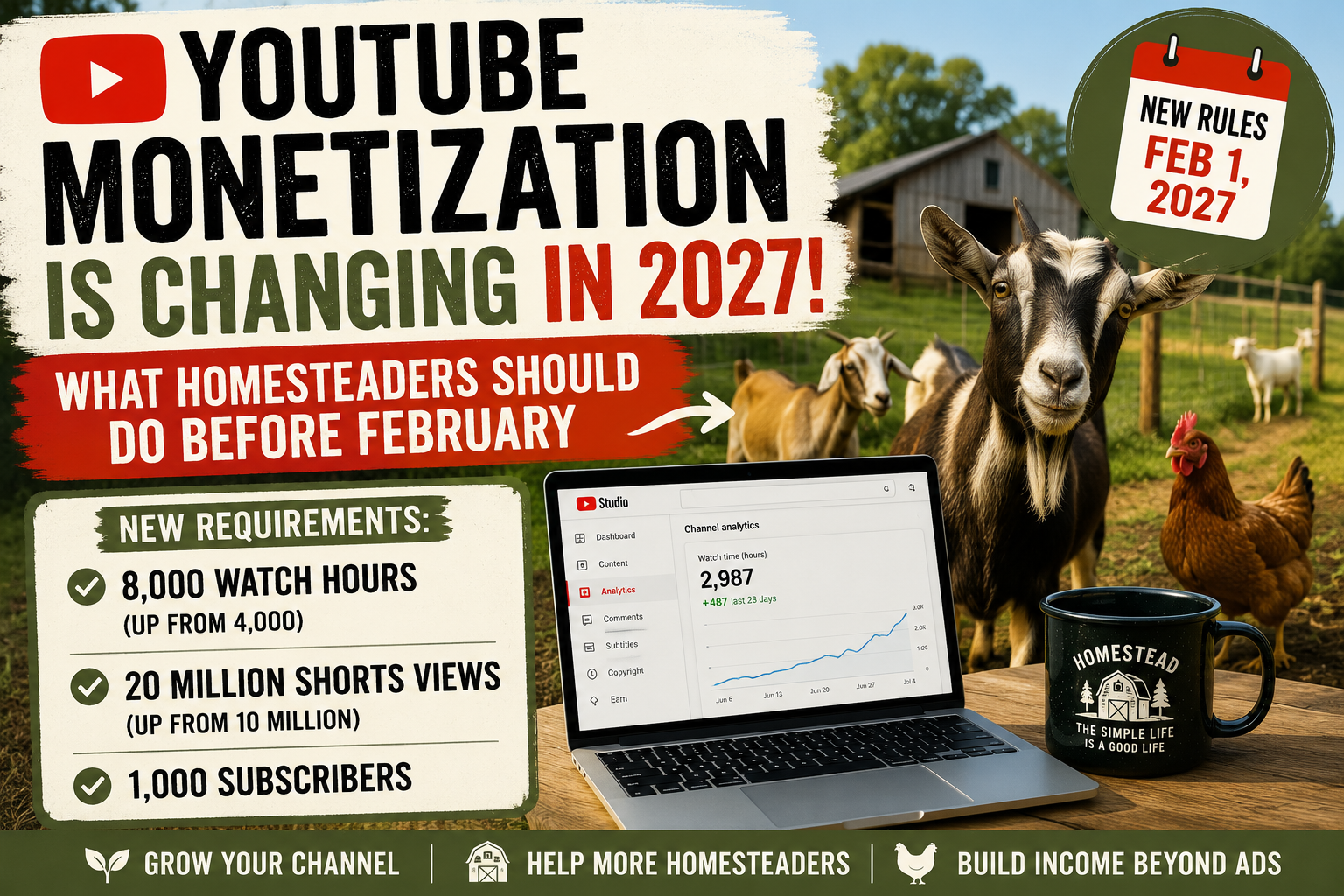
YouTube Monetization Is Changing in 2027
If you’ve been documenting your homestead on YouTube, thinking about starting a channel, or slowly working toward those magical 4,000 watch hours, there’s a pretty big change coming.
Beginning February 1, 2027, YouTube is increasing the requirements for new creators who want to qualify for ad and YouTube Premium revenue through the YouTube Partner Program.
And the biggest change?
The watch-hour requirement is doubling.
Right now, a creator can qualify for full YPP ad and Premium revenue sharing with 1,000 subscribers and either:
- 4,000 qualified public watch hours in the previous 12 months, or
- 10 million qualified Shorts views during the previous 90 days.
Beginning February 1, 2027, new applicants will need:
- 1,000 subscribers
- 8,000 qualified watch hours in the previous 365 days
OR
- 20 million qualified Shorts views in the previous 90 days.
If you’re already in the YouTube Partner Program, YouTube says the new entry threshold won’t remove you from the program.
So if you’re a homesteader sitting at 2,500, 3,000 or 3,500 watch hours and thinking, I’ll worry about monetization eventually, I wouldn’t wait too long.
You have until the end of January to qualify under the current threshold.
But even if you’re nowhere near 4,000 watch hours, I don’t think this announcement means you should give up on YouTube.
In fact, I think homesteaders are particularly well positioned to build channels that make money without depending entirely on YouTube ads.
Let’s talk about what’s changing and what I’d be doing between now and February.
What Is Changing With YouTube Monetization in 2027?
YouTube announced several changes to its Partner Program that take effect on February 1, 2027.
For smaller homestead channels, the most important change is the new requirement for accessing ad and Premium revenue sharing.
| Route | Current Requirement | Starting Feb. 1, 2027 |
|---|---|---|
| Subscribers | 1,000 | 1,000 |
| Long-form watch hours | 4,000 | 8,000 |
| Shorts views | 10 million | 20 million |
| Watch-hour period | 12 months | 365 days |
| Shorts period | 90 days | 90 days |
YouTube says the new thresholds apply to new applicants, not creators already accepted into YPP.
That’s a pretty substantial jump for a small niche channel.
And homesteading channels tend to be exactly that: niche.
You’re probably not trying to compete with MrBeast.
You may be teaching 5,000 people how to build a goat shelter out of pallets.
And that’s okay.
Those 5,000 people may be incredibly valuable to your business.
The Current YouTube Monetization Requirements
Right now, the primary path to YouTube ad revenue is:
1,000 subscribers
PLUS either:
4,000 qualified public watch hours during the previous 12 months
OR
10 million qualified Shorts views during the previous 90 days.
YouTube also states that watch time generated in the Shorts Feed does not count toward your 4,000 long-form watch-hour requirement.
There is also a lower YPP entry level for features such as fan funding and Shopping.
That currently requires:
500 subscribers
plus either:
3,000 qualified watch hours
or
3 million qualified Shorts views.
Those lower thresholds are not changing in February 2027.
What Happens February 1, 2027?
Beginning February 1, new creators seeking ad and Premium revenue sharing will need:
1,000 subscribers
PLUS
8,000 qualified watch hours during the previous 365 days
OR
20 million qualified Shorts views during the previous 90 days.
That’s why I think anyone who’s already relatively close to 4,000 hours should pay attention to this announcement now.
Imagine reaching 3,800 watch hours in January.
Under the current program, you’re almost there.
Wait until February and suddenly you’re not even halfway to the new 8,000-hour requirement.
What If Your Homestead Channel Is Already Monetized?
If you’re already in the full YouTube Partner Program, don’t panic.
YouTube says existing creators will not lose their YPP status simply because they don’t meet the new 8,000-hour or 20-million-Shorts entry requirements.
There is something existing creators need to do, though.
YouTube is updating its monetization terms.
Creators should review the applicable updated monetization modules in YouTube Studio and accept them by January 31, 2027 if they want to avoid interruptions to applicable earnings.
So even if your channel has been monetized for years, I wouldn’t completely ignore this update.
What If You’re Close to 4,000 Watch Hours?
This is the group I’d be paying the most attention to.
If your channel already has:
- 1,000 subscribers
- several thousand watch hours
- a library of videos
- and videos that are continuing to bring in views
I would absolutely make reaching the current monetization threshold a goal before February.
But I would not start uploading random videos just to chase watch time.
That’s especially important with a homestead channel.
Your content should continue building something valuable for you long after February.
Every video you make should ideally do at least one of these things:
- Answer a question people are searching for
- Bring new people into your homesteading community
- Lead readers to your blog
- Promote an affiliate product you actually use
- Introduce people to a product or service you sell
- Build trust with your audience
- Generate long-term search traffic
The goal isn’t merely to hit 4,000 hours.
The goal is to build a channel that can become an actual asset.
Should Homesteaders Focus on Shorts?
I wouldn’t make Shorts your primary monetization strategy.
Shorts are fantastic for things like:
- Baby goats
- Funny chicken moments
- Garden harvests
- Farm chores
- Before-and-after property transformations
- Quick homestead tips
- Animal births
- Feeding time
- Seasonal farm moments
Those clips can get a lot of attention.
And they can absolutely help new people discover your channel.
But beginning in February, the Shorts path to full YPP entry requires 20 million qualified Shorts views in 90 days.
That’s an enormous number for most small homestead creators.
So I would think about Shorts differently.
Use Shorts for discovery.
Then use long-form videos to build your actual audience.
A viewer may first find you because of a 20-second clip of a goat doing something ridiculous.
Then they watch your:
How Much Does It Cost to Raise Goats?
video.
Then:
Our Goat Barn Setup
Then:
What I Wish I Knew Before Getting Goats
Now you’ve gained a viewer who may continue watching your channel for years.
That is much more valuable than one viral Short.
Homesteading Is Actually a Great Niche for Long-Form YouTube
Homesteaders have one huge advantage on YouTube:
There is always something to make content about.
Your everyday life contains searchable information.
Think about how many questions people have before starting a homestead.
Goat content
- How much does it cost to raise goats?
- What do goats eat?
- How much hay does a goat need?
- How do you build a goat shelter?
- How much fencing do goats need?
- What goat breed should beginners get?
- What is it really like owning goats?
Chicken and poultry content
- How many chickens should I start with?
- How much does it cost to raise chickens?
- Quail vs. chickens
- How to build a brooder
- How many eggs do quail lay?
- How to raise poultry in winter
Gardening content
- What vegetables can you plant in July?
- What can you grow through winter?
- How do low tunnels work?
- How do you preserve tomatoes?
- How do you build garden beds cheaply?
DIY homestead content
- DIY pallet goat shelter
- Cheap farm fencing
- DIY hay feeder
- How to build a rabbitry
- How to heat a greenhouse without electricity
These aren’t just video ideas.
They’re search queries.
People can find those videos months or years after you upload them.
That’s exactly the type of content I would concentrate on if I were trying to increase watch hours before February.
Stop Thinking of YouTube Ad Revenue as the Whole Goal
This is probably the biggest point I want homestead creators to take away from this.
Getting monetized on YouTube is great.
I love an income stream that can keep generating money from content I’ve already created.
But AdSense should not be the only way your content makes money.
Imagine you make a video:
Our Portable Goat Fencing Setup
Maybe it gets 5,000 views.
YouTube pays you something for those views once you’re monetized.
Great.
But that video can potentially make money in several other ways too.
You could include affiliate links to:
- Electric netting
- Fence chargers
- Ground rods
- Fence testers
- Work gloves
- Farm tools
The same video could link to a detailed article on your homestead blog.
That article could earn ad revenue.
It could contain affiliate links.
The video might also introduce a local viewer to your goatscaping business.
Suddenly one piece of content isn’t creating one revenue stream.
It could be contributing to four or five.
That’s the type of creator business I want to build.
What Homestead Creators Should Do Before February
If you want to take advantage of the current YouTube requirements before they change, here’s what I would concentrate on.
1. Check Your Current Watch Hours
First, find out where you actually stand.
Open YouTube Studio and look at the Earn section.
You may be closer than you think.
If you currently have:
3,500 watch hours: I’d absolutely push toward 4,000.
2,500 watch hours: You still have several months to make meaningful progress.
500 watch hours: I wouldn’t panic and start posting junk just to chase monetization.
Build strategically instead.
2. Look at Which Videos Are Already Working
Your YouTube analytics contain a giant clue about what you should make next.
Look for videos that have:
- Higher-than-normal watch time
- Consistent search traffic
- High impressions
- Strong click-through rates
- Lots of comments or questions
- Continued views months after publication
If your audience loves your goat fencing videos, make more goat fencing videos.
If your pallet shelter video keeps bringing in traffic, make:
5 Cheap Goat Shelter Ideas
or
What I’d Change About My Pallet Goat Shelter
or
Inside Our Goat Shelter After One Winter
YouTube is already telling you what your audience wants.
Listen to it.
3. Create Searchable Long-Form Content
If watch hours are your goal, I’d prioritize useful long-form videos.
That doesn’t mean every video needs to be 45 minutes long.
Don’t stretch a five-minute answer into 20 minutes just for watch time.
But don’t rush through a topic that genuinely deserves more explanation either.
A detailed 12- or 15-minute tutorial that someone actually watches can be much more useful than a two-minute clip.
Examples:
How We Set Up Portable Electric Fencing for Goats
What Raising 10 Goats Actually Costs Us
Tour of Our Small Homestead
How I Built a Goat Shelter Using Pallets
Everything I Wish I Knew Before Raising Quail
How We Prepare Our Barn for Winter
Those are videos people intentionally choose to watch.
4. Turn Your Everyday Farm Work Into Content
One of the biggest mistakes I think homestead creators make is assuming they need to come up with some amazing new idea every time they film.
You don’t.
You’re already doing things people want to learn about.
Building a shelter?
Film it.
Setting up fencing?
Film it.
Starting seeds?
Film it.
Processing the garden harvest?
Film it.
Repairing something that broke?
Film it.
Trying something that fails miserably?
Honestly, film that too.
Some of the most helpful homestead content isn’t:
Look how perfectly we do everything.
It’s:
Well, that didn’t work. Here’s what I’m doing differently.
5. Build Content Clusters
Don’t make 20 completely unrelated videos.
Build clusters.
For example:
Beginner Goats
You could create:
- What You Need Before Bringing Goats Home
- How Much Does It Cost to Own Goats?
- Best Goat Breeds for Beginners
- What Do Goats Eat?
- Goat Fencing for Beginners
- Cheap Goat Shelter Ideas
- 10 Things I Wish I Knew Before Getting Goats
Now one viewer can discover one of those videos and binge several more.
That helps your viewer.
It helps your authority.
And yes—it helps your watch hours.
6. Send YouTube Viewers to Your Blog
This is a big one for homestead creators.
You already did the work.
You researched the topic.
You filmed the video.
You explained everything.
Turn that video into a blog post too.
Now you’ve created:
YouTube traffic + Google traffic.
Embed the video inside the blog.
Link the YouTube video to the blog.
Add additional photos, product links, measurements, supply lists or details to the article.
You’ve now made the same piece of content work much harder.
7. Add Affiliate Links Where They Actually Make Sense
Homestead content is almost made for affiliate marketing because we’re constantly using physical products.
You don’t need to turn every video into an infomercial.
Just link to things people are already going to ask about.
If you’re demonstrating your fencing setup and viewers are inevitably going to comment:
“What fence charger is that?”
Put the link in the description.
The same goes for:
- Farm tools
- Gardening equipment
- Incubators
- Poultry supplies
- Electric fencing
- Seed-starting supplies
- Canning equipment
- Animal supplies
- Work clothing
- Barn equipment
Useful content first.
Relevant affiliate link second.
8. Make Every Video Lead Somewhere
Before publishing a video, ask:
What should this person do next?
Maybe it’s:
Watch another goat video.
Or:
Read the full tutorial on my blog.
Or:
Subscribe to the channel.
Or:
Download a printable.
Or:
Check out the fencing supplies I used.
Or, depending on your business:
Learn about our goatscaping services.
You don’t need six calls to action in every video.
Choose the most logical next step.
9. If You’re Close to Monetization, Start a Publishing Sprint
If you’re relatively close to 4,000 watch hours, I’d create a publishing plan between now and the end of January.
For many homestead creators, something as simple as:
One strong long-form video every week
would create roughly 20 additional videos before the requirements change.
And the videos you publish in September and October have several months to accumulate views before February.
That’s much better than waiting until January and suddenly realizing you need another 1,200 watch hours.
A Simple YouTube Strategy for Homesteaders
If I were building a homesteading YouTube channel right now, my strategy would look something like this:
Shorts → Discovery
↓
Searchable Long-Form Video → Trust + Watch Time
↓
Blog Post → Google Traffic + More Information
↓
Email List / Subscriber → Audience You Can Reach Again
↓
Ads + Affiliates + Products + Services → Income
That is much more powerful than:
Upload video → Hope YouTube pays me.
And it’s also much safer.
Platforms change.
Algorithms change.
Monetization requirements change.
We’ve literally just watched YouTube announce that its watch-hour requirement is doubling.
But if your videos also feed your website, your email list and your actual business?
One platform changing its rules doesn’t wipe out everything you’ve built.
Frequently Asked Questions
When do the new YouTube monetization requirements begin?
The new requirements for new applicants seeking ad and Premium revenue sharing begin February 1, 2027.
How many YouTube watch hours will I need in 2027?
New applicants using the long-form route will need 8,000 qualified watch hours during the previous 365 days, along with 1,000 subscribers.
How many watch hours do I need right now?
The current full YPP requirement is 4,000 qualified public watch hours during the previous 12 months, along with 1,000 subscribers.
Are YouTube Shorts requirements changing too?
Yes.
The new full YPP entry requirement through Shorts will increase from 10 million to 20 million qualified Shorts views during the previous 90 days.
Will I lose monetization if I’m already monetized?
YouTube says creators already in YPP will not lose their long-form monetization simply because they don’t meet the new entry thresholds.
Existing creators should still review YouTube’s updated monetization terms before the January 31 deadline.
Is YouTube still worth starting for homesteaders?
I absolutely think so.
But I wouldn’t start a homestead YouTube channel solely because you want AdSense revenue.
Use YouTube to document what you’re already doing, answer questions people are searching for, drive traffic to your website, recommend products you genuinely use, grow your audience and potentially bring customers into your other homestead businesses.
Ad revenue can become another piece of that puzzle.
Final Thoughts
I don’t think YouTube’s new requirements mean it’s too late to start a homestead channel.
But if you’ve been putting off taking YouTube seriously, this might be the push you needed.
If you’re already close to 4,000 watch hours, I’d make reaching the current threshold before February a priority.
And if you’re nowhere close?
Start building anyway.
You don’t need millions of subscribers to create something valuable.
A video that reaches 1,000 people who are genuinely interested in raising goats, gardening, keeping chickens, building a homestead or becoming more self-sufficient can be far more valuable than a viral video watched by a million people who don’t care what you do.
Make useful videos.
Answer real questions.
Document what you’re already doing.
Build your blog alongside your channel.
And create a business that can earn from your content in more than one way.
Because YouTube monetization is great.
But the real opportunity is building a homesteading audience—and a library of content—that continues working for you long after you hit publish.
And for more ideas on making money on the homestead, check out this blog!
or watch this video:


Post your Comment About This Product