
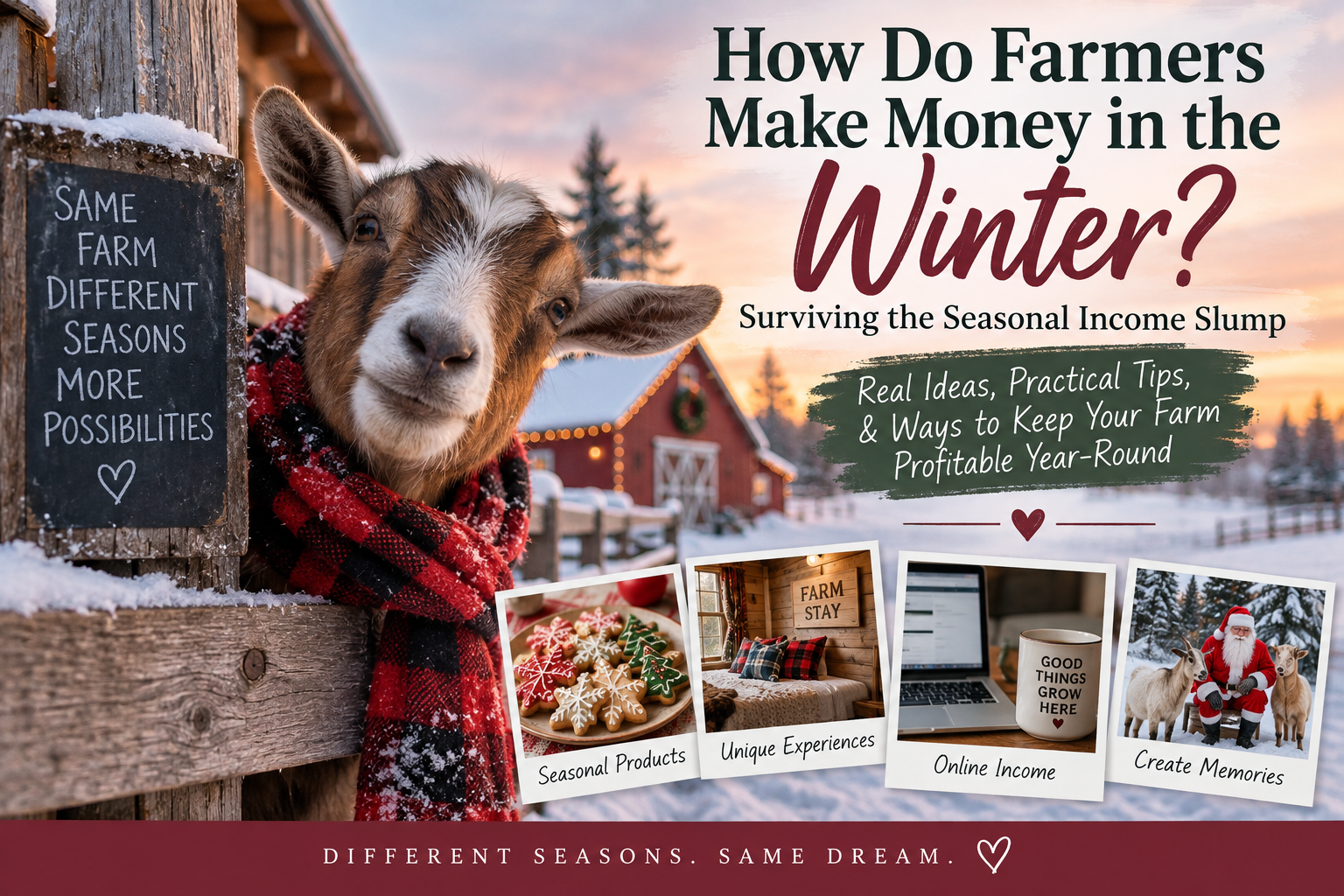
One of the things nobody really prepares you for when you start a farm or homestead business is just how seasonal the income can be.
There are months when opportunities seem to be everywhere.
Then winter comes.
The grass stops growing. Farmers markets slow down or close completely. Outdoor events disappear. Certain products aren’t available anymore. Depending on what kind of farm you run, entire income streams can basically shut off until spring.
And unfortunately, your bills don’t get the memo.
The mortgage is still due. Animals still need to eat. The electric bill may actually go up. There is bedding to buy, equipment to maintain, water to keep from freezing, and a seemingly endless list of things that still cost money even when the farm isn’t bringing in as much.
This is something I’ve been thinking about a lot lately because I’m realizing that building a sustainable farm isn’t just about figuring out how to make money. It’s about figuring out how to make money throughout the entire year.
And I don’t think the answer is necessarily trying to make so much money during the summer that you can simply survive the winter. For most small farms and homesteads, that probably isn’t realistic.
Instead, I think the better question is: How can we adapt what we already have—our property, animals, skills, audience, and knowledge—to create income during the slower seasons?
That’s what I want to talk about.
The Problem With Seasonal Farm Income
Farming has always been seasonal. That’s not necessarily a bad thing. Seasons are literally built into what we do.
There is a planting season. A growing season. A harvest season. A breeding season. A kidding season. A market season.
But when your household depends on income from the farm, those natural cycles can create a serious cash-flow problem.
For example, one of the services I offer through my farm is goatscaping. Goatscaping makes sense when everything is growing. Poison ivy, brush, grapevine, weeds, brambles—give me a horribly overgrown property during the summer and my goats have a job.
Give me that same property in January in Western New York? Not so much.
That doesn’t mean goatscaping isn’t a viable business. It means I can’t expect one seasonal service to support an entire farm for 12 months.
And I think that’s where diversification becomes incredibly important.
Stop Thinking About One Farm Income Stream
When people talk about starting a farm business, there’s often this idea that you have to choose the thing.
You’re going to sell eggs. You’re going to raise meat rabbits. You’re going to sell vegetables. You’re going to offer goat yoga. You’re going to sell at the farmers market.
But why does it have to be one thing?
Especially on a small farm or homestead, I think it makes much more sense to build several complementary income streams. Not twenty completely unrelated businesses that leave you exhausted. But several things that work together.
Your animals can generate one type of income. Your property can generate another. Your knowledge can generate another. Your audience can generate another. Your skills can generate another.
And, ideally, those income streams don’t all peak and disappear at exactly the same time.
Plan Your Farm Income Around the Seasons
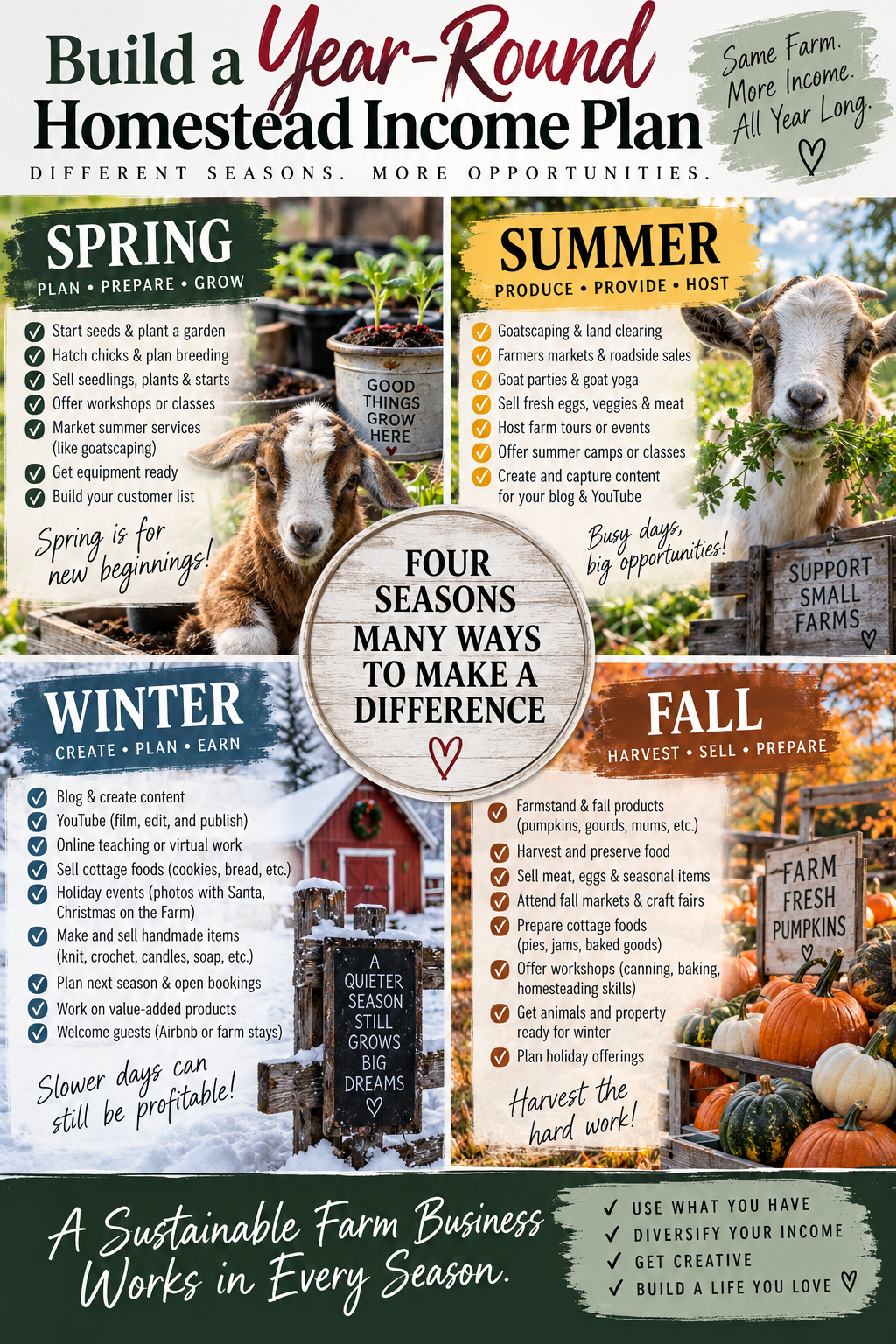
Instead of making one annual list of things you sell, it can be helpful to actually sit down and divide the year into seasons.
Ask yourself: What makes money for me in spring? What makes money in summer? What makes money in fall? What could make money in winter?
You might discover that you already have plenty of spring and summer income opportunities but almost nothing planned for January and February.
That’s useful information. Because now you aren’t just randomly searching for another side hustle. You’re specifically looking for something that fills a hole in your farm’s calendar.
Create Income That Isn’t Dependent on the Weather
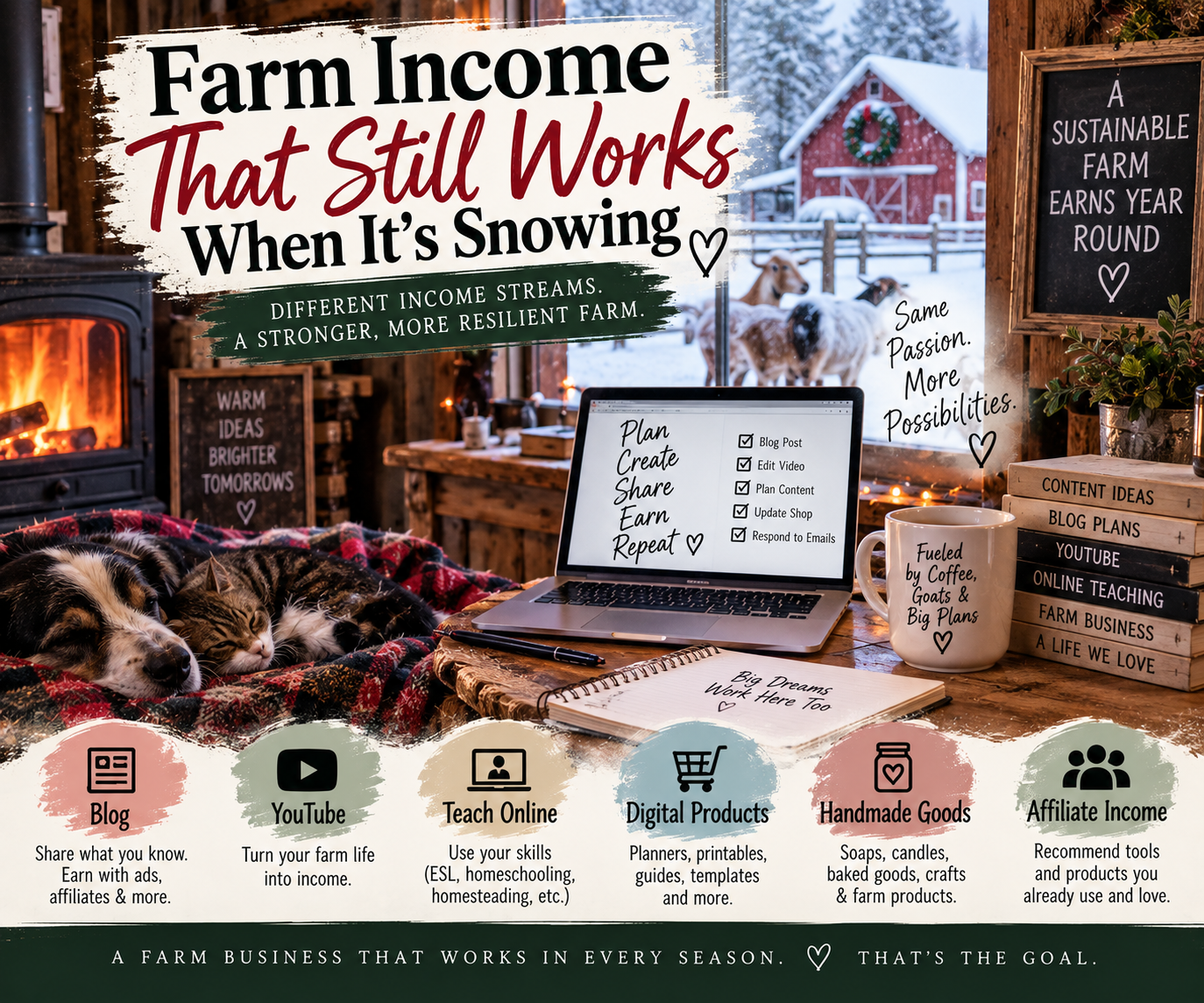
This is probably one of the biggest things I’m working toward myself.
If one income stream requires grass, sunshine, warm weather, or a growing season, I want other income streams that don’t.
And in 2026, we have options available to us that farmers twenty or thirty years ago simply didn’t have. You can make money from a farm without every dollar coming directly from something physically produced on the farm.
Start a Blog
This blog is actually a perfect example.
I’m already doing the work. I’m raising the animals. I’m gardening. I’m learning what works and what absolutely does not work. I’m building things. I’m making mistakes. I’m figuring things out.
Why shouldn’t that experience become another farm asset?
A blog allows you to take knowledge you already have and turn it into content people can find for years. And unlike goatscaping, Google doesn’t particularly care if there are three feet of snow outside.
A blog post about raising meat rabbits can make money in January. A post about incubating quail eggs can make money in February. A post you wrote two years ago can potentially still bring people to your website today.
That makes blogging especially interesting to me as a long-term way of creating income that isn’t completely tied to the season I’m currently in.
Start a YouTube Channel
The same concept applies to YouTube.
If you’re already doing interesting things around your homestead, film them.
You don’t need to pretend to be an expert. Honestly, some of the most useful homesteading content is simply: Here’s what I’m doing. Here’s why I’m doing it. Here’s what worked. Here’s what I would never do again.
You can film gardening, kidding season, incubating eggs, building rabbit cages, preserving food, fixing fences, raising poultry, goatscaping, buying farm equipment—the list is almost endless.
And winter can actually be a great time to work on the content you captured during the busy season.
Summer can be your capture season. Winter can become your editing, publishing, planning, and monetizing season.
Use Affiliate Marketing
You also don’t have to create your own product to make money online.
If people are constantly asking: What incubator do you use? What fencing do you recommend? What brooder is that? What rabbit cages do you have? What tools do you use?
Those recommendations can potentially become affiliate income.
The important part is recommending things you genuinely use or would recommend anyway—not stuffing random affiliate links into everything you publish.
If you’re already answering the question for free, an affiliate program can give you a way to earn a commission when someone decides to purchase through your recommendation. Just make sure you follow the disclosure requirements for affiliate links.
Teach Online During Your Farm’s Slow Season
This is another one I think people overlook.
Your winter income doesn’t necessarily have to come from farming.
Before focusing so heavily on the farm, I built a completely different business around online teaching through Independent Teacher Academy. And that’s something I can connect back to now.
If you have reliable internet, a computer, and something you can teach, online teaching can be a really interesting winter income option.
Maybe that’s ESL. Maybe you’re a math tutor. Maybe you teach music. Maybe you have another professional skill entirely.
The beautiful thing about remote work is that snow doesn’t stop you from doing it.
For someone whose primary farm income peaks in spring, summer, and fall, a flexible online teaching schedule could help fill the winter gap without requiring them to leave the farm every day.
If teaching online sounds like it could fit your slow season, I have a full guide over on Independent Teacher Academy: How to Start Teaching Online and Make Money from Home.
Look at Your State’s Cottage Food Laws
Another possibility is selling food you make at home.
Exactly what you can sell—and where you can sell it—depends heavily on your state’s cottage food laws, so this is one where you absolutely need to research your own state’s requirements.
But don’t assume the end of farmers-market season automatically means the end of selling.
Farmers Markets Aren’t the Only Place to Sell
When the outdoor farmers markets shut down, look for where customers went.
Flea markets. Indoor markets. Holiday markets. Craft fairs. Church bazaars. Community events. Pop-up markets.
You may be able to take some of the same things you sold all summer and simply change where you’re selling them.
And your product mix can change with the season, too. Maybe summertime was zucchini bread and jam. November might be pies, dinner rolls, cookies, or other Thanksgiving-oriented products permitted under your state’s laws. December might be Christmas cookies or giftable foods.
Instead of thinking, “The farmers market closed, so my season is over,” try asking: “Where are people shopping now?”
That’s a completely different question.
Use the Holidays Instead of Fighting Them
Winter isn’t actually a season when people stop spending money. Quite the opposite.
Thanksgiving, Christmas, and New Year’s create enormous amounts of consumer spending. The trick is figuring out whether something you already know how to do fits what people are buying during those months.
Can you bake? Could you sell Christmas cookies or other permitted cottage foods? Can you knit or crochet? Could you make Christmas gifts? Do you make candles, soap, ornaments, wreaths, signs, or other handmade items?
The question becomes: What skills do I already have that become more valuable during the holidays?
And don’t limit yourself to physical products.
Turn Your Farm Into a Holiday Experience
This is where you can get really creative.
People aren’t only buying things during the holidays. They’re buying experiences and memories.
If you have a farm with animals, you’ve already got something that most people don’t have access to every day.
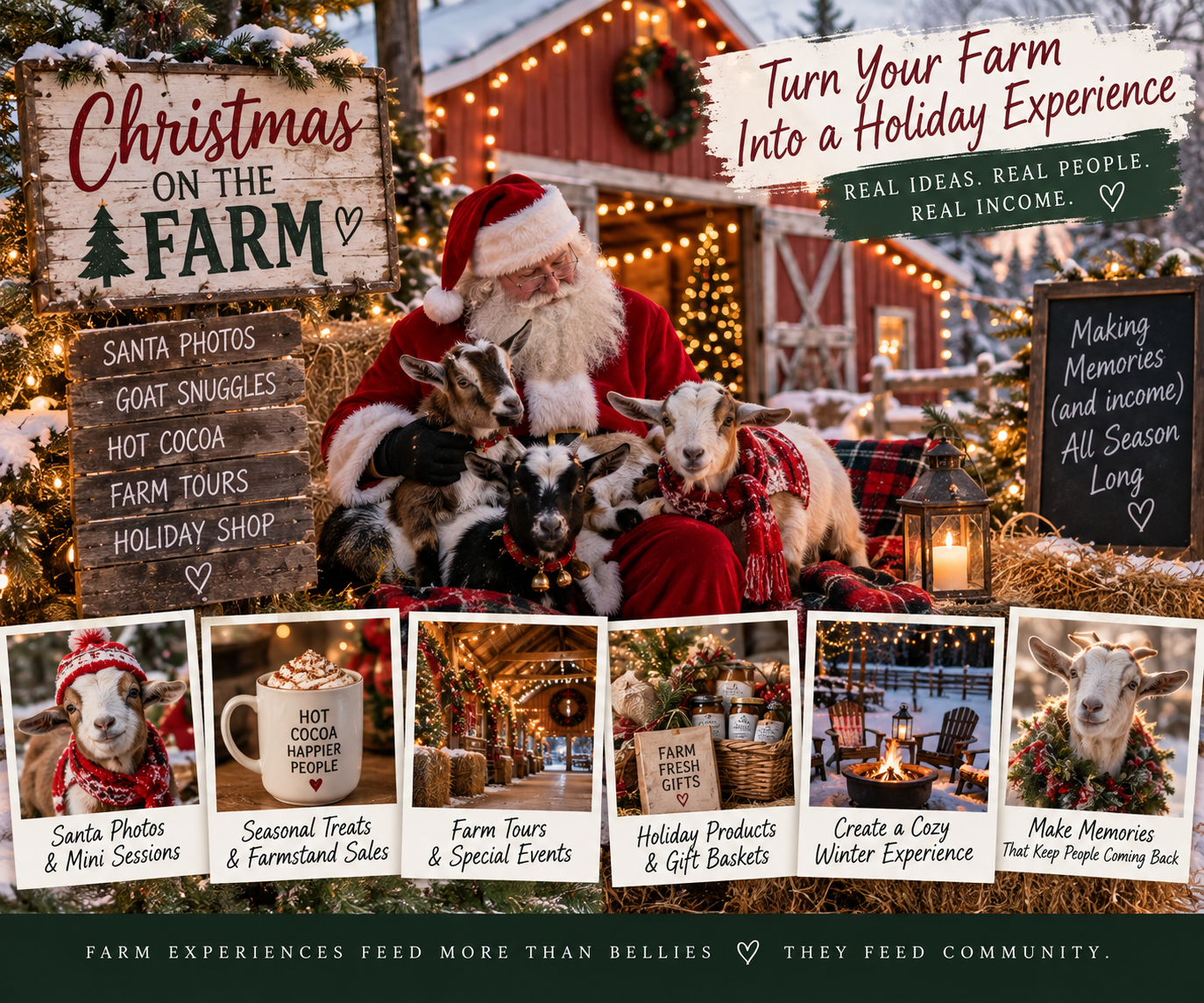
Imagine something as simple as Christmas on the Farm.
Santa comes out for a day. Families reserve time slots. Kids get pictures with Santa. Maybe there’s a Highland cow in the photo. Maybe it’s goats. Maybe it’s a miniature horse. Maybe families can feed the animals afterward.
Add hot cocoa, Christmas lights, a cute photo area, and suddenly you’re not selling an animal product at all. You’re selling a Christmas memory.
Obviously, any public farm event needs to be approached seriously when it comes to insurance, safety, local regulations, parking, animal handling, and liability. But from a business standpoint, there are so many possibilities.
Partner With People Who Have Skills You Don’t
You also don’t have to personally provide every part of an experience.
This is something I’ve learned through offering events with my own animals. I don’t need to become a yoga instructor to offer goat yoga. I can partner with a yoga instructor.
The instructor brings the yoga expertise. I bring the goats.
The same thing could work with a photographer. You provide the farm, scenery, animals, and atmosphere. The photographer handles the photography.
You could collaborate with photographers, yoga instructors, bakers, artists, craft instructors, florists, other local farmers, Santa performers, teachers, or workshop instructors.
Sometimes the easiest way to create another income stream isn’t learning an entirely new skill. It’s finding someone whose skill complements something you already have.
Consider Making Products From What You Already Produce
Winter can also be a good time to turn raw farm products into something with additional value.
Goat milk is an obvious example. Instead of only thinking about milk as milk, some farms turn it into products such as goat milk soap.
Fiber animals create another possibility. Wool, alpaca fiber, or other fibers can potentially become yarn, felted items, knitted products, or handmade gifts.
The larger idea here is value-added products.
Ask: What am I already producing that could become something worth more?
You’ll need to research the laws and regulations that apply to whatever you’re making and selling, but it’s a useful exercise for almost any farm.
Monetize Property You Aren’t Using
This definitely won’t apply to everyone. But some homesteaders have an asset they haven’t considered part of the business: space.
Maybe there’s a guest house. A tiny house. A cabin. An apartment over a barn. An RV hookup. Or another separate space that could legally and safely be rented.
A short-term farm stay could potentially create an income stream that isn’t dependent on selling vegetables or livestock.
And if I were doing this, I wouldn’t want to create just another place to sleep. I’d want to create an experience.
Think Hallmark Christmas movie.
Wake up on a snowy farm. Drink coffee while watching the animals. Go outside and feed the goats. Come back in for hot chocolate. Experience the kind of farm Christmas people imagine when they see those ridiculously perfect holiday movies.
You’re no longer competing solely on having a bed and a bathroom. You’re selling the experience of staying on a farm.
Again, this is one where zoning, insurance, taxes, local short-term-rental laws, septic capacity, fire codes, and liability all matter. But for someone with the right property, it’s worth investigating.
Book Next Season’s Money During the Off-Season
Winter income doesn’t necessarily have to mean money that arrives in January.
Winter can also be when you build the pipeline for spring and summer.
This is something I’m thinking about with goatscaping. The goats might not be clearing properties in January, but that doesn’t mean I can’t be talking about goatscaping in January.
Winter is a perfect time to update your website, post before-and-after photos, create educational content, answer common customer questions, reach out to previous clients, build a waitlist, open spring bookings, create packages, improve contracts and systems, and market upcoming services.
That way, when everything starts growing again, you’re not starting from zero. You already have customers waiting.
Pay Yourself Like Your Income Isn’t Seasonal
This part isn’t nearly as exciting as Christmas goats or making money on YouTube, but it’s probably one of the most important.
If your farm earns dramatically different amounts throughout the year, it can help to stop thinking about every good month as money you can immediately spend.
Instead, look at the farm annually.
Let’s say your farm eventually produces $48,000 in usable income for your household during the year. That doesn’t necessarily mean you should take $8,000 out during a particularly good month.
You might structure your household around approximately $4,000 per month and allow the stronger months to fund the weaker ones.
That requires discipline—and it obviously only works once the business is producing enough annual profit to support those withdrawals—but it can make seasonal income much more predictable at home.
You can also build a dedicated reserve specifically for the farm’s slow season.
Because January shouldn’t be an emergency. January happens every year.
Reduce Winter Expenses Before Winter Gets Here
There’s another side to this equation that doesn’t involve making another dollar.
Sometimes improving winter cash flow means spending less.
Winter expenses should be part of your summer and fall planning.
Can you buy or store hay before prices rise? Can you repair shelters before you’re doing emergency repairs in a snowstorm? Can you reduce the number of animals you’re carrying through winter? Can you improve water systems before everything freezes? Can you stock bedding? Can you preserve more food for your own household? Can you pay annual expenses during stronger months?
The cheapest winter emergency is usually the one you prevented in October.
Don’t Create 15 New Jobs for Yourself
There’s one caution I want to add because diversification sounds wonderful on paper.
Until you accidentally create seven businesses and hate all of them.
The goal isn’t to spend January teaching online at 6 AM, feeding livestock at 8, baking 400 cookies at 10, shipping soap at noon, filming YouTube at 2, hosting Christmas photos at 4, and crocheting scarves until midnight.
That’s not diversification. That’s chaos.
The goal is to identify a few income streams that fit together and peak at different times.
If summer is incredibly busy on your farm, maybe winter is exactly when an online business makes sense. If December is packed with holiday events, maybe January becomes your content-production month.
Your business should follow the rhythm of your farm rather than constantly fighting against it.
Look at Everything You Already Have Differently
I think this is ultimately the biggest lesson for me.
When you’re trying to make a farm financially sustainable, don’t only ask: “What can I sell?”
Ask: What do I have?
I have animals. I have land. I have knowledge. I have experiences. I have skills. I have an audience. I have things I’m already doing every single day that other people want to learn about.
Someone else might have a commercial kitchen. Someone might have an incredible knitting skill. Someone might have a beautiful barn. Someone might have an extra cabin. Someone might be an amazing teacher. Someone might grow the best pumpkins in town. Someone might have absolutely adorable Highland cows that people would pay to take Christmas pictures with.
The answer is going to look different for every farm.
The Goal Isn’t to Eliminate Seasonality
I don’t actually think we need to eliminate the seasonal nature of farming. That’s part of what makes this lifestyle what it is.
I don’t need my goatscaping business to operate in January. I need January to have a different job.
Maybe summer is when I’m physically out working with the goats. Maybe fall is when the farmstand and seasonal products become more important. Maybe winter is when I write, make videos, teach, sell online, plan, market, and build the next season.
Then spring starts the whole cycle again.
That’s a much more sustainable way for me to think about farm income.
Instead of trying to force every income stream to work 365 days a year, I’m trying to build a business where something is working in every season.
And if you’re trying to turn your homestead into a business too, that may be the better question to ask:
Not “How do I make money farming all winter?”
But: “What should my farm business be doing this season?”


Post your Comment About This Product