
Raising meat rabbits is one of those homesteading projects that looks incredibly simple from the outside. Get a few rabbits, breed them, raise the babies, and suddenly you have a steady source of homegrown meat.
Compared with a lot of livestock, raising meat rabbits for beginners can be surprisingly manageable.
Rabbits don’t require acres of pasture. They don’t need a huge barn. They’re quiet, reproduce quickly, and can produce a substantial amount of meat from a relatively small setup.
But there is definitely more to raising meat rabbits than putting a buck and doe together and waiting for dinner.
You need to think about breeds, housing, feeding, breeding schedules, nesting boxes, kits, grow-out space, sanitation, summer heat, winter weather, and what you’re actually going to do with all those rabbits once your breeding program gets going.
I’ve learned that lesson with pretty much every animal we’ve added to our homestead: the animal itself is usually the easy part. Building a system that actually works is where the learning happens.
So if you’re considering raising rabbits for meat, this guide walks through what you actually need to know before getting started.
Why Raise Rabbits for Meat?
There is a reason meat rabbits have been raised on small farms and homesteads for generations.
They can produce a lot of food without requiring a lot of land.
That alone makes rabbits particularly interesting for small homesteads.
Unlike cattle, sheep, or even goats, you don’t necessarily need pasture. A rabbitry can fit inside a barn, shed, garage, covered outdoor area, or purpose-built structure.
Rabbits also reproduce remarkably quickly.
A doe can produce multiple litters per year, and those litters can contain several kits each. That means a very small breeding herd can potentially produce dozens of meat rabbits annually.
- Rabbits require relatively little space.
- They’re quiet.
- Manure can be extremely useful in the garden.
- Housing can be fairly inexpensive.
- They mature quickly compared with larger livestock.
- A small breeding herd can produce a surprising amount of meat.
- You don’t need specialized acreage to get started.
That doesn’t mean they’re maintenance-free.
You’re essentially trading land requirements for management. When animals live in a smaller space, keeping housing clean, providing appropriate nutrition, monitoring health, and managing temperatures become especially important.
What Are the Best Meat Rabbit Breeds?
Technically, you can eat meat from virtually any rabbit breed.
That doesn’t mean every rabbit makes a good meat rabbit.
Good meat breeds tend to grow quickly, have good feed conversion, produce decent-sized litters, mother well, and develop the type of body that gives you a worthwhile carcass.
Some of the most common meat rabbit breeds include New Zealand, Californian, Champagne d’Argent, Silver Fox, Rex, American Chinchilla, and Flemish Giant or other giant-breed crosses.
But bigger isn’t automatically better.
Giant rabbits can take longer to mature and consume considerably more feed. If your primary goal is efficient meat production, a medium-to-large rabbit bred specifically for meat production can make more sense than simply buying the biggest rabbit you can find.
I have an entire guide comparing the best meat rabbit breeds for beginners, including what to consider when choosing the right breed for your particular homestead.
How Many Meat Rabbits Should You Start With?
You don’t need ten rabbits to start producing your own meat.
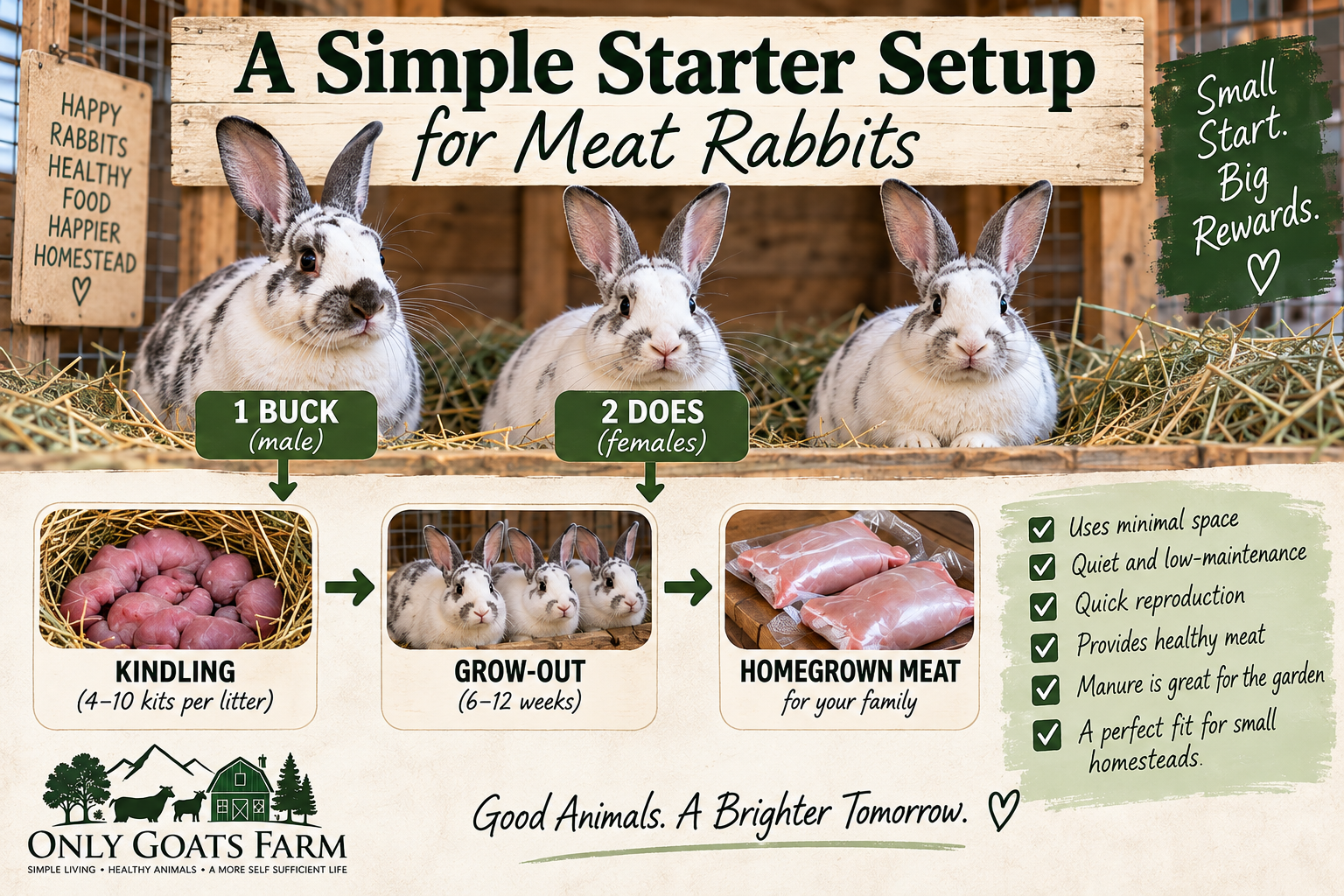
A very common beginner setup is 1 buck + 2 does.
That gives you two breeding females without requiring multiple males.
You could even start with one buck and one doe while you’re learning.
Starting smaller has a major advantage: you get to make your beginner mistakes on a small scale.
You’ll learn how quickly your cages get dirty, how much feed you’re actually using, how your rabbits tolerate your climate, how much grow-out space you need, and whether you even enjoy raising rabbits before suddenly having 30 of them.
Housing Meat Rabbits
There isn’t one perfect rabbitry design.
Some people use traditional hanging wire cages. Others use stackable cages, hutches, colony systems, tractors, sheds, barns, or combinations of several systems.
I’ve put together a separate guide showing different rabbitry setup ideas because your ideal setup depends heavily on your property and management style.
Regardless of the housing system you choose, rabbits need protection from predators, good ventilation, protection from rain and snow, shade, clean water, dry resting areas, safe flooring, enough space to move comfortably, and protection from extreme heat.
Heat Is a Bigger Concern Than Cold
People frequently worry about keeping rabbits warm in winter.
Healthy rabbits with appropriate shelter generally tolerate cold temperatures much better than extreme heat.
Heat can become dangerous very quickly.
Your rabbitry should have excellent airflow and plenty of shade. Depending on your climate and setup, you may also need fans, frozen water bottles, cooling tiles, or other methods for helping rabbits regulate their body temperature during hot weather.
What Supplies Do You Actually Need?
Rabbit supplies are an area where it’s very easy to overspend.
Walk into a pet store and you’d think a rabbit requires an entire shopping cart of accessories.
Homestead rabbits really don’t.
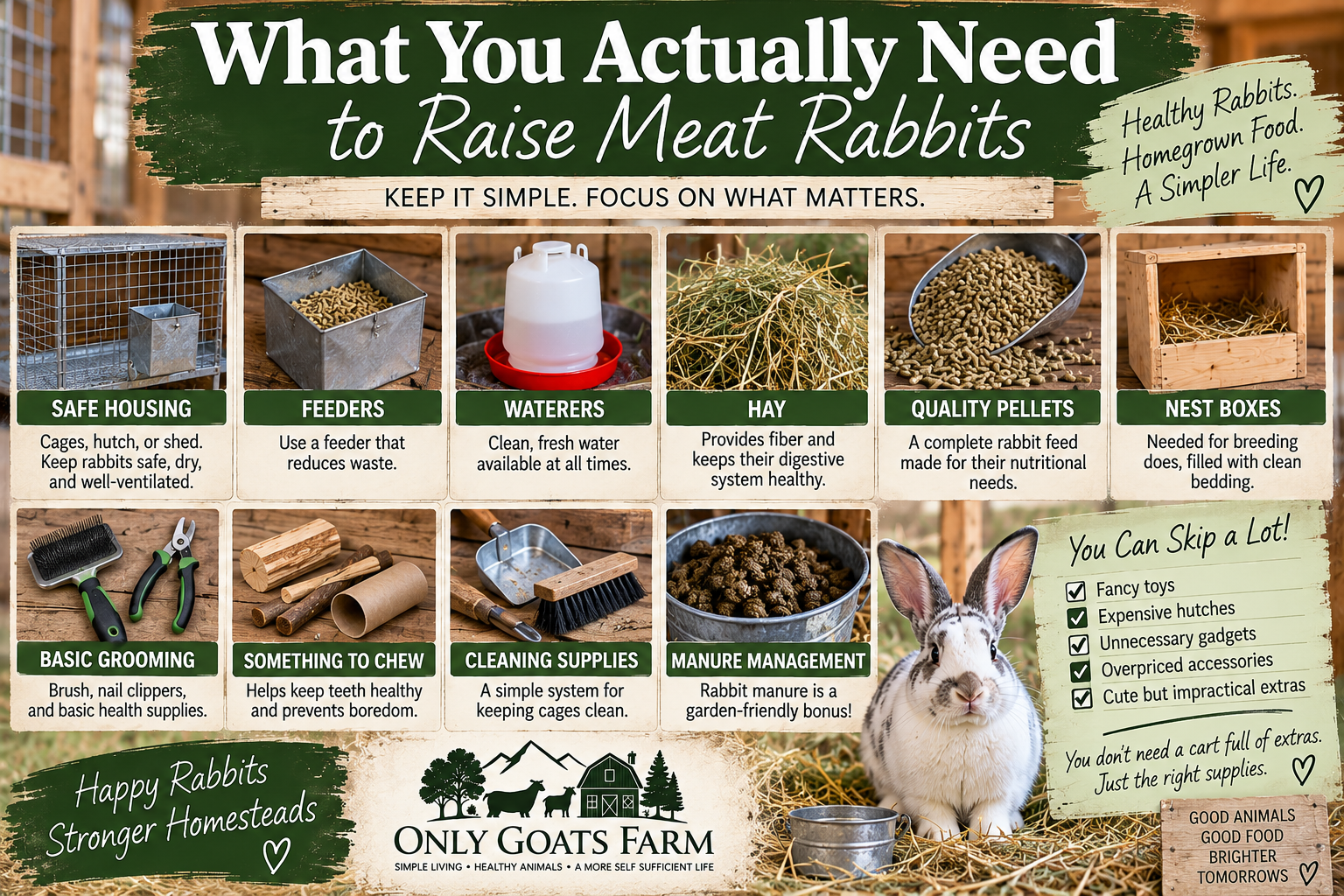
The basics are pretty simple: safe housing, feeders, waterers, hay, appropriate rabbit feed, nest boxes for breeding does, basic grooming or health supplies, something safe for chewing, and a system for cleaning and manure management.
You can skip a surprising amount of the stuff marketed toward rabbit owners.
I broke this down much further in Rabbit Supplies You Don’t Need: What You Actually Need to Raise Rabbits.
What Do Meat Rabbits Eat?
Nutrition is one area where I wouldn’t recommend winging it when you’re first starting.
A quality commercial rabbit pellet provides a predictable nutritional foundation and makes feeding considerably simpler.
Rabbits also need access to clean water at all times.
Hay provides fiber and gives rabbits something to continually chew, which is important because rabbit teeth grow continuously.
Depending on your feeding system, rabbits may also receive appropriate greens, forage, garden plants, or other supplemental foods.
But natural doesn’t automatically mean safe.
There are plants rabbits shouldn’t eat, and suddenly switching foods can cause digestive problems.
If your eventual goal is reducing or eliminating commercial pellets, that’s something worth researching as its own feeding system rather than simply replacing pellets with random garden scraps.
Breeding Meat Rabbits
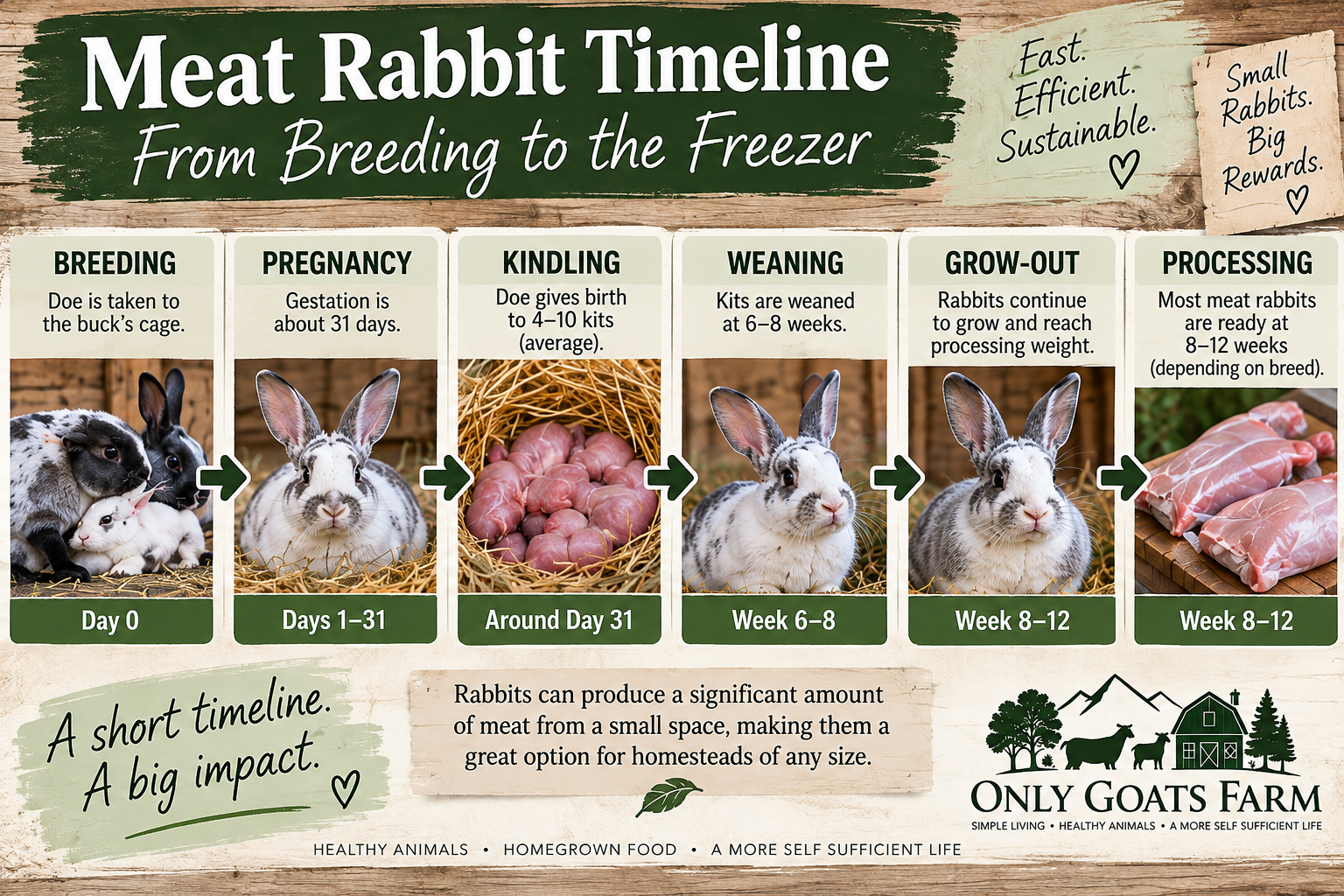
When you’re ready to breed, the doe is generally taken to the buck’s enclosure, rather than putting the buck into the doe’s territory.
Watch the breeding rather than simply putting them together indefinitely.
Record the breeding date.
A basic breeding record can include the doe, buck, breeding date, expected kindling date, actual kindling date, number born, number alive, number weaned, and notes about the litter.
How Long Are Rabbits Pregnant?
Rabbit gestation is approximately 31 days, although kindling can occur a little earlier or later.
Around day 28, you’ll generally provide the doe with a clean nest box and appropriate nesting material.
As kindling approaches, many does begin pulling fur from their chest and belly to line the nest.
What Is Kindling?
When a rabbit gives birth, it’s called kindling, and baby rabbits are called kits.
Most does don’t need you hovering over them while they give birth.
Once she has finished, check the nest. Make sure the kits are together and warm, remove any dead kits, make sure the nest is dry, check for kits born outside the box, and make sure the doe appears healthy.
And yes, you can handle the babies to check them.
The old idea that a mother rabbit will automatically abandon her babies because a human touched them is a myth.
Why Doesn’t My Mother Rabbit Stay With Her Babies?
This surprises a lot of first-time rabbit breeders.
A doe usually doesn’t sit with her babies all day like a cat or dog would.
That’s normal.
Mother rabbits generally nurse their kits only once or twice per day, often when things are quiet.
When Are Meat Rabbits Weaned?
Many meat rabbit breeders wean kits somewhere around 6-8 weeks, although management systems vary.
Avoid making multiple major changes simultaneously whenever possible. Weaning is already stressful.
Grow-Out Pens for Meat Rabbits
This is the part beginners sometimes forget to plan.
Your breeders have cages. Great. Where are the babies going?
A litter of growing rabbits requires considerably more space than a nest full of newborn kits.
Your grow-out area needs to be part of your rabbitry plan before you start breeding.
When Are Meat Rabbits Ready to Process?
The exact processing age depends on breed, genetics, feeding program, growth rate, and your desired carcass size.
Many commercial-type meat rabbits are processed somewhere around 8-12 weeks, although slower-growing breeds and different production systems may take longer.
Age isn’t the only thing that matters. Pay attention to growth.
Choosing Replacement Breeding Stock
Don’t keep a rabbit as a breeder simply because it’s cute.
If your goal is meat production, your breeding stock should move your herd toward better production.
Consider growth rate, body structure, litter size, mothering ability, milk production, temperament, health, fertility, survival rate of kits, and feed efficiency.
How Much Meat Can Rabbits Produce?
Imagine you have two does.
If each doe produces five surviving grow-outs per litter and you breed each doe four times per year, that’s 2 does × 5 rabbits × 4 litters = 40 meat rabbits per year.
Increase average litter survival to seven and suddenly you’re looking at 56 rabbits per year.
Actual production varies enormously, and I wouldn’t recommend pushing a new breeding program to maximum production immediately.
How Much Does It Cost to Raise Meat Rabbits?
Your biggest expenses will generally include breeding stock, housing, feed, hay, feeders and waterers, nest boxes, occasional veterinary or health expenses, and processing equipment if you process at home.
The startup year is usually more expensive because you’re building infrastructure.
Rabbit Manure Is a Homestead Bonus
Rabbit manure can be an incredibly useful homestead resource.
You can add it to compost, apply it around garden plants, mix it into garden beds, use it around fruit trees, or add it to other soil-building systems.
Common Meat Rabbit Mistakes Beginners Make
Starting With Too Many Rabbits
You don’t need a huge breeding herd. Start small and learn your system first.
Breeding Before Grow-Out Housing Is Ready
Those tiny kits become eating, pooping, space-consuming teenagers remarkably quickly. Build first. Breed second.
Poor Ventilation
A closed rabbitry can become hot, humid, and unhealthy. Fresh airflow matters.
Ignoring Heat
Cold gets a lot of attention, but summer heat can be a much bigger threat. Have a cooling plan before the hottest day of the year arrives.
Changing Feed Too Quickly
Rabbit digestive systems can be sensitive. Make dietary changes gradually.
Not Keeping Records
Breeding dates, litter sizes, growth rates, and health problems become impossible to track accurately if you’re relying on memory.
Can You Raise Meat Rabbits in a Small Backyard?
Potentially, yes.
Rabbits are one of the more practical livestock options for limited spaces because they’re quiet and don’t require pasture.
But check your local zoning and animal ordinances before setting up a breeding operation.
Can Meat Rabbits Be Raised in Winter?
Yes.
Rabbits generally handle cold weather fairly well when they’re healthy, dry, protected from wind, and acclimated to the temperatures.
Winter management focuses heavily on keeping water from freezing, preventing drafts while maintaining ventilation, keeping nesting areas dry, providing adequate calories, and protecting newborn kits.
Are Meat Rabbits Worth Raising?
For the right homestead, absolutely.
They’re especially attractive if you’re working with limited acreage but still want to produce more of your family’s food.
But they’re not free meat.
You’re exchanging money, feed, labor, and management for a source of homegrown protein.
And there is an emotional side that deserves to be acknowledged. If you’re raising rabbits for meat, eventually you have to process rabbits.
What I Would Do If I Were Starting Meat Rabbits From Scratch
I would keep it simple.
I’d start with a small number of quality rabbits rather than buying every inexpensive rabbit I could find.
I’d build the rabbitry before buying the rabbits.
I’d make sure I had grow-out space before breeding them.
I’d choose one consistent feeding program and learn it before experimenting.
I’d keep records from the very first breeding.
And most importantly, I’d give myself time to learn.
Frequently Asked Questions About Raising Meat Rabbits
How many rabbits do I need to start raising meat?
One buck and two does is a practical small breeding group, although you can begin with just one buck and one doe while learning.
What is the best meat rabbit for beginners?
New Zealand and Californian rabbits are popular meat breeds because of their growth rates and meat production, but several heritage breeds and crosses can also work well.
How long does it take to raise a rabbit for meat?
Many commercial-type meat rabbits reach processing size around 8-12 weeks, although growth varies by breed, genetics, diet, and management.
Can I raise rabbits without commercial pellets?
It is possible to develop alternative feeding systems, but simply removing pellets without replacing the nutrients they provide isn’t a good plan.
Do meat rabbits smell?
The rabbits themselves generally aren’t the problem. Accumulated urine, wet bedding, and manure are. A properly ventilated and regularly cleaned rabbitry should be much easier to manage.
Ready to Start Raising Meat Rabbits?
Rabbits can be an incredible addition to a small homestead.
You don’t need ten acres. You don’t need an enormous barn. And you definitely don’t need to start with twenty rabbits.
Start with a manageable setup, good breeding stock, safe housing, appropriate nutrition, and a plan for the offspring you’re going to produce.
If you’re planning your rabbitry, read Best Meat Rabbit Breeds for Beginners, Rabbitry Setup Ideas, and Rabbit Supplies You Don’t Need next.


Post your Comment About This Product