
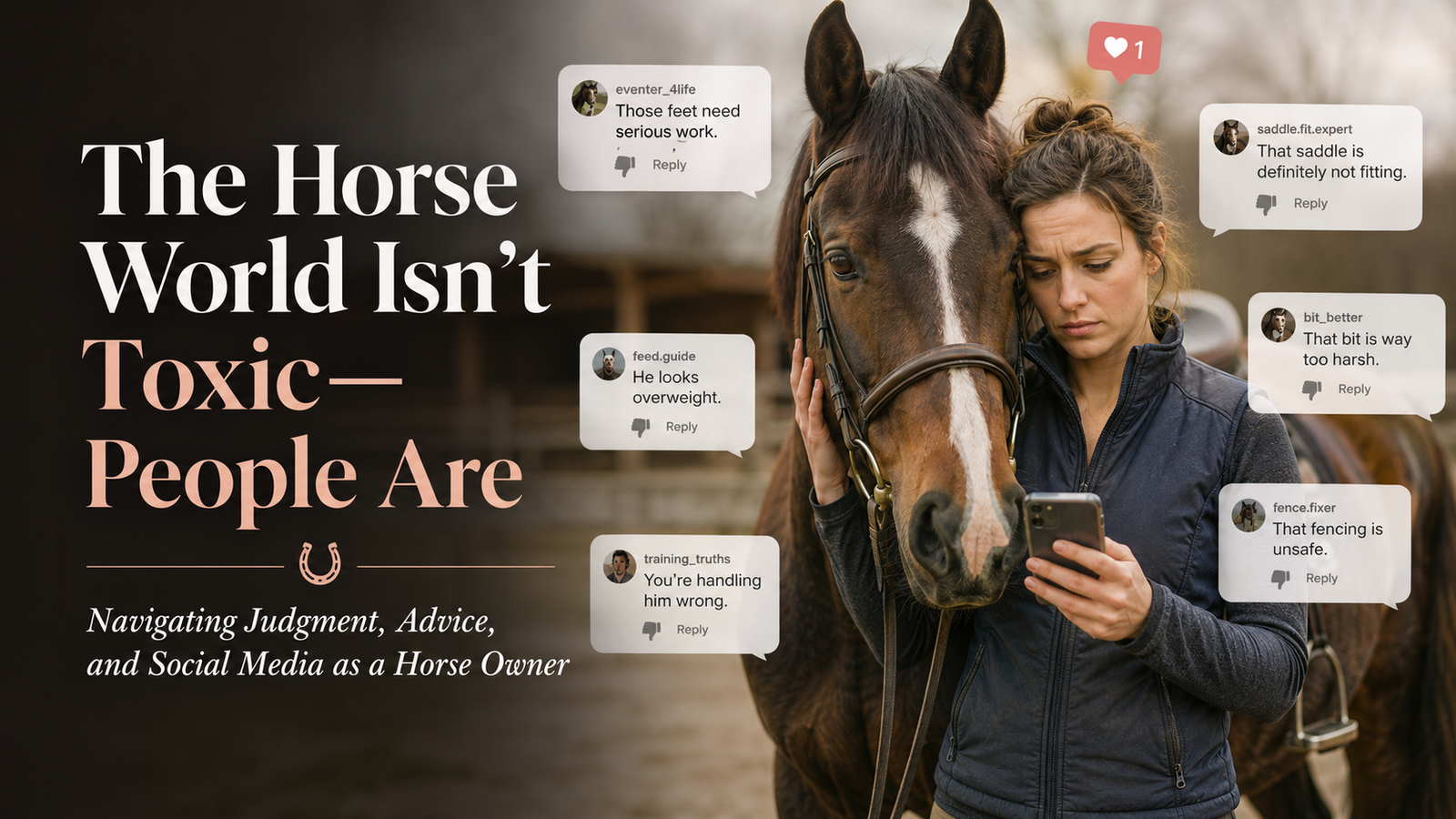
You post a photo because you’re proud of your horse.
Maybe it’s a picture from your first ride together. Maybe your horse is finally looking healthier after months of work. Maybe you simply caught a sweet moment and wanted to share it with people who understand how much horses mean to you.
Within minutes, strangers are zooming in on your horse’s feet, body condition, saddle fit, teeth, bit, helmet, fencing, pasture and even the way you’re holding the lead rope.
Someone notices a hoof angle.
Someone thinks your horse is too fat.
Someone else says the same horse is too thin.
Another person decides your saddle doesn’t fit based on one photograph taken from twenty feet away.
Somehow, a happy moment becomes a public trial.
People often say that “the horse world is toxic.” I don’t actually think horses—or even the horse world itself—are the problem. I think social media has amplified something that has always existed: people who confuse having experience with having the right to belittle someone else.
There is nothing wrong with wanting to protect horses. There is nothing wrong with offering advice when something looks concerning.
The problem is the way people choose to do it.
Every Horse Owner Starts Somewhere
Nobody is born knowing how to care for a horse.
No one automatically knows how to wrap a leg, recognize the early signs of colic, evaluate body condition, check saddle fit, balance a horse’s nutrition or decide whether a horse needs a blanket.
Nobody begins their horse journey knowing everything there is to know about hoof care, fencing, pasture management, groundwork, training or emergency care.
Every experienced horse owner once had a first horse.
Every trainer once handled a horse without decades of experience behind them.
Every veterinarian, farrier and equine professional had to learn the basics before they could master the complicated parts.
Experience is built through time, education, observation and, yes, mistakes.
Most people can look back at their first few years with horses and identify things they would do differently now. That doesn’t necessarily mean they were careless or cruel. It means they were still learning.
We all are.
Advice Isn’t the Problem
There is an important difference between giving advice and using information as a weapon.
These are two comments you might see in the same post:
“Hey, your saddle looks like it might be bridging. It may be worth having a qualified saddle fitter take a look at it.”
And:
“That saddle doesn’t fit. You shouldn’t even own a horse.”
The concern may be the same.
The impact is completely different.
The first comment gives the owner something useful to investigate. It explains the possible problem without pretending that a stranger can make a complete diagnosis from one photograph.
The second comment is designed to shame.
Most horse owners genuinely want to do the right thing for their animals. When someone respectfully points out a potential problem and explains why it matters, many owners are grateful.
Shaming someone rarely makes them more willing to listen.
It usually makes them defensive, embarrassed or afraid to ask another question.
Helpful advice gives someone a path forward. Cruel criticism only tells them they aren’t good enough.
Social Media Rewards Outrage
Part of the problem is the way social media works.
Outrage creates engagement.
Arguments lead to more comments. More comments push a post in front of more people. More people join the argument, and suddenly a simple photo has hundreds of strangers debating whether the owner deserves to have a horse.
Confidence also sounds authoritative online.
The person saying, “There could be several reasons for this, and you should probably speak with your veterinarian,” may be giving the most responsible answer.
However, the person declaring, “This is absolutely the problem, and anyone who disagrees is an idiot,” often sounds more convincing.
Algorithms reward arguments.
Certainty attracts attention.
Kindness isn’t always as exciting.
This can make the horse world appear far harsher online than it often is in person. Many knowledgeable, compassionate horse people are quietly helping others every day. They just aren’t creating the dramatic comment threads that get pushed to the top of everyone’s feed.
Everyone Is an Expert on Your Horse
One veterinarian tells you one thing.
Your farrier recommends something different.
Five Facebook commenters disagree with both of them.
Then your trainer gives you another opinion entirely.
Welcome to horse ownership.
Horse care is not always black and white. There are certainly clear situations involving neglect, abuse or immediate danger, but many everyday management decisions have more than one acceptable answer.
Different horses have different needs.
A feeding program that works well for one horse may be completely inappropriate for another. A barefoot horse may thrive in one environment while another horse needs shoes. One horse may need a blanket in certain weather while another horse living in the same barn does not.
Climate, age, workload, health, breed, metabolism, pasture quality and living conditions all matter.
There are often multiple correct ways to solve the same problem.
That nuance tends to disappear online. People see one photograph or a ten-second video and assume they understand the horse’s complete history, health and management.
They don’t.
Be Careful Who You Listen To
Not every opinion deserves equal weight.
When someone gives you advice, consider where it is coming from.
Does this person have real experience with the issue they are discussing?
Can they explain why they are recommending something?
Are they willing to teach, or are they more interested in proving that they know more than you?
Does their advice agree with your veterinarian, farrier, trainer or another trusted professional who has actually examined your horse?
Are they acknowledging that there may be details they cannot see from a post?
Good advice usually comes with an explanation.
It may include questions.
It may encourage you to consult a professional.
It should not require humiliating you in order to help your horse.
Credentials and experience matter, but so does the ability to recognize the limits of what can be determined through a screen.
It’s Okay to Keep Learning Publicly
Many people stop posting about their horses because they are afraid of criticism.
They stop sharing photos.
They stop asking questions.
They stop talking about problems until those problems become bigger because they are afraid that admitting they need help will result in hundreds of strangers attacking them.
That isn’t good for horses or their owners.
If everyone hides until they are “perfect,” new horse owners lose the opportunity to learn from real experiences.
They only see polished photographs, perfect rides and confident owners who appear to have never struggled.
That isn’t reality.
Horse ownership is a lifelong education. Even people who have owned horses for forty years encounter new problems, change their opinions and learn better ways of doing things.
You should be able to share your progress without pretending you have already mastered everything.
Perfection isn’t the goal.
Progress is.
If You’re the Experienced Horse Person…
Remember your first horse.
Remember the first time you tried to wrap a leg.
Remember the first mistake you made that seems obvious to you now.
Remember the questions you were embarrassed to ask.
Most importantly, remember the people who helped you without making you feel stupid.
Be that person for someone else.
Correct people when correction is necessary.
Speak up when a horse’s welfare is genuinely at risk.
Protect horses when they need protecting.
But don’t forget that there is a human being on the other side of the screen.
A person can love their horse deeply and still be mistaken about something.
A person can need education without deserving humiliation.
A person can be new without being negligent.
You can tell someone the truth without being cruel. In fact, they are far more likely to hear that truth when it is delivered with respect.
Final Thoughts
The horse world doesn’t need fewer beginners.
It needs more mentors.
Every confident horse owner started as someone who didn’t know enough. They asked questions, made mistakes, changed their minds and learned through experience.
The difference wasn’t that they avoided every mistake.
It was that someone gave them enough room to learn from those mistakes.
The horse world isn’t toxic because people disagree. Disagreement is normal, and honest conversations are necessary when the welfare of an animal is involved.
It becomes toxic when people use concern for horses as an excuse to bully humans.
We can protect horses without chasing new owners out of the community.
We can share knowledge without using it to make ourselves feel superior.
We can correct someone and still treat them like a person.
The horse world doesn’t need fewer people who are learning.
It needs more experienced people who remember what it felt like to be one of them.


Post your Comment About This Product