
Introduction
I feel like more and more people are starting to realize just how important it is to know how to grow food.
Grocery prices are crazy right now. Produce quality can be hit or miss. Egg shortages happen overnight. And honestly, there’s something comforting about being able to walk outside and harvest food from your own backyard.
That’s where survival gardening comes in.
Now, when people hear the term “survival garden,” they sometimes picture some extreme doomsday setup with bunkers and freeze-dried food.
But really, a survival garden is just a practical garden.
It’s a garden focused on growing foods that can actually help feed your family.
Instead of just planting a couple fun vegetables here and there, a survival garden focuses on things like:
- Calories
- Nutrition
- Storage crops
- Reliable producers
- Foods you can preserve and use long term
Think potatoes instead of novelty vegetables. Dry beans instead of decorative plants. Winter squash that lasts for months instead of crops that spoil in a week.
You do not need a huge homestead to start.
Even a backyard garden can produce an incredible amount of food when you plant intentionally.
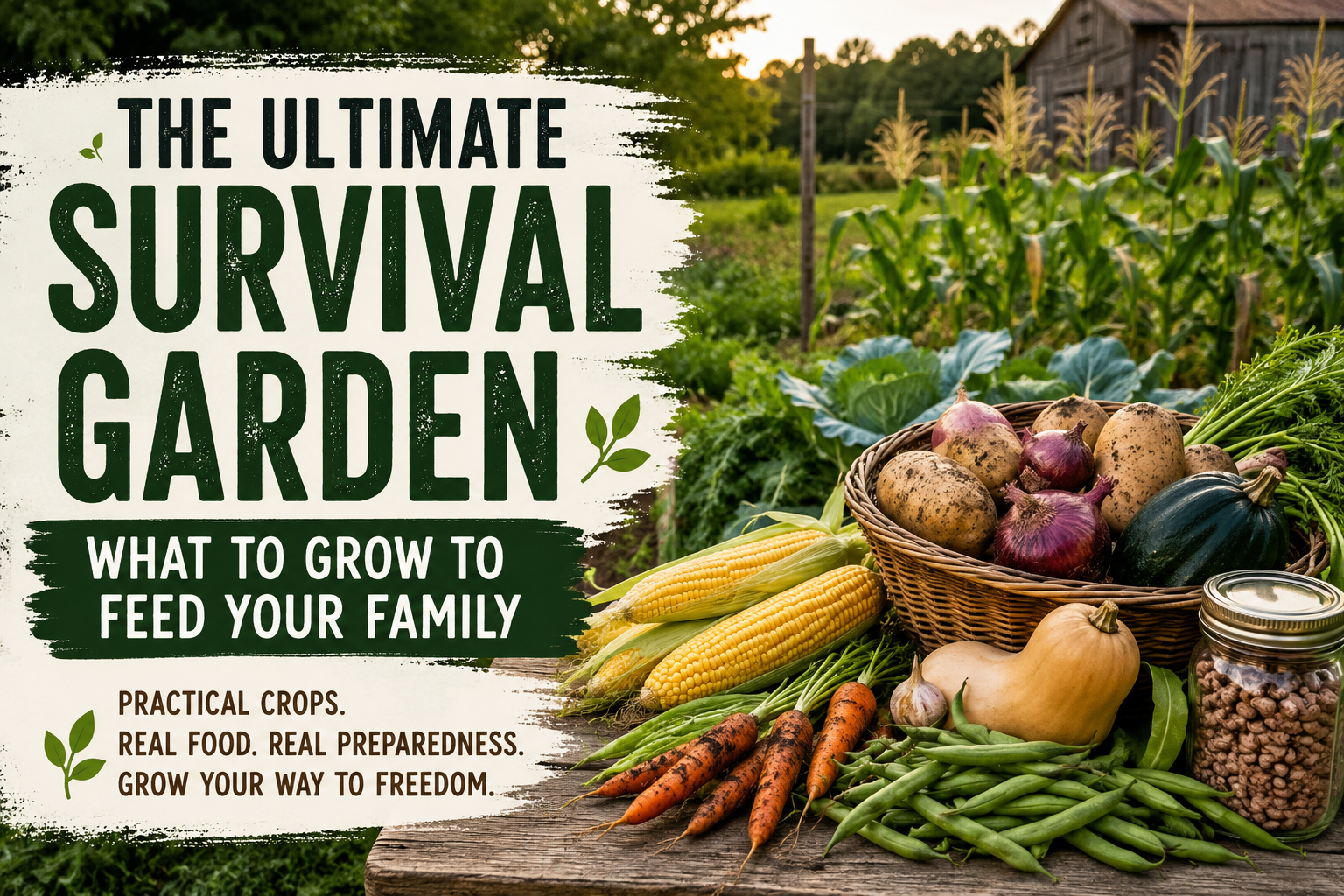
A few rows of potatoes. Some corn. A patch of winter squash. Tomatoes for canning. Onions and garlic hanging in storage.
And when those tomato plants produce more than you expected, here are 25 Things to Do With Too Many Tomatoes so that surplus can become meals, pantry staples, and preserved food instead of waste.
Little by little, those things add up.
One of my favorite things about gardening is that every year you learn something new. Every season gets you one step closer to being more self-sufficient, more confident, and more capable of producing food for your family.
In this post, we’re going to talk about the best crops to grow in a survival garden, the crops that are actually worth the space, and how to build a garden that does more than just look pretty in the summer.
What Is a Survival Garden?
Definition of a Survival Garden
So what actually is a survival garden?
At its core, a survival garden is a garden designed to help provide real food for your household.
Not just a couple salads in the summer.
Not just a few tomatoes for fun.
Not just decorative plants that look pretty for a few months.
A survival garden is focused on growing foods that can genuinely help feed your family.
That usually means focusing on crops that are:
- High producing
- Filling and calorie dense
- Easy to store
- Good for preserving
- Reliable growers
- Practical for your climate
Instead of asking:
“What would be fun to grow?”
You start asking:
“What foods would actually make the biggest impact for my family?”
That’s why survival gardens usually focus heavily on crops like:
- Potatoes
- Corn
- Beans
- Winter squash
- Onions
- Garlic
- Carrots
- Cabbage
These are the types of foods that can:
- Feed a family for months
- Be canned or preserved
- Store well through winter
- Lower grocery bills significantly
- Help create more food security over time
I think one of the biggest misconceptions is that a survival garden has to be huge.
It doesn’t.
Even a modest backyard garden can produce a surprising amount of food when you focus on the right crops.
A survival garden is really less about fear and more about resilience.
It’s about learning practical skills.
It’s about becoming a little more self-sufficient every year.
It’s about knowing how to grow food, preserve it, and provide for your family in a very real way.
And honestly? There’s something incredibly rewarding about that.
Survival Garden vs Hobby Garden
A lot of people think all gardens are basically the same, but there’s actually a pretty big difference between a hobby garden and a survival garden.
Neither one is “wrong” — they just have different goals.
| Hobby Garden | Survival Garden |
|---|---|
| Focused on fun, variety, or aesthetics | Focused on practical food production |
| Often grows trendy or specialty vegetables | Focuses on calorie-dense staple crops |
| Fresh eating is the main goal | Storage and preservation are major priorities |
| Usually smaller harvests | Focuses on high production and yield |
| Crops may spoil quickly | Crops are chosen for long-term storage |
| Decorative plants are common | Practicality matters most |
| May rely heavily on grocery stores still | Designed to reduce dependence on grocery stores |
| Often includes novelty plants | Usually includes potatoes, beans, corn, squash, onions, etc. |
| Gardening is mostly a hobby | Gardening becomes part of the household food system |
You do not have to completely overhaul your garden overnight to start moving toward more self-sufficiency.
Even adding a few practical storage crops each year can make a huge difference over time. If that’s one of your goals, start with my guide to the best vegetables for long-term food storage.
Why You Might Want to Start a Survival Garden
There are so many different reasons people decide to start a survival garden.
For some people, it’s about lowering grocery bills.
For others, it’s about healthier food.
For some, it’s connected to homesteading and wanting a simpler, more self-sufficient lifestyle.
For me, I think one of the biggest reasons is peace of mind.
There’s something really comforting about knowing you can step outside and grow real food for your family.
Even if you’re only producing a portion of your food at first, those skills add up over time.
You learn how to grow food.
You learn what stores well.
You learn how to preserve harvests.
And every year, you become a little more capable and a little more self-sufficient.
A survival garden does not have to be perfect or massive to make a difference.
Even a small garden can teach valuable skills while helping provide fresh, practical food for your household.
The Most Important Crops for a Survival Garden
When planning a survival garden, not all crops are equal.
Some vegetables are fun to grow but do not provide much food overall. Others can genuinely help feed your family, store for months, and reduce grocery costs in a very real way.
These are the crops I personally think are some of the most valuable to focus on in a survival garden.
| Crop | Why It’s Important | Storage Potential | Best Uses |
|---|---|---|---|
| Potatoes | One of the best calorie crops with huge yields | Excellent | Fresh eating, storage, livestock feed |
| Dry Beans | Great protein source and stores dry for years | Excellent | Soups, storage food, protein source |
| Corn | Calorie dense and useful for both humans and livestock | Very good | Cornmeal, feed, fresh eating |
| Winter Squash & Pumpkins | Heavy producers that store for months | Excellent | Baking, soups, livestock feed |
| Carrots | Nutrient dense and cold hardy | Excellent | Fresh eating, root cellar storage |
| Cabbage | Great cool-weather crop with fermentation potential | Very good | Sauerkraut, fresh eating, storage |
| Garlic & Onions | Essential pantry staples with long storage life | Excellent | Cooking, seasoning, storage |
One thing you’ll probably notice is that most survival garden crops have a few things in common:
- They produce heavily
- They store well
- They are versatile in cooking
- They can help feed a family long term
A survival garden is less about growing the trendiest vegetables and more about growing the crops that give you the biggest return for the space and effort you put in.
What Makes a Survival Garden Successful?
A successful survival garden is not about having the biggest garden.
It’s not about growing every crop imaginable.
And it’s definitely not about being perfect.
A successful survival garden is about growing practical food consistently and learning how to make the most of what you produce.
Here are some of the biggest things that make a survival garden actually successful long term.
Focus on Storage & Preservation
Growing food is only half the battle.
If everything spoils at the end of summer, you still end up relying heavily on the grocery store all winter.
That’s why preservation becomes such a huge part of survival gardening.
A lot of the best survival garden crops are chosen specifically because they store well or preserve well. If you are deciding what should go into jars for long-term pantry storage, my 25 best foods to pressure can guide covers vegetables, meat, broth, soups, and other useful staples.
Some of the most useful preservation methods include:
- Canning
- Drying
- Root cellaring
- Freezing
- Fermenting
Even learning one or two preservation skills each year can make a huge difference over time. If you have a pear tree or access to a big fall harvest, these 25 ways to use too many pears include canning, dehydrating, fruit leather, pear butter, baking, and more.
Grow What Your Family Actually Eats
This is a big one.
A survival garden should be practical for YOUR household.
There’s no point growing massive amounts of food your family will not actually eat.
It’s easy to get caught up in trendy crops or growing what everyone else online is growing.
But realistically, the best survival garden is one built around foods your household already uses regularly.
Build Gradually
One of the biggest mistakes people make is trying to become fully self-sufficient overnight.
That usually leads to burnout.
A survival garden is something you build over time.
Every year you learn:
- What grows well in your climate
- What stores well
- What your family actually eats
- What preservation methods work best for you
You do not need to start with a massive garden.
Even adding:
- A potato row
- A few storage crops
- One preservation method
- A small corn patch
…can make a meaningful difference.
Little by little, your garden and your skills grow together.
Improve Soil Every Year
Healthy soil is one of the biggest keys to a productive survival garden.
A lot of survival gardening is really just learning how to build healthy, fertile soil over time.
The better your soil becomes, the easier it is to:
- Grow productive crops
- Retain moisture
- Reduce fertilizer needs
- Improve plant health
Some of the best ways to improve soil include:
- Compost
- Animal manure
- Mulching
- Crop rotation
- Cover crops
Honestly, good soil makes everything easier.
A healthy survival garden starts from the ground up.
Common Survival Garden Mistakes
One of the biggest things I’ve learned about gardening is that it’s really easy to get overly ambitious in the beginning.
A lot of us start out wanting the perfect homestead garden right away.
We want:
- Tons of food
- Perfect rows
- Every vegetable imaginable
- Full self-sufficiency immediately
But survival gardening is a learning process.
And honestly, most mistakes are completely normal.
A lot of them are just part of learning what works for your climate, your space, and your family.
Here are some of the most common survival garden mistakes I see people make.
Growing Only Summer Vegetables
This is probably one of the biggest mistakes beginner gardeners make.
A lot of people fill their gardens with things like lettuce, cucumbers, zucchini, and tomatoes.
And while those crops are great, they are not usually the backbone of a survival garden.
A survival garden needs crops that can actually help feed your family long term.
That means prioritizing things like:
- Potatoes
- Dry beans
- Corn
- Winter squash
- Storage onions
- Cabbage
Summer vegetables definitely still have a place, but if your entire garden is made up of crops that spoil quickly, it becomes harder to rely on it as a true food-producing system.
Forgetting Storage Foods
A lot of people focus heavily on fresh eating without thinking about winter.
But one of the biggest goals of a survival garden is extending your harvest beyond the growing season.
Without storage crops, you end up producing food for only a short window of the year.
Planting Too Much at Once
This is SUCH a common mistake.
It’s easy to get excited and suddenly decide you’re going to grow every crop imaginable your first year.
But huge gardens can become overwhelming very quickly.
Especially once:
- Weeding starts
- Harvest season hits
- Preservation season begins
- Everything ripens at once
A smaller, manageable garden that is well maintained will almost always outperform a massive garden that burns you out.
Honestly, survival gardening works best when you build gradually.
Add more each season.
Learn new preservation methods slowly.
Figure out what grows best for you.
That approach is usually much more sustainable long term.
Final Thoughts
At the end of the day, a survival garden does not have to be perfect to make a real difference.
You do not need acres of land.
You do not need to grow 100% of your food.
And you definitely do not need to learn everything overnight.
Even a small backyard garden can teach incredibly valuable skills.
Every season you learn:
- How to grow food
- What works in your climate
- What stores well
- How to preserve harvests
- What your family actually uses
And little by little, those skills build confidence.
I think that’s one of the most rewarding parts of gardening.
You start realizing just how much food you really can produce yourself.
A few potato rows turn into a pantry shelf full of food.
A patch of onions turns into months of storage.
A few preservation skills start creating a more self-sufficient household over time.
A survival garden is really less about fear and more about resilience.
It’s about learning practical skills, becoming more capable every year, and creating a garden that does more than just look pretty for a few months.
Start where you are.
Grow what makes sense for your family.
Learn little by little.
That’s how most successful survival gardens begin.
What’s Next?
If you’ve been thinking about starting a survival garden, my biggest advice is to just start.
You do not need to grow everything at once.
Even learning how to grow a few practical crops like potatoes, onions, squash, or corn can teach you valuable skills while helping lower grocery costs over time.


Post your Comment About This Product