
If you are getting started raising rabbits, it is surprisingly easy to spend way more money than you need to.
Rabbit water bottles. Rabbit hay feeders. Rabbit nesting boxes. Rabbit toys. Tiny bags of hay labeled specifically for rabbits.
Before long, you can have hundreds of dollars invested in supplies before you have even brought your rabbits home.
But do rabbits actually need all of that?
Recently, I talked with Sarah from Fish or Price Ranch on my Homestead Hangout about raising rabbits. Sarah has years of experience raising and breeding rabbits, including Flemish Giants, Rex rabbits, and her own breeding projects.
At one point, I asked her what rabbit supplies she had purchased over the years that she considered a waste of money.
Her answer?
“Almost everything.”
And honestly, the more we talked about it, the more sense it made.
You absolutely need good housing, food, clean water, and safe equipment for your rabbits. But that doesn’t necessarily mean everything you buy has to have the word rabbit printed on the package.
Here are some of the rabbit supplies you may be able to skip — and cheaper alternatives that may work just as well.
1. You Probably Don’t Need Tiny Bags of “Rabbit Hay”
One of the easiest places to overspend is hay.
Walk into the pet section of almost any store and you’ll find small bags of hay marketed specifically for rabbits.
If you only have one pet rabbit, buying a small bag might be convenient.
But if you’re raising several rabbits — especially if you’re building a small homestead rabbitry — those bags can get expensive quickly.
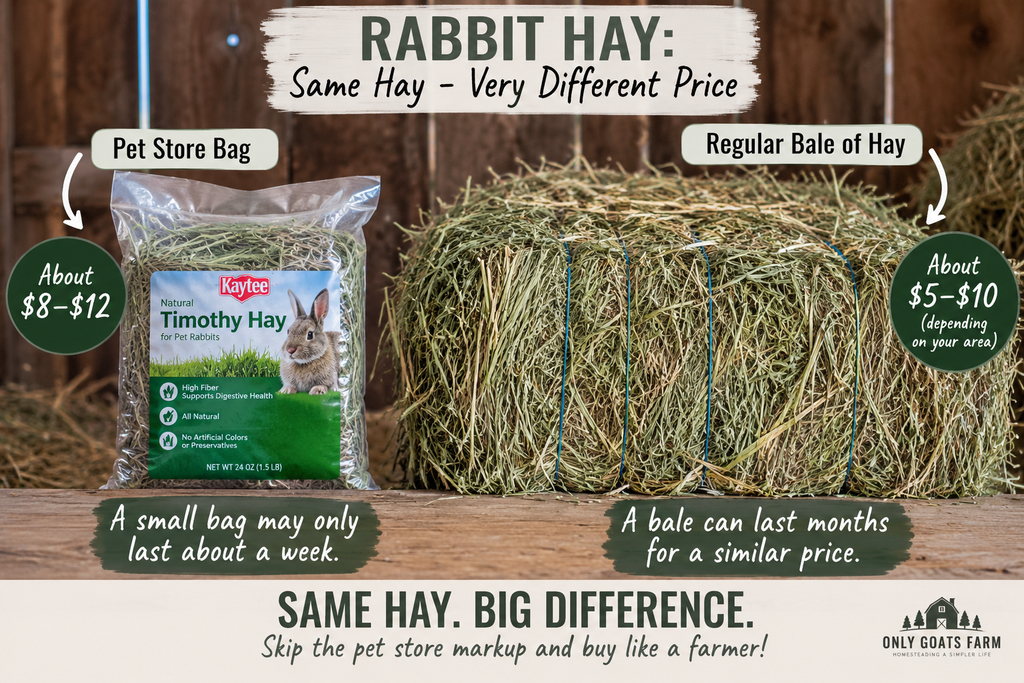
Sarah recommends buying a regular bale of hay instead.
During our conversation, she explained that a small package of rabbit hay might only last a rabbit around a week, while a full bale can last much longer for a similar amount of money depending on local hay prices.
That was one of those obvious-in-hindsight homesteading lessons.
Instead of shopping in the pet aisle, shop like you’re feeding livestock.
Just Make Sure You Can Store It
If you buy hay by the bale, you’ll need somewhere dry to store it.
You don’t want your hay sitting outside getting wet or developing mold.
A barn, shed, covered hay storage area, or other dry location makes buying hay in larger quantities much easier.
And if you raise goats, sheep, horses, or other livestock already, you may already be buying hay this way anyway.
2. You May Not Need an Expensive Rabbit Hay Feeder
This one was interesting because I actually use hay feeders in my rabbitry.
I’ve made my own using inexpensive metal shelving and other materials rather than buying expensive rabbit-specific feeders.
But when I asked Sarah how she keeps her rabbits from wasting hay, her answer was simple:
They’re going to waste some.
Her approach is generally to put hay directly in the rabbit’s space instead of adding another feeder.
She explained that some types of feeders can create their own problems, including areas where animals can potentially get caught or places where hay becomes contaminated.
That doesn’t mean a hay feeder is automatically bad.
I still think there are situations where they make sense.
But it does mean you probably don’t need to rush out and buy a $20 or $30 rabbit hay feeder before your rabbits arrive.
Try the simple solution first.
If you decide you want a hay rack later, you can buy one — or build your own.
3. Rubber Livestock Bowls Can Replace Rabbit Water Bottles
This may have been my favorite tip from our conversation.
I currently use rabbit water bottles in my rabbitry, although I have already had one rabbit who simply refused to drink from one.
And living in Western New York means I also have another problem to think about:
winter.
My rabbitry is inside my barn, but the barn isn’t heated. That means frozen water is going to be part of rabbit care during the coldest part of the year.
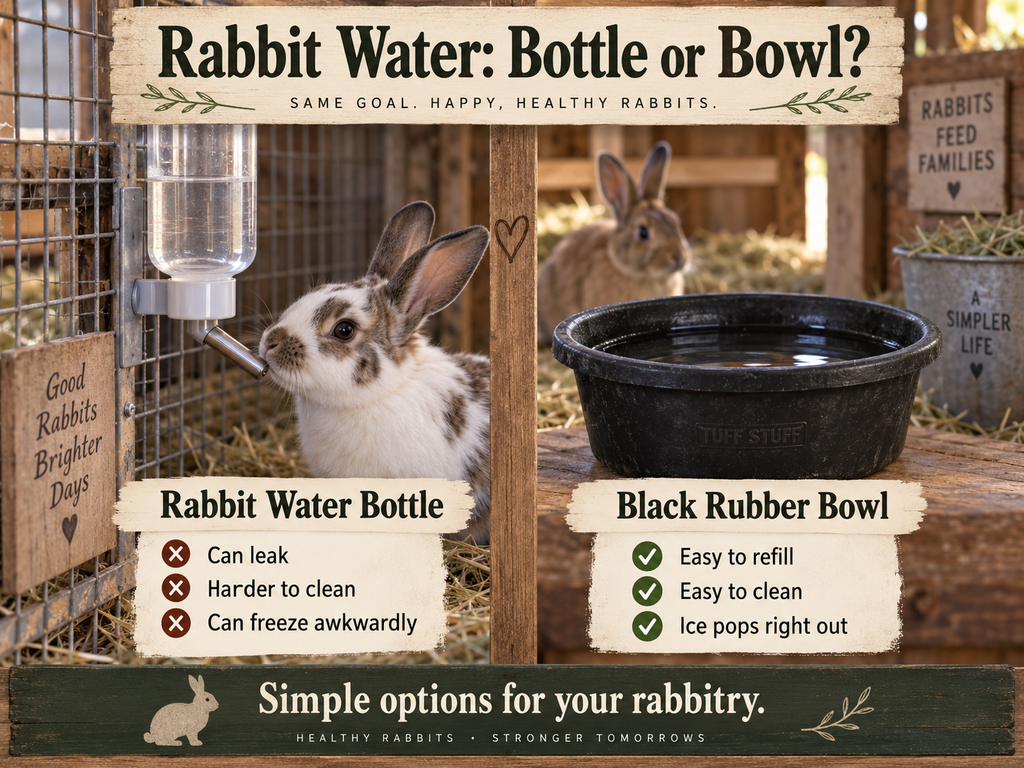
Sarah told me that instead of rabbit bottles, she uses the flexible black rubber livestock bowls sold at farm stores.
When the water freezes, she can flip the bowl upside down and flex it to pop the ice out. If it is really frozen, she lets the dark bowl sit in the sun for a few minutes until the ice releases.
She also said some of her bowls have lasted for years.
That is something I plan to experiment with in my own rabbitry this winter.
A flexible rubber bowl may cost less than a rabbit water bottle, may be easier to clean, and could potentially make dealing with frozen water easier.
I’ll be testing that theory when Western New York winter arrives.
4. You Don’t Necessarily Need a $30 Rabbit Nest Box
If you are breeding rabbits, eventually you’re going to need nest boxes.
And like many livestock supplies, the moment something gets marketed specifically for rabbits, the price can jump.
You can find commercially made rabbit nest boxes for $20, $30, $40, or more depending on the style and material.
Sarah uses something much simpler:
plastic organizer baskets.
Yes — the kind you can find at places like Dollar Tree or Walmart.
She explained that the important part is choosing a basket large enough for your breed of rabbit and allowing appropriate airflow.
For a larger breed like a Flemish Giant, obviously you’re going to need something much larger than you would for a small rabbit.
But the container doesn’t necessarily need to be sold as a “rabbit nesting box.”
5. Plastic Nest Boxes May Be Easier to Clean Than Wood
Sarah previously used wooden nesting boxes but eventually switched to plastic.
Her reasoning was cleanliness.
Wood is difficult to thoroughly sanitize because moisture and waste can soak into the material.
Plastic can be scrubbed and cleaned between litters.
Sarah said that in her own rabbitry, she saw fewer problems with nest-box eye after switching from wood to plastic.
That’s one of the reasons inexpensive plastic baskets work well for her setup.
They’re cheap.
They’re washable.
And if one gets damaged or becomes difficult to clean, replacing it doesn’t cost much.
What About Cardboard Boxes?
I’ve actually used a cardboard box as an emergency nest box before.
We purchased rabbits at an auction and didn’t know one of the does was pregnant.
Then one day we walked into the barn and found baby rabbits on the wire.
I gathered the babies, fur, and nesting material and placed everything into a cardboard box.
It wasn’t fancy.
But it worked.
At least initially.
Later, after receiving advice online, I switched them into a metal nest box — and unfortunately, we ended up losing the litter.
That experience made me much more open to the idea that the most expensive or “correct” commercial product isn’t automatically the best solution for every rabbitry.
Sarah pointed out that cardboard can work temporarily, although it eventually becomes soiled and has to be replaced.
If you constantly have shipping boxes around your house, that may not be difficult.
Still, a washable plastic basket gives you something permanent that can be reused.
6. Think Twice Before Buying a Prefab Rabbit Hutch
Those little wooden rabbit hutches at farm stores look adorable.
Unfortunately, cute doesn’t always mean practical.
Sarah pointed out something that also drives me crazy about many prefab chicken coops:
They’re difficult to clean.
Some of these hutches have doors big enough for the rabbit to enter but not large enough for a person to comfortably reach the entire interior.
That can make cleaning much harder than it needs to be.
I’ve had a similar experience with prefab chicken coops.
I had one that lasted about two winters before it started falling apart.
Meanwhile, we’ve built structures ourselves using inexpensive or free materials that lasted much longer.
Before spending several hundred dollars on a rabbit hutch, ask yourself:
- Can I easily reach every part of it?
- Can I clean it thoroughly?
- Is it predator resistant?
- Will it survive my climate?
- Is there enough ventilation?
- Is it large enough for the breed I’m raising?
- Could I build something more functional for the same amount of money?
A rabbit hutch doesn’t have to look like something from Pinterest.
It needs to work.
7. Rabbit Enrichment Doesn’t Have to Be Expensive
Rabbits do need things to do.
Sarah described them as problem solvers and talked about giving her rabbits simple enrichment such as branches, pinecones, and inexpensive cat toy balls.
Again, none of those things need to be marketed as special “rabbit toys.”
Safe branches can give rabbits something to chew.
Simple toys can give them something to move around.
The goal is enrichment — not buying the cutest package in the pet aisle.
So What Do Rabbits Actually Need?
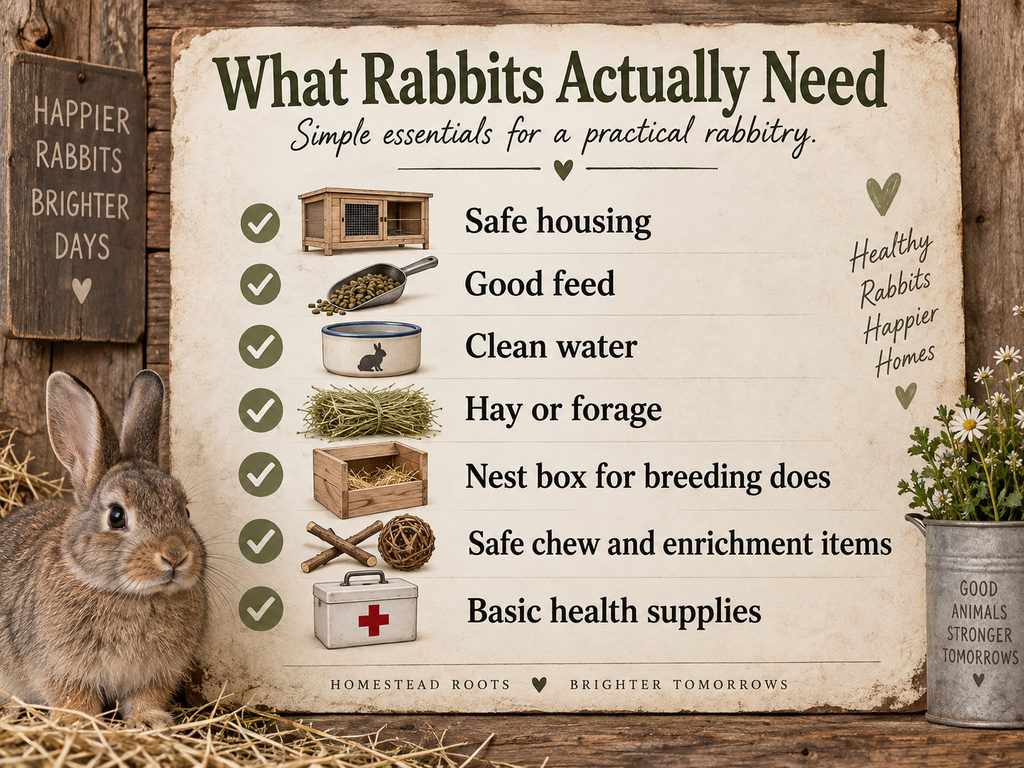
If I were putting together a very basic rabbit setup, I would focus my money on the things that actually affect the rabbits’ quality of life.
Safe Housing
Your rabbits need protection from predators, weather, excessive heat, moisture, and other hazards.
Housing is one area where I would rather spend money on something strong and functional than spend money on something pretty.
Good Feed
A quality rabbit pellet is one of the main recurring expenses you’ll have.
Depending on how you raise your rabbits, you may also provide hay, forage, branches, or other appropriate foods.
Clean Water
Whether you use bottles, bowls, an automatic watering system, or something else, your rabbits need reliable access to clean water.
Choose the watering system that works best in your climate and with your rabbitry setup.
A Nest Box for Pregnant Does
If you’re breeding rabbits, your does will need an appropriate nest area before they give birth.
Sarah typically puts her nest boxes in around day 28 of pregnancy and notes that rabbit gestation generally runs roughly 28 to 32 days in her experience.
The nest box doesn’t necessarily have to be expensive.
It just needs to be appropriately sized, safe, and something you can keep clean.
Something to Chew and Explore
Rabbits are intelligent animals.
Simple enrichment can go a long way.
Branches, safe natural materials, and inexpensive toys can all potentially provide stimulation without spending a fortune.
The Biggest Rabbit-Supply Mistake Beginners Make
The biggest mistake isn’t necessarily buying one particular feeder or one particular hutch.
It’s assuming that every product marketed for rabbits is something your rabbits actually need.
During our conversation, I joked that if you put the word rabbit on a $1 plastic basket, suddenly somebody would sell it as a $20 rabbit nesting box.
And that’s really the point.
Sarah described her approach as finding inexpensive things that work even when they weren’t originally designed specifically for rabbits.
That mindset applies to almost everything on a homestead.
Before buying something, ask:
What problem am I actually trying to solve?
Then find the simplest, safest way to solve it.
Sometimes that means buying the rabbit-specific product.
Sometimes it means building something yourself.
And sometimes it means walking past the pet aisle and buying a $5 rubber bowl instead.
Start Simple and Upgrade Later
If you’re just getting started with rabbits, you don’t need the perfect rabbitry on day one.
Start with the essentials.
Learn what works.
Pay attention to what annoys you about your setup.
Then upgrade the things that actually need upgrading.
That’s exactly what I’m doing with my own rabbitry.
I’m still experimenting with cage setups, watering systems, hay feeders, nest boxes, and winter management.
Some of the ideas Sarah shared are things I already do.
Others — like using flexible rubber bowls for winter water — I’m going to test myself.
Because that’s really what homesteading is.
You learn from other people.
You try things.
You figure out what works on your farm.
And hopefully, you don’t spend $20 on something you could have bought for $1.
What rabbit supply did you buy that turned out to be completely unnecessary?
I’d love to hear what you would skip if you were starting your rabbitry over again.
Read more about rabbit setup ideas


Post your Comment About This Product