
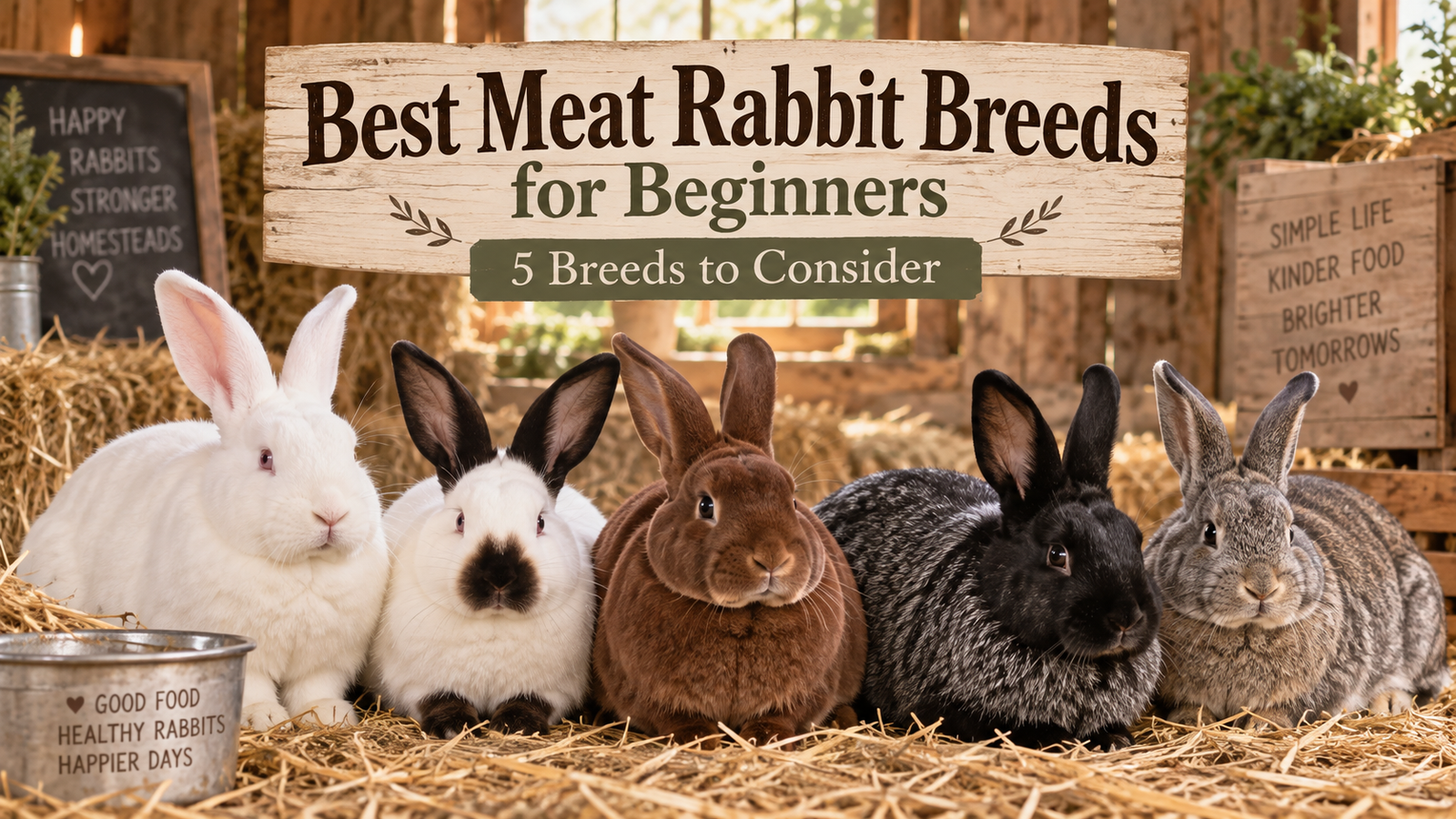
If you’re thinking about raising rabbits for meat, choosing your breed is one of the most important decisions you’ll make.
And one of the biggest mistakes beginners can make is assuming:
The biggest rabbit must produce the most meat.
That sounds logical.
A 15-pound rabbit should be better for the freezer than a 10-pound rabbit, right?
Not necessarily.
Recently, I had Sarah from Fish or Price Ranch join me for an episode of the Homestead Hangout to talk about raising rabbits. She has years of experience with rabbits, including breeding and showing Flemish Giants and Rex rabbits.
When I asked what she wished beginners knew before starting meat rabbits, her answer was simple:
Learn your breeds.
Different rabbit breeds grow at different rates, carry different amounts of meat on their frame, have different feed requirements, and may offer additional benefits such as valuable fur.
So if you’re trying to choose the best meat rabbit breed for your homestead, don’t shop based on size or cuteness alone.
Here’s what I would consider instead.
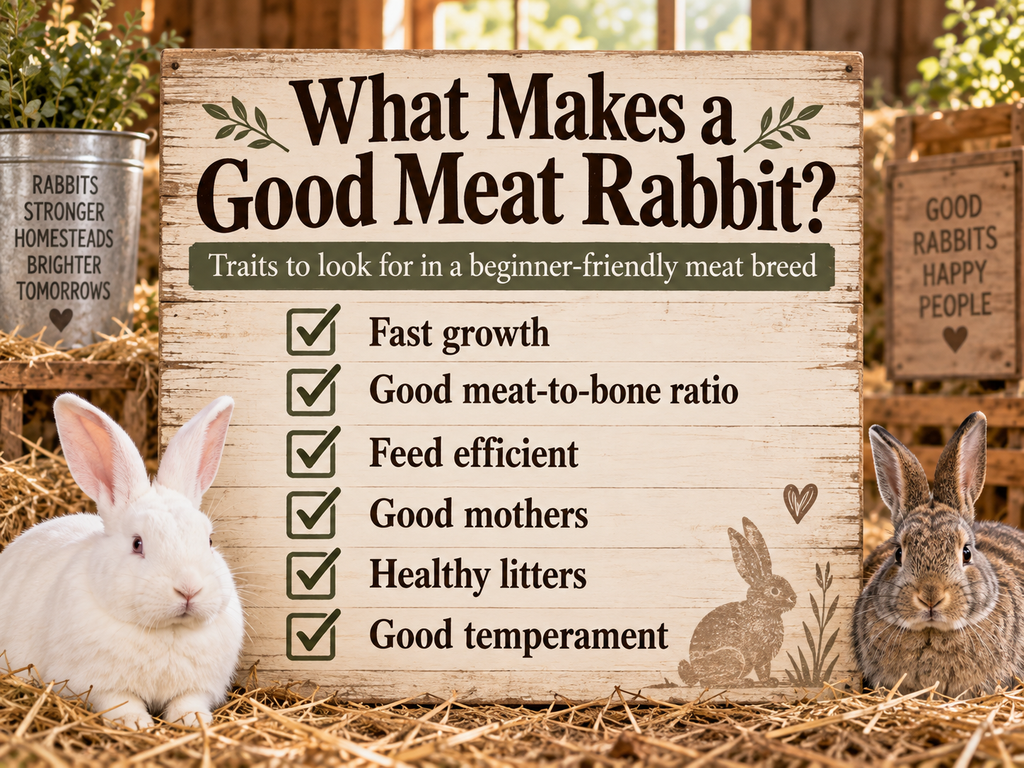
What Makes a Good Meat Rabbit Breed?
Before comparing individual breeds, it helps to understand what you’re actually looking for.
A good meat rabbit isn’t simply a large rabbit.
For a homestead meat program, I would look at:
- Growth rate
- Meat-to-bone ratio
- Feed efficiency
- Adult size
- Litter size
- Mothering ability
- Temperament
- Health and hardiness
- Availability of good breeding stock in your area
- Whether you also want to use the fur
You also need a rabbit that works with your particular setup.
Housing, climate and available space matter, too.
If you’re still working out how you’ll house your rabbits, my guide to different rabbitry setup ideas walks through hanging cages, stacked cages, racks, hutches, tractors and colony setups.
Choosing the right breed and choosing the right setup really go hand in hand.
1. New Zealand Rabbits
If someone told me they wanted to start raising rabbits primarily for meat and had absolutely no idea which breed to buy, New Zealands would be one of the first breeds I would investigate.
Despite the name, the breed was developed in the United States.
New Zealands are one of the classic commercial meat rabbits.
They have the type of body we’re looking for in a meat rabbit: a substantial, well-filled frame rather than simply a large skeleton covered in rabbit.
They’re also widely available compared with some of the more unusual meat breeds, which can make it easier for a beginner to find unrelated breeding stock.
Why New Zealands are good for beginners
Pros:
- Bred heavily for meat production
- Good commercial body type
- Common enough that breeding stock may be easier to find
- Available in several colors
- Good choice for a dedicated meat program
- Commonly crossed with Californians
New Zealand Whites in particular have been a standard commercial meat rabbit for decades.
Penn State Extension identifies medium-sized New Zealand Whites as a top meat-production choice, followed by Californians.
Potential downside
Because they are so common, quality varies enormously.
A rabbit being called a New Zealand doesn’t automatically make it great meat stock.
Ask the breeder questions.
How quickly do their kits grow?
What age do they normally process?
What do their fryers weigh at that age?
How large are the litters?
How well do the does raise their babies?
I’d rather buy good meat genetics from a knowledgeable breeder than buy the cheapest New Zealand rabbits I could find.
2. Californian Rabbits
Californians are another classic choice for meat production and probably belong right beside New Zealands on a beginner’s shortlist.
They’re the white rabbits with the darker ears, nose, feet and tail.
Californians were developed as a commercial breed and have long been used for meat.
They’re generally a medium-sized rabbit, which is actually an advantage.
Remember:
We aren’t trying to produce the biggest adult rabbit possible.
We’re trying to efficiently produce a well-muscled rabbit in a reasonable amount of time.
Why Californians are good meat rabbits
Pros:
- Excellent commercial body type
- Well established as a meat breed
- Moderate adult size
- Frequently used in commercial production
- Can be crossed with New Zealands
The American Rabbit Breeders Association also identifies New Zealand Whites and Californians as the two most popular meat breeds and notes that New Zealand/Californian crossbred fryers are used in commercial production.
That makes these two breeds a very logical place for beginners to start.
3. Rex Rabbits
Rex rabbits become especially interesting if you don’t want meat to be the only usable product from your rabbits.
This was Sarah’s choice when she moved into meat rabbits.
She liked the Rex because she wanted the fur, too.
And if you’ve ever touched a Rex, you understand why.
Their coat has a short, incredibly soft, almost velvet-like texture.
Rex are particularly well known for fur production, and standard Rex can also provide a useful homestead-sized carcass.
Why choose Rex rabbits?
Pros:
- Meat plus high-quality fur
- Medium size
- Beautiful range of colors
- Useful for a more whole-animal homestead approach
- Established breed with plenty of dedicated breeders
For someone who wants to eventually tan pelts, make crafts, or simply use more of each animal, I think Rex are worth considering.
The American Rabbit Breeders Association describes the Rex coat as a short, dense, velvet-like fur and notes the breed’s importance in fur production.
Are Rex the best if you only want meat?
Maybe not necessarily.
If your only goal is producing efficient freezer rabbits, I’d probably compare available Rex stock against good New Zealand and Californian lines before deciding.
But if fur matters to you?
Rex become much more appealing.
4. Silver Fox Rabbits
Silver Fox rabbits are another breed Sarah mentioned during our conversation, and they’re especially interesting for homesteaders.
They’re a larger, distinctly American heritage breed developed for both meat and fur.
Their coat is unusual because when the fur is brushed backward, it can stand upright rather than immediately falling back into place.
They’re also known for having a relatively calm temperament.
Why Silver Fox rabbits make sense on a homestead
Pros:
- Meat and fur
- Large commercial-type body
- Generally docile temperament
- Attractive heritage breed
- Good option for people who want something besides the most common commercial breeds
The Livestock Conservancy lists Silver Fox as useful for meat, fur, pets and exhibition, with adult rabbits reaching roughly 11 to 12 pounds. It also rates them as appropriate for novice keepers.
If you want a meat rabbit that’s a little less ordinary than a New Zealand or Californian, I’d put Silver Fox high on the list.
5. Champagne d’Argent
Champagne d’Argents are another traditional meat breed worth knowing about.
They’re striking rabbits.
Young rabbits are born dark and gradually develop the characteristic silvery appearance as they mature.
They’re an old breed with a long history of being raised for meat.
Why consider Champagne d’Argents?
Pros:
- Traditional meat breed
- Medium-to-large size
- Attractive coat
- Useful for homesteaders interested in heritage breeds
- Another option if good New Zealand or Californian stock isn’t available locally
Penn State includes Champagne d’Argents among commercial rabbit breeds used for meat production.
I wouldn’t necessarily drive across three states to get one just because it’s a Champagne.
Again, quality of the actual breeding line matters more than the name printed on the pedigree.
A fantastic local line of New Zealands is probably more useful than mediocre stock from a breed you chose simply because it sounded interesting.
What About Flemish Giants for Meat?
This is where Sarah’s experience got particularly interesting.
She loves Flemish Giants.
She raised all seven colors and showed them successfully.
And initially, she had the same thought many beginners have:
They’re huge. They must be fantastic meat rabbits.
But she eventually found that Flemish Giants weren’t the best option for what she wanted.
And this is exactly why adult size can be misleading.
A giant rabbit has to grow:
- A larger skeleton
- Larger organs
- More overall body
- And eventually the meat you’re trying to produce
That can mean more time and feed before you reach your goal.
Flemish Giants absolutely can be eaten, and they have historically been used for meat.
But if your main goal is efficient meat production, I’d look carefully at a standard commercial meat breed before choosing a giant simply because of its mature weight.
For most beginners, bigger isn’t automatically better.
Should You Cross Meat Rabbit Breeds?
You don’t necessarily have to raise purebred rabbits for your freezer.
Crossbreeding can actually make a lot of sense in a production program.
Sarah talked about liking crosses because combining two carefully selected breeds can potentially give you useful traits from both.
One of the most familiar examples is crossing New Zealand and Californian rabbits.
The goal isn’t to randomly breed rabbits together and hope something magical happens.
You should still be selecting for things that matter:
- Fast growth
- Healthy kits
- Strong feet and legs
- Good mothering
- Large litters
- Good body type
- Feed efficiency
- Temperament
- Overall vigor
Keep records.
If one doe consistently raises big, healthy litters that grow quickly, that’s information you want.
If another rabbit consistently has health problems, produces poorly, or doesn’t raise kits well, that’s information too.
The breed gives you a starting point.
Your selection decisions build the actual meat-rabbit line.
Purebred vs Crossbred: Which Should Beginners Choose?
There’s nothing wrong with either.
Choose purebred rabbits if:
- You want pedigreed breeding stock
- You may eventually show
- You want to sell breeding animals
- Preserving a particular breed matters to you
- You want predictable breed characteristics
Consider crosses if:
- Your main focus is freezer production
- You’re selecting specifically for performance
- You have access to quality animals from complementary breeds
- Pedigrees and showing aren’t important to your goals
You can also maintain purebred breeding animals and produce crossbred grow-outs for meat.
There isn’t one correct system.
Start With Good Rabbits, Not Lots of Rabbits
Another piece of advice from my conversation with Sarah was to start small.
You don’t need twenty rabbits immediately.
Starting with a small number gives you time to learn:
- Feeding
- Watering
- Cleaning
- Breeding
- Nest boxes
- Kit care
- Record keeping
- Processing
- How much rabbit your family actually eats
It also gives you time to figure out whether you even like raising rabbits before building a giant rabbitry.
Rabbits reproduce quickly enough that your numbers can increase later.
Trust me.
You do not need help accumulating animals on a homestead.
They handle that part surprisingly well on their own.
How to Choose Your First Meat Rabbits
Once you’ve picked a breed, don’t buy the first rabbits that appear on Facebook Marketplace.
Try to find someone who is actually breeding toward goals similar to yours.
Ask:
How old are the parents?
What do they weigh?
How many kits do the does usually have?
How many do they successfully raise?
At what age do you normally process the offspring?
What do they weigh at processing age?
Have you had recurring health problems in the line?
How long have you been working with this stock?
And, whenever possible, I’d rather see the rabbitry.
You can learn a surprising amount by seeing how someone keeps their animals.
Look at the adult rabbits.
Look at their feet.
Look at their body condition.
Look at the cages.
Look at the babies.
A fancy pedigree doesn’t compensate for unhealthy animals or poor breeding decisions.
Which Meat Rabbit Breed Is Best for Beginners?
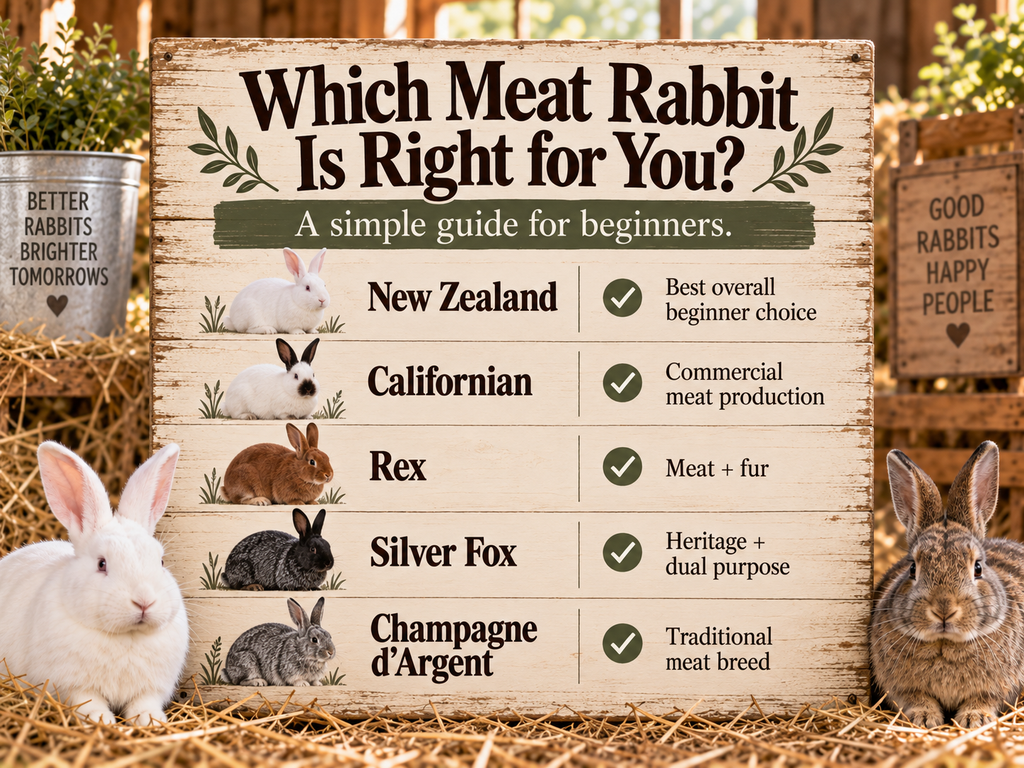
If I had to simplify everything into a quick recommendation:
Best overall beginner meat rabbit:
New Zealand
Another excellent commercial meat choice:
Californian
Best if you want meat AND excellent fur:
Rex
Best heritage/dual-purpose option:
Silver Fox
Another traditional meat breed worth considering:
Champagne d’Argent
And if you’re considering Flemish Giants solely because they’re enormous, I’d compare them carefully against the growth and production of standard meat breeds before making your decision.
Your best rabbit may also depend on what excellent stock is actually available near you.
A well-selected rabbit from a proven meat line beats choosing a breed based entirely on an internet list.
Don’t Forget the Rabbitry
Breed selection is only one piece of the puzzle.
Before bringing rabbits home, you also need a system for:
- Housing
- Predator protection
- Feed
- Hay or forage
- Water
- Manure management
- Breeding
- Nest boxes
- Grow-out space
If you’re still planning that part, start with my Rabbitry Setup Ideas guide before purchasing cages or building your rabbit area.
And if part of your long-term goal is making your homestead produce some income instead of constantly eating it, rabbits are also one of the livestock options I discuss in my 10 Ways to Make Money on the Homestead.
Final Thoughts
The biggest takeaway from my conversation with an experienced rabbit breeder wasn’t that everyone should buy one particular breed.
It was:
Know what you’re buying and why you’re buying it.
If your goal is meat, select rabbits that efficiently produce meat.
If you want fur, factor that into your decision.
If you want pedigreed breeding stock, choose accordingly.
And don’t assume that the largest rabbit is automatically the best meat rabbit.
New Zealands, Californians, Rex, Silver Fox and several other breeds can all work well on a small homestead.
The best one is the breed — and more importantly, the specific breeding line — that fits your goals, your setup and the way you want to raise your food.
What meat rabbit breed are you raising — or which one are you considering? Leave a comment below. I’d love to hear what’s working in other homestead rabbitries.


Post your Comment About This Product