
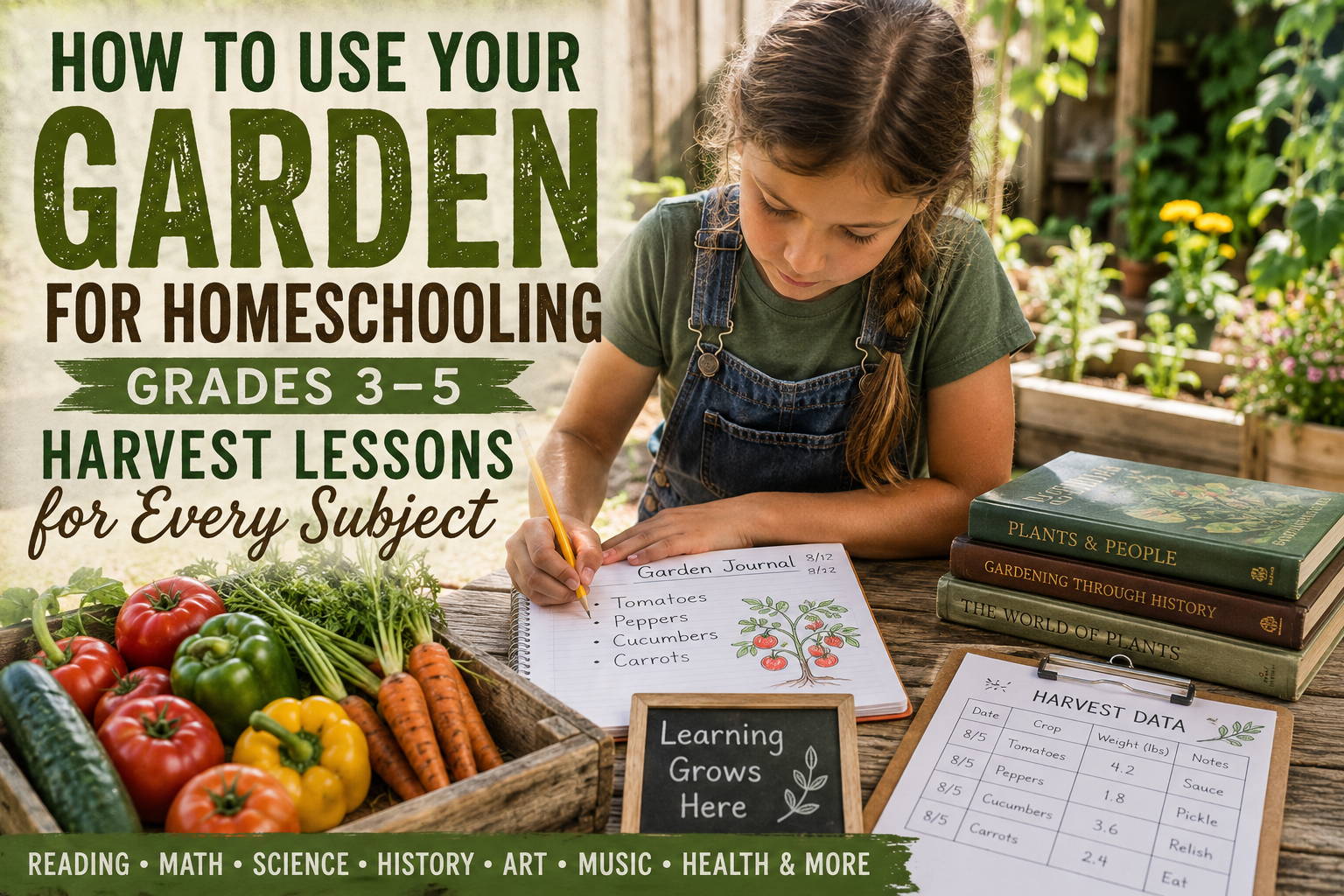
A garden can become one of the most useful learning spaces available to a homeschool family. By the time children reach third through fifth grade, they are ready to do much more than count vegetables or label the parts of a plant. They can collect and analyze data, conduct controlled experiments, research the history of crops, calculate farm-stand profits, write reports, design garden improvements, and explain how the garden functions as an ecosystem.
Harvest season is especially useful because children can see the results of months of work. Every basket of vegetables presents opportunities for reading, writing, mathematics, science, social studies, art, music, health, and physical education.
These activities are designed for grades 3–5 and include ways to adjust the difficulty for each grade. They are connected to Common Core State Standards, Next Generation Science Standards, the C3 Framework for Social Studies, National Core Arts Standards, and SHAPE America standards.
A Note About Educational Standards
Common Core provides grade-specific standards for English language arts and mathematics. Science activities in this unit are connected to the Next Generation Science Standards, while social studies activities use the C3 Framework. Art, music, health, and physical education are connected to their respective national frameworks.
These frameworks can help you document what your child is learning, but they are not a complete curriculum or a replacement for your state’s homeschool requirements. Use the standards as planning tools and adapt the lessons to your child’s ability, interests, and current studies.
1. English Language Arts: Research, Write, and Present a Garden Topic
Older elementary students can move beyond simple garden observations and begin using the garden as the basis for research and explanatory writing.
Have your child choose one garden question to investigate.
Possible questions include:
- Why do tomatoes split?
- How do bees help the garden?
- What causes blossom-end rot?
- How does compost improve soil?
- Why do some vegetables grow better in cool weather?
- What is the best way to store a particular crop?
- How do gardeners protect plants from frost?
- What is the life cycle of a squash plant?
- How are pickles made?
- Why do leaves change color in fall?
The child can gather information from books, extension publications, seed packets, garden observations, interviews, and reliable websites.
After completing the research, have the child create an informational piece with a clear topic, organized sections, facts, definitions, and a conclusion.
Third Grade
A third grader can write several organized paragraphs explaining the topic.
Encourage the child to include:
- A clear introduction
- Facts gathered from at least two sources
- Domain-specific words
- A labeled drawing or diagram
- A concluding sentence
This supports W.3.2, which addresses informative and explanatory writing, and W.3.7, which introduces short research projects that build knowledge about a topic.
Fourth Grade
A fourth grader can organize the report with headings and connect ideas using words such as because, therefore, for example, and as a result.
The child could also compare two sources and explain which one provided clearer or more useful information.
This connects with W.4.2, W.4.7, and informational-reading skills that require students to explain ideas using details and examples from a text.
Fifth Grade
A fifth grader can combine information from several sources, quote or paraphrase accurately, include charts or photographs, and present a more developed conclusion.
This supports W.5.2, W.5.7, and RI.5.9, which asks students to integrate information from multiple texts on the same topic.
Write a Harvest How-To Guide
Another option is to have the child write instructions for a real garden task.
Possible topics include:
- How to harvest potatoes
- How to save bean seeds
- How to prepare a garden bed for winter
- How to freeze peppers
- How to make refrigerator pickles
- How to build a simple compost pile
- How to wash and store fresh vegetables
- How to identify a ripe pumpkin
The child should list materials, organize the steps in the correct order, use precise verbs, and explain any safety precautions.
Finish the assignment by asking someone else to follow the instructions. If a step is unclear or missing, the child can revise the guide.
2. Mathematics: Measure, Graph, Budget, and Calculate the Harvest
Garden and harvest work provides natural practice with multiplication, division, fractions, decimals, measurement, data, area, and money.
Create a Harvest Inventory
Weigh or count each type of produce every time you harvest. Record the date, crop, number of items, total weight, and intended use.
A harvest record might include:
| Date | Crop | Quantity | Weight | Use |
|---|---|---|---|---|
| August 10 | Tomatoes | 18 | 7 pounds | Sauce |
| August 10 | Peppers | 12 | 2 pounds | Pickling |
| August 10 | Cucumbers | 9 | 4 pounds | Relish |
After collecting data for several weeks, children can create bar graphs, line plots, or line graphs.
Third Grade Math
Third graders can:
- Create scaled picture graphs and bar graphs
- Solve one- and two-step problems based on harvest data
- Measure vegetables to the nearest quarter inch
- Compare weights and lengths
- Use multiplication to calculate equal groups
These activities connect with 3.MD.B.3, which covers scaled picture and bar graphs, and 3.MD.B.4, which involves measuring lengths and displaying the data on a line plot.
Example:
Each basket holds six tomatoes. If you fill four baskets, how many tomatoes do you have?
Fourth Grade Math
Fourth graders can:
- Convert pounds to ounces
- Compare fractions of a pound
- Create line plots using halves, quarters, and eighths
- Calculate the area and perimeter of garden beds
- Determine how much fencing or mulch is needed
- Compare harvest totals from different weeks
These activities support 4.MD.A.1, which addresses measurement conversions, and 4.MD.B.4, which uses fractional measurements in line plots.
Example:
One basket contains 2¾ pounds of tomatoes and another contains 1½ pounds. How many pounds are there altogether?
Fifth Grade Math
Fifth graders can:
- Convert measurements within a measurement system
- Work with fractions in recipes
- Calculate the volume of raised beds or storage containers
- Compare produce prices using decimals
- Find average yield per plant
- Estimate income and expenses for a farm stand
Fifth-grade fraction standards include solving problems involving fractions and interpreting them in real situations. Measurement standards also include converting between standard units and displaying fractional data on line plots.
Example:
A salsa recipe uses 2½ pounds of tomatoes. How many batches can you make with 10 pounds?
Plan a Pretend Farm Stand Budget
Give the child a list of expenses:
- Seeds
- Soil
- Containers
- Labels
- Produce bags
- Table rental
- Sign materials
Then ask the child to assign prices to the harvested products and estimate revenue.
The child can calculate:
- Total expenses
- Total sales
- Profit or loss
- Price per item
- Price per pound
- How many items must sell to recover expenses
This turns an ordinary math lesson into a realistic small-business exercise.
3. Science: Conduct Garden Investigations
Grades 3–5 students are ready to move from simple observation to planning investigations, controlling variables, collecting evidence, and developing models.
Study the Life Cycle of a Garden Plant
Choose a flowering plant such as a tomato, pepper, bean, cucumber, squash, or pumpkin.
Document its stages:
- Seed
- Germination
- Seedling
- Mature plant
- Flowering
- Pollination
- Fruit and seed production
- Plant decline
The child can create a labeled diagram, photo timeline, poster, or physical model.
3-LS1-1 asks students to develop models showing that organisms have diverse life cycles but share birth, growth, reproduction, and death.
Track Weather and Harvest Results
Record daily or weekly:
- High and low temperatures
- Rainfall
- Cloud cover
- Frost
- Wind
- Soil moisture
- Harvest quantity
At the end of the month, graph the data and look for patterns.
Ask:
- Did the harvest increase after rain?
- Did cool weather slow the tomatoes?
- Which crops continued producing as temperatures dropped?
- Did a period of extreme heat affect flowers or fruit?
This activity connects with 3-ESS2-1, which asks students to use tables and graphs to describe typical weather conditions during a season.
Compare Plant Traits
Grow two or more varieties of the same crop and compare:
- Plant height
- Leaf shape
- Flower color
- Fruit size
- Fruit color
- Days to maturity
- Disease resistance
- Flavor
Children can distinguish inherited traits from traits affected by growing conditions.
For example, tomato color is inherited, while the size of an individual tomato may also be affected by water, temperature, sunlight, and soil conditions.
This activity supports third-grade standards involving inherited traits and environmental influences on organisms.
Examine Plant Structures
Fourth graders can examine how specialized plant structures support survival, growth, and reproduction.
Study:
- Roots that absorb water
- Stems that support the plant
- Leaves that capture light
- Flowers involved in reproduction
- Thorns that discourage animals
- Tendrils that help vines climb
- Waxy leaves that reduce water loss
- Seeds and fruits that support reproduction and dispersal
This connects with 4-LS1-1, which focuses on internal and external structures that support survival, growth, behavior, and reproduction.
Build a Garden Ecosystem Model
Fifth graders can create a model showing how matter moves through a garden ecosystem.
Include:
- Sunlight
- Plants
- Insects
- Chickens or other animals
- People
- Fallen leaves
- Food scraps
- Compost
- Soil organisms
- Water and air
Use arrows to show how plants become food, food scraps enter the compost, decomposers break materials down, and nutrients return to the soil.
5-LS1-1 addresses the idea that plants obtain materials needed for growth primarily from air and water. 5-LS2-1 asks students to model the movement of matter among plants, animals, decomposers, and the environment.
4. Engineering: Solve a Real Garden Problem
Engineering becomes especially meaningful when children are solving a problem that actually affects the garden.
Possible challenges include:
- Design a trellis for climbing beans.
- Create a simple irrigation system.
- Build a shade structure for lettuce.
- Design a basket that protects tomatoes from bruising.
- Create a tool for planting seeds at equal spacing.
- Design a cover that protects seedlings from frost.
- Build a drying rack for herbs.
- Create a produce-washing station.
- Design a better farm-stand display.
- Build a barrier that discourages a garden pest.
Start by defining the problem and its limits.
For example:
Design a bean trellis that is at least four feet tall, uses no more than $15 in materials, and can support six bean plants.
Have children draw several possible solutions, compare their ideas, build a prototype, test it, and make improvements.
The grades 3–5 engineering standards include defining a design problem with criteria and constraints, comparing possible solutions, and conducting fair tests to improve a model or prototype. These are covered in 3-5-ETS1-1, 3-5-ETS1-2, and 3-5-ETS1-3.
5. Social Studies: Explore Food, Trade, History, and Community
Gardens connect social studies with the real questions of how people obtain food, use resources, adapt to their environment, and work together.
Map the Garden and Its Resources
Have the child create a scaled or carefully labeled garden map.
Include:
- Garden beds
- Paths
- Buildings
- Compost areas
- Water sources
- Fences
- Trees
- Slopes
- Sunny and shaded areas
- Cardinal directions
- A legend and scale
Older children can create a second map proposing changes for next year.
D2.Geo.1.3-5 asks students to construct maps and graphic representations of familiar and unfamiliar places.
Trace a Crop From Its Origin to Your Garden
Choose one crop and research where it originated and how it spread.
Possible crops include:
- Corn
- Tomatoes
- Potatoes
- Pumpkins
- Apples
- Wheat
- Beans
- Peppers
- Rice
Locate the crop’s place of origin on a map. Research how it was grown and used, how it traveled to other regions, and how different cultures prepare it today.
This supports geographic thinking about how culture and environment influence how people adapt to and modify their surroundings. D2.Geo.4.3-5 specifically addresses this relationship.
Compare Gardening in the Past and Present
Study old seed catalogs, historic photographs, diaries, newspaper articles, farm tools, or family stories.
Compare:
- Hand tools and machinery
- Food storage methods
- Seed varieties
- Pest control
- Watering methods
- Transportation
- Farm markets
- Canning and freezing
- Family and community labor
D2.His.2.3-5 asks students to compare life in specific historical periods with life today. Children can also compare information from multiple historical sources under D2.His.10.3-5.
Study the Resources Required to Produce Food
Choose one garden product and identify everything needed to produce it.
For a jar of pickled peppers, that might include:
- Natural resources: peppers, water, salt
- Human resources: gardener, processor, seller
- Physical resources: jars, stove, canner, tools
- Transportation and energy
- Knowledge and skills
D2.Eco.3.3-5 asks children to identify the human, physical, and natural resources used to produce goods and services.
Make a Family Garden Decision
Present a real question:
- Should more garden space be used for food or flowers?
- Should extra produce be sold, preserved, or donated?
- Should the family purchase a greenhouse?
- How should limited water be divided during a dry period?
- What garden rules are needed to keep people safe?
Let each child research the options, present an argument, listen to other perspectives, and participate in a family decision.
The C3 Framework emphasizes responsible participation, collaborative decision-making, and understanding how people benefit from and are challenged by working together.
6. Art: Create a Botanical Study
Botanical art combines close scientific observation with visual creativity.
Select a leaf, flower, fruit, seedpod, or whole plant. Ask the child to observe it carefully before drawing.
Encourage the child to notice:
- Proportions
- Symmetry
- Veins
- Texture
- Color variations
- Light and shadow
- Imperfections
- Connections between structures
The finished project can include a detailed illustration, labels, the plant’s common and scientific names, harvest information, and written observations.
Grade-Level Adjustments
Third graders can add details that help communicate meaning. This connects with VA:Cr3.1.3.a.
Fourth graders can document and represent a garden, greenhouse, barn, or other constructed environment under VA:Cr2.3.4.a.
Fifth graders can visually document a garden place or object with personal significance, supporting VA:Cr2.3.5.a.
Other garden art projects include:
- Vegetable and leaf printing
- Seed mosaics
- Painted garden markers
- Watercolor produce studies
- Harvest still lifes
- Garden maps
- Illustrated recipe cards
- Nature weaving
- Farm-stand signs and labels
7. Music: Compose a Garden Soundscape
Ask children to sit quietly in or near the garden and record the sounds they hear.
Possible sounds include:
- Birds
- Bees
- Wind
- Rain
- Rustling leaves
- Footsteps
- Garden tools
- Watering
- Chickens or livestock
- Vegetables dropping into a basket
Children can imitate the sounds using voices, body percussion, household objects, or instruments.
Then arrange the sounds into a short composition.
A simple structure might be:
- Quiet morning sounds
- Increasing garden activity
- Harvesting rhythm
- Quiet ending
Third graders can improvise rhythmic and melodic ideas and explain how they connect to a purpose. Fourth graders can add simple harmony or accompaniment. Fifth graders can connect the composition to a social, cultural, or historical harvest tradition. These activities align with MU:Cr1.1.3, MU:Cr1.1.4, and MU:Cr1.1.5.
8. Health and Physical Education: Work Safely and Build Healthy Habits
Gardening includes lifting, carrying, bending, squatting, walking, digging, pulling, pushing, and reaching. These tasks can become part of a purposeful physical education lesson.
Create a Garden Work Circuit
Set up safe stations such as:
- Carry a partially filled watering can.
- Move mulch with a child-sized shovel.
- Push a wheelbarrow along a marked path.
- Squat to collect vegetables.
- Carry harvest baskets.
- Pull weeds for a set period.
- Stretch and cool down.
Children can record how long they worked, which muscles they used, and how their breathing changed.
SHAPE America’s grades 3–5 indicators include describing how movement supports health, identifying opportunities for physical activity outside formal PE, setting observable goals, and reflecting on movement experiences. These include 4.5.3, 4.5.6, 4.5.8, and 4.5.10.
Make a Garden-to-Table Health Decision
Give the child a realistic situation:
You have tomatoes, cucumbers, peppers, carrots, and herbs. What healthy snack or meal could you prepare?
Ask the child to consider:
- Nutrition
- Food safety
- Allergies
- Preparation time
- Available ingredients
- The needs of different family members
Grades 3–5 health standards include comparing possible outcomes, choosing a health-promoting option, and reflecting on how a decision affects oneself and others. These skills appear in 5.5.1 through 5.5.5.
Children can also demonstrate behaviors that support health under 7.5.1 and 7.5.2, such as washing hands, cleaning produce, using tools safely, staying hydrated, and asking for adult assistance when needed.
A One-Week Garden Homeschool Unit for Grades 3–5
Monday: Research and Observation
Choose a garden question, read two or more sources, and begin a research notebook.
Tuesday: Harvest Math
Harvest, weigh, measure, and graph the produce. Calculate totals, averages, conversions, or prices at the appropriate grade level.
Wednesday: Science Investigation
Study a plant life cycle, compare varieties, track weather, or create a garden ecosystem model.
Thursday: History, Geography, and Economics
Map the garden, research the history of a crop, identify production resources, or create a farm-stand budget.
Friday: Create and Present
Complete a botanical drawing, compose a garden soundscape, prepare a garden-to-table recipe, and present the week’s findings.
How to Document the Unit for a Homeschool Portfolio
Save a small collection of work showing what the child learned.
Possible portfolio items include:
- A research report
- A bibliography or source list
- A harvest spreadsheet
- A graph or line plot
- A garden map
- A plant-life-cycle model
- Photographs of an experiment
- An engineering design and test record
- A farm-stand budget
- A botanical illustration
- A written recipe
- A parent note listing the standards addressed
One well-documented garden project can demonstrate progress across several subjects.
Final Thoughts
For children in grades 3–5, garden learning can become much more than a nature walk or seasonal craft. Students can use real evidence, solve practical problems, evaluate choices, conduct research, and communicate what they have learned.
The garden gives academic skills an immediate purpose. Fractions help adjust a recipe. Measurement helps build a raised bed. Research helps diagnose a plant problem. Economics helps price a harvest. Science explains how compost returns matter to the soil.
Instead of putting harvest work aside to complete school, families can turn the harvest itself into a rich, standards-connected homeschool unit.
Want to see more ideas? Check out these:
K-2 Homeschool in the garden plan


Post your Comment About This Product