
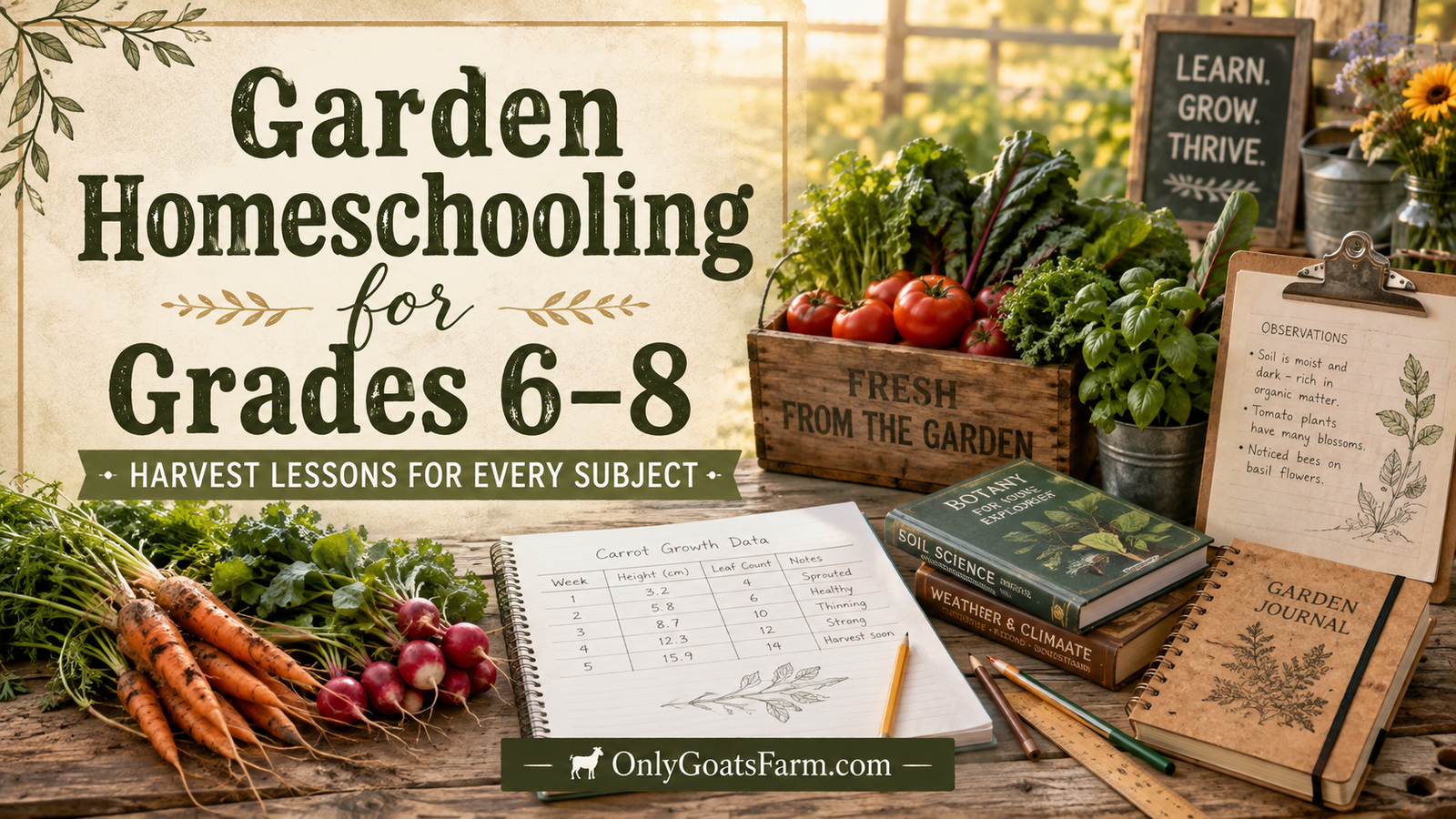
A garden can become a serious learning laboratory once children reach middle school. Students in grades 6–8 are ready to move beyond simple nature observations and begin conducting controlled experiments, analyzing data, comparing sources, building mathematical models, debating real-world issues, and designing solutions to practical problems.
Harvest season provides an especially useful setting for this work. A middle school student can track crop yields, investigate plant growth, calculate the profitability of a farm stand, research the history of a crop, test a watering system, analyze local food access, or create a multimedia presentation explaining what happened in the garden.
Instead of treating garden work and schoolwork as competing responsibilities, families can combine them into one meaningful, standards-connected homeschool unit.
These activities are designed for grades 6–8 and cover:
- English language arts
- Mathematics
- Science
- Engineering and technology
- Social studies
- Art
- Music
- Health
- Physical education
A Note About the Educational Standards
The lessons in this unit are connected to the Common Core State Standards for English language arts and mathematics, the Next Generation Science Standards, the C3 Framework for Social Studies, the National Core Arts Standards, and SHAPE America’s current health and physical education standards.
Common Core provides separate grade-level expectations for sixth, seventh, and eighth grade. NGSS science and engineering standards are organized as a combined middle-school grade band covering grades 6–8. The C3 Framework and SHAPE America standards also include expectations for the 6–8 grade band, while the National Core Arts Standards provide individual standards for sixth, seventh, and eighth grade.
These standards can help you plan lessons and document academic work, but you can still adjust the difficulty, timeline, and finished product to fit your child.
1. English Language Arts: Research and Defend a Garden Claim
Middle school students can use the garden as the foundation for both informational writing and evidence-based arguments.
Begin with a question that does not have an obvious one-sentence answer.
Possible research questions include:
- Does mulch significantly improve soil moisture?
- Which tomato variety produced the highest yield?
- Should gardeners use plastic or organic mulch?
- Are heirloom vegetables worth growing?
- Does companion planting actually work?
- Should a family preserve, sell, donate, or eat excess produce?
- Which method is best for extending the growing season?
- Are raised beds more productive than in-ground gardens?
- How does extreme weather affect crop production?
- Should communities invest in public gardens?
- What is the most sustainable way to water a garden?
- Do pollinator gardens improve vegetable production?
Have the student develop a working claim, collect information, and revise the claim as new evidence becomes available.
Conduct a Garden Research Project
A complete middle-school garden research project can include:
- A focused research question
- Background reading
- Notes from several reliable sources
- Firsthand garden observations
- Photographs, measurements, or other data
- A written report
- A bibliography
- A presentation or visual display
Students should learn to distinguish between a personal garden blog, a seed-company advertisement, an extension publication, a scientific study, and an unsupported social media claim.
Ask the student:
- Who created this source?
- What expertise does the author have?
- Is the source trying to inform or sell something?
- Does it cite evidence?
- How recently was it published or updated?
- Do other reliable sources agree?
- Is the information appropriate for our climate and growing conditions?
Common Core standards W.6.7 through W.8.7 ask students to conduct short research projects using several sources, while W.6.8 through W.8.8 build expectations for assessing credibility, quoting or paraphrasing accurately, avoiding plagiarism, and citing sources. Informative writing standards W.6.2 through W.8.2 require students to organize and analyze relevant information using facts, details, precise vocabulary, graphics, and clear conclusions.
Sixth-Grade Expectations
A sixth grader can:
- Form a focused question
- Use three or more sources
- Summarize information in their own words
- Include basic citations
- Organize the report with headings
- Create a chart or labeled diagram
- Write a clear conclusion
Seventh-Grade Expectations
A seventh grader can:
- Generate related follow-up questions
- Compare claims made by different sources
- Explain cause-and-effect relationships
- Address an opposing viewpoint
- Use quotations selectively
- Connect published research with garden evidence
Eighth-Grade Expectations
An eighth grader can:
- Develop a self-generated research question
- Explore several possible explanations
- Evaluate source accuracy and usefulness
- Combine qualitative and quantitative evidence
- Address claims and counterclaims
- Present conclusions through writing and multimedia
Write a Persuasive Garden Proposal
Students can also write a proposal addressing a real family or community decision.
Possible proposals include:
- Build a greenhouse.
- Add a rainwater collection system.
- Expand the vegetable garden.
- Create a pollinator habitat.
- Sell produce at a farm stand.
- Donate extra produce.
- Replace part of a lawn with food crops.
- Begin composting household food scraps.
- Purchase a pressure canner.
- Add fencing to reduce crop damage.
The proposal should explain the problem, recommend a solution, consider costs and drawbacks, cite evidence, and respond to possible objections.
2. Mathematics: Analyze Yield, Cost, Growth, and Profit
The garden gives middle school students a reason to use ratios, percentages, algebra, geometry, statistics, probability, and functions.
Create a Detailed Harvest Database
Track information such as:
- Plant variety
- Number of plants
- Planting date
- First harvest date
- Harvest quantity
- Harvest weight
- Damaged or unusable produce
- Rainfall
- Watering frequency
- Hours of sunlight
- Expenses
- Estimated retail value
- Amount eaten, preserved, sold, or donated
The student can use a notebook or spreadsheet.
A simple table might include:
| Date | Crop | Plants | Harvest Weight | Rainfall | Use |
|---|---|---|---|---|---|
| August 8 | Tomatoes | 6 | 8.4 lb | 0.6 in | Sauce |
| August 12 | Tomatoes | 6 | 10.1 lb | 0.2 in | Fresh |
| August 16 | Tomatoes | 6 | 11.7 lb | 1.1 in | Canning |
After several weeks, ask the student to calculate:
- Total yield
- Yield per plant
- Average harvest weight
- Percentage of produce lost
- Cost per pound
- Estimated value per plant
- Change in yield over time
- Ratio of preserved food to fresh food
- Percentage sold, donated, preserved, or eaten
Sixth-Grade Garden Math
Sixth graders can use ratios and rates to answer questions such as:
- How many pounds were produced per plant?
- How much water was used per garden bed?
- How many jars can be filled from 12 pounds of produce?
- What percentage of the harvest was damaged?
- How does the garden’s yield compare with the space it occupies?
Standard 6.RP.A.3 covers solving real-world problems with ratios and rates. Students can also use variables to represent changing garden quantities under 6.EE.C.9, calculate the area of irregular garden spaces under 6.G.A.1, and summarize harvest data using measures of center, variation, dot plots, histograms, and box plots under 6.SP.A.1–3 and 6.SP.B.4–5.
Example:
Six tomato plants produced 48 pounds of tomatoes. What was the average yield per plant? At that rate, how many pounds might 10 plants produce?
Seventh-Grade Garden Math
Seventh graders can investigate proportional relationships and percentages.
Possible activities include:
- Calculate projected yield for a larger garden.
- Compare costs per ounce or pound.
- Determine a farm-stand markup.
- Calculate percentage loss from pests.
- Adjust recipes using proportional reasoning.
- Compare germination rates between seed varieties.
- Use a random sample to estimate the total number of fruits on a large plant.
Standards 7.RP.A.2 and 7.RP.A.3 address proportional relationships, unit rates, percentages, markups, and multistep problems. Seventh-grade statistics also includes using random samples and comparing two populations, making it useful for comparing varieties, beds, treatments, or growing methods.
Example:
A gardener randomly samples five bean plants and finds an average of 18 pods per plant. Use the sample to estimate the number of pods on 40 plants. Explain why the estimate may not be exact.
Eighth-Grade Garden Math
Eighth graders can model relationships between two changing quantities.
Possible variables include:
- Days since planting and plant height
- Hours of sunlight and yield
- Water applied and growth
- Number of plants and total production
- Time and cumulative harvest
- Number of products sold and total revenue
- Outdoor temperature and greenhouse temperature
Students can create scatter plots, look for associations, fit an informal line, and interpret slope as a rate of change.
Standards 8.F.B.4–5 ask students to construct and interpret functions describing relationships between quantities. Standards 8.SP.A.1–3 involve scatter plots, patterns of association, informal linear models, and interpreting slope and intercept in context. The official standards even use plant height and sunlight as an example of bivariate biological data.
Example:
Plot the height of a sunflower each week. Does its growth appear linear throughout the entire season? During which period was its rate of change greatest?
Design a Profitable Farm Stand
Give the student a realistic budget that includes:
- Seeds or transplants
- Soil amendments
- Packaging
- Labels
- Payment-processing fees
- Table or tent
- Signs
- Fuel or transportation
- Labor time
- Spoiled or unsold products
Students can then determine:
- Cost per item
- Break-even point
- Selling price
- Gross revenue
- Net profit
- Profit margin
- Effect of changing demand
- Effect of a discount
- Whether value-added products are more profitable
This project can be completed with pretend numbers or actual family garden records.
3. Science: Conduct a Controlled Garden Experiment
Middle school is an excellent time to move from informal observation to controlled experimentation.
A strong garden experiment begins with a testable question.
Examples include:
- Does mulch reduce soil-moisture loss?
- Does compost increase plant growth?
- Does seed depth affect germination?
- Does shade cloth reduce heat stress?
- Does fertilizer concentration affect growth?
- Do different soil mixtures retain different amounts of water?
- Does pruning affect tomato yield?
- Does spacing affect plant size?
- Do pollinator-friendly flowers change insect activity?
- Does seed age affect germination?
- Does water temperature affect seed germination?
- Which food-storage method slows spoilage most effectively?
Plan the Experiment
Ask the student to identify:
- Independent variable
- Dependent variable
- Controlled variables
- Control group
- Number of trials
- Measurement method
- Data-collection schedule
- Possible sources of error
For example:
How does mulch depth affect soil moisture?
The student might compare beds with zero, two, and four inches of mulch while keeping the soil, crop, sunlight, and watering schedule as similar as possible.
Measure and Record
Possible measurements include:
- Plant height
- Number of leaves
- Germination percentage
- Soil temperature
- Soil moisture
- Number of flowers
- Number of fruits
- Total harvest weight
- Insect visits
- Days to maturity
- Percentage of damaged produce
Students should record unexpected events such as storms, animal damage, equipment problems, or missed measurements.
Connect the Experiment to Middle-School Science
Relevant NGSS performance expectations include:
- MS-LS1-4: Use evidence and reasoning to explain how plant structures affect reproductive success.
- MS-LS1-5: Explain how environmental and genetic factors influence organism growth.
- MS-LS1-6: Explain the role of photosynthesis in cycling matter and moving energy.
- MS-LS2-1: Analyze how resource availability affects organisms and populations.
- MS-LS2-3: Model the cycling of matter and flow of energy through an ecosystem.
- MS-LS2-4: Construct an evidence-based argument about how ecosystem changes affect populations.
- MS-LS2-5: Evaluate solutions for maintaining biodiversity and ecosystem services.
Model the Garden as an Ecosystem
Have students create a detailed model containing:
- Sun
- Water
- Air
- Soil minerals
- Plants
- Pollinators
- Herbivorous insects
- Predators
- People
- Livestock
- Decomposers
- Compost
- Waste products
Use arrows to distinguish between:
- Energy flow
- Movement of matter
- Predator-prey relationships
- Competition
- Decomposition
- Human inputs and removals
Students should be able to explain why energy flows through the system while matter is continually rearranged and recycled.
Study Photosynthesis and Plant Growth
Students can compare leaves grown in full sun and partial shade, investigate leaf surface area, or examine how plants respond to limited light.
They can create a model explaining how plants use light, carbon dioxide, and water to build plant matter. The lesson should emphasize that most of a plant’s dry mass does not come directly from soil.
Investigate Pollination and Reproduction
Observe flowers at different stages and record:
- Flower structure
- Time of day insects visit
- Types of insects observed
- Number of visits
- Fruit formation
- Seed formation
- Differences between covered and uncovered flowers
Students can then explain how flower structures and animal behaviors may affect the probability of successful reproduction.
4. Engineering and Technology: Design a Garden Solution
Middle school students can complete an authentic engineering design challenge by solving a problem that actually affects the garden.
Possible challenges include:
- Create a drip-irrigation system.
- Design a rainwater collection system.
- Build a cold frame.
- Construct a season-extension cover.
- Design a solar food dehydrator.
- Create a produce-washing station.
- Build a compost sifter.
- Design an animal-resistant barrier.
- Create a low-cost greenhouse ventilation system.
- Build a storage system that prevents bruising.
- Design a tool that plants seeds at consistent spacing.
- Create a farm-stand display that protects produce from sun.
Define Criteria and Constraints
Suppose the challenge is:
Design a system that waters a four-foot-by-eight-foot garden bed evenly while using no more than five gallons of water and $20 in materials.
Criteria might include:
- Even water distribution
- Ease of use
- Durability
- Low water waste
- Safe operation
Constraints might include:
- Budget
- Available materials
- Time
- Garden dimensions
- Water pressure
- Weather
- Age-appropriate tool use
Students should sketch multiple solutions, compare their strengths, select a design, build a prototype, and test it.
Test and Improve the Design
Record:
- How long the device operates
- How much water it uses
- Whether all areas receive water
- Leaks or failures
- Construction cost
- Needed repairs
- Improvements made after testing
The NGSS middle-school engineering standards MS-ETS1-1 through MS-ETS1-4 cover defining criteria and constraints, evaluating competing designs, analyzing test data, and developing models that allow repeated testing and modification.
Add Technology
Students can use digital tools to:
- Build a spreadsheet
- Create graphs
- Make a scale drawing
- Record a time-lapse video
- Design labels or signs
- Build a digital presentation
- Create a QR code linking to product information
- Compare weather and garden data
- Document prototype changes
- Build a simple website or digital portfolio
5. Social Studies: Investigate Food Systems, Trade, and History
Middle school students can use one garden crop to investigate how geography, economics, history, and civic decisions influence what people grow and eat.
Trace a Crop Around the World
Choose a crop such as:
- Tomato
- Potato
- Corn
- Squash
- Pepper
- Apple
- Wheat
- Rice
- Bean
- Cucumber
Research:
- Where it originated
- How it was cultivated
- How it spread
- Who controlled its production
- How trade affected its distribution
- How cultures adapted it into local foods
- How modern varieties differ
- Where it is commercially produced today
- Environmental conditions needed for production
Create a map showing movement over time.
C3 geography standards D2.Geo.1.6-8 and D2.Geo.3.6-8 involve creating maps and using mapping techniques to represent and analyze cultural and environmental patterns. D2.Geo.4.6-8 asks students to explain how cultural patterns and economic decisions influence environments and daily life.
Calculate Food Miles
Compare a garden vegetable with a similar product sold in a grocery store.
Research:
- Place of origin
- Approximate travel distance
- Transportation method
- Packaging
- Storage requirements
- Seasonal availability
- Price
- Advantages and disadvantages of local and distant production
Avoid assuming that local food is automatically better in every way. Ask students to consider yield, storage, transportation efficiency, climate, labor, cost, and consumer access.
Explore the History of Food Preservation
Research how people preserved harvests before modern refrigeration.
Possible topics include:
- Drying
- Fermenting
- Root cellars
- Salting
- Smoking
- Pickling
- Canning
- Ice houses
- Seed storage
Students can compare primary sources, historic advertisements, household manuals, photographs, tools, and modern explanations.
Relevant C3 history standards include D2.His.2.6-8, which examines change and continuity; D2.His.10.6-8, which identifies limitations in the historical record; D2.His.13.6-8, which evaluates the usefulness of sources; and D2.His.14.6-8, which explains multiple causes and effects.
Build a Garden Business Model
Students can investigate:
- Supply and demand
- Pricing
- Competition
- Product differentiation
- Labor
- Production costs
- Profit
- Risk
- Advertising
- Customer preferences
- Value-added products
- Waste reduction
The C3 Framework’s middle-school economics standards include explaining how economic decisions affect individuals, businesses, and society; examining buyers and sellers; analyzing competition; explaining supply-and-demand price changes; and examining innovation and entrepreneurship. These appear in D2.Eco.1.6-8, D2.Eco.3.6-8, D2.Eco.4.6-8, D2.Eco.6.6-8, and D2.Eco.7.6-8.
Debate a Local Food Issue
Possible issues include:
- Should vacant public land be used for community gardens?
- Should schools compost cafeteria waste?
- Should neighborhoods allow front-yard vegetable gardens?
- Should communities restrict pesticide use?
- Should public funds support farmers markets?
- Should excess garden produce be donated?
- Should pollinator habitats be required in new developments?
- Who should have access to a community garden plot?
Students can research several perspectives, establish discussion rules, present arguments, listen to opposing views, and propose an informed action.
C3 civic standards D2.Civ.7.6-8 and D2.Civ.10.6-8 address democratic participation and the relevance of different interests and perspectives. D4.7.6-8 asks students to assess their ability to take action on local, regional, or global problems while considering possible strategies and outcomes.
6. Art: Create a Scientific and Persuasive Garden Portfolio
Middle school garden art can combine scientific accuracy, personal expression, design, and public communication.
Create a Botanical Illustration
Choose a plant and produce a detailed study showing:
- Root system
- Stem
- Leaf arrangement
- Flower
- Fruit
- Seed
- Scale
- Color variation
- Surface texture
- Signs of damage or disease
Add the common name, scientific name, date, location, and written observations.
Design a Garden Campaign
Students can design materials supporting a real garden goal.
Possible projects include:
- Pollinator-awareness poster
- Farm-stand logo
- Seed-packet design
- Composting campaign
- Garden map
- Produce label
- Food-waste infographic
- Harvest recipe cards
- Community-garden proposal display
- Garden-season photo essay
Sixth-grade visual arts standard VA:Cr1.1.6a emphasizes combining concepts collaboratively to generate innovative ideas. Seventh graders under VA:Cr1.1.7a apply methods for overcoming creative blocks, while eighth graders under VA:Cr1.1.8a document early stages of the creative process visually or verbally. The standards also progress toward planning investigations, establishing criteria, refining work, and connecting art to social, cultural, historical, and personal knowledge.
Curate a Garden Exhibition
At the end of the unit, students can display:
- Botanical illustrations
- Photographs
- Garden maps
- Experiment results
- Seed collections
- Posters
- Product designs
- Models
- Written reflections
Ask the student to decide what belongs in the exhibit, arrange the materials, write labels, and explain the choices.
7. Music: Compose a Harvest Soundscape
A garden soundscape lets students combine observation, composition, cultural research, and technology.
Spend time recording or listing garden sounds:
- Wind
- Rain
- Insects
- Birds
- Garden tools
- Watering
- Footsteps
- Gates
- Harvest baskets
- Livestock
- Kitchen preparation
- Canning equipment
Students can recreate these sounds using instruments, body percussion, household materials, or digital recordings.
Build a Composition
The piece could include:
- A quiet introduction
- Morning garden sounds
- Increasing work activity
- A repeated harvesting rhythm
- A storm or weather change
- A reflective ending
Sixth graders can create phrases in AB or ABA form. Seventh graders can create variations over an accompaniment. Eighth graders can develop an expanded form with introductions, transitions, and a coda. These expectations correspond with MU:Cr1.1.6a, MU:Cr1.1.7a, and MU:Cr1.1.8a.
Research Harvest Music
Students can also explore:
- Work songs
- Folk songs
- Harvest festival music
- Agricultural rhythms
- Music associated with planting or seasonal celebrations
- How musical traditions reflect labor, place, and culture
The final project could combine a short research presentation with a performance or original composition.
8. Health and Physical Education: Plan Safe, Sustainable Garden Work
Middle school students can take more responsibility for planning garden labor, evaluating physical effort, and making health-related decisions.
Create a Garden Fitness Plan
Garden tasks may include:
- Digging
- Raking
- Carrying water
- Moving compost
- Pushing a wheelbarrow
- Harvesting
- Squatting
- Reaching
- Pulling weeds
- Carrying baskets
Have students identify:
- Muscles used
- Safe lifting technique
- Appropriate tool size
- Need for hydration
- Signs of overheating
- Importance of rest
- Clothing and sun protection
- Safe body positioning
- When adult assistance is required
Students can set a realistic work goal, monitor progress, and reflect on whether the plan should be adjusted.
SHAPE America’s grades 6–8 physical education indicators include demonstrating correct technique in outdoor activities, contributing positively to a group, following safe practices, participating in activities that support health, setting activity goals, and examining barriers to participation. Relevant indicators include 1.8.1, 3.8.2, 3.8.7, 4.8.3, 4.8.6, and 4.8.7.
Evaluate a Garden-to-Table Meal
Ask students to design a meal using available garden ingredients.
They should consider:
- Nutritional variety
- Portion sizes
- Allergies
- Food safety
- Preparation methods
- Cost
- Time
- Family preferences
- Food waste
- How much of the meal was locally produced
Students can compare several possible meals and explain which one best fits the family’s needs.
Current SHAPE America health standards for grades 6–8 include analyzing health-supporting behaviors, accessing reliable information, applying decision-making processes, setting and monitoring goals, demonstrating health-promoting practices, and advocating for family or community well-being. Relevant indicators include 1.8.2–3, 3.8.3–4, 5.8.1–6, 6.8.1–6, 7.8.1–3, and 8.8.1–5.
Create a Food-Safety Campaign
Students can research and design a poster, brochure, video, or presentation about:
- Handwashing
- Cleaning produce
- Avoiding cross-contamination
- Safe use of kitchen tools
- Refrigerator storage
- Recognizing spoilage
- Safe canning practices
- Heat and hydration during harvest
- Seeking adult help when needed
The student should use trustworthy sources and adapt the message for a specific audience.
A Two-Week Garden Homeschool Unit for Grades 6–8
Day 1: Choose a Garden Question
Tour the garden, identify a problem or topic, and write a focused research question.
Day 2: Conduct Background Research
Find several reliable sources, take notes, and create a bibliography.
Day 3: Plan the Investigation
Identify variables, measurements, materials, criteria, and possible sources of error.
Day 4: Collect Garden Data
Measure plants, weigh produce, record environmental conditions, or test a prototype.
Day 5: Analyze the First Results
Create tables and graphs. Calculate ratios, averages, percentages, or rates of change.
Day 6: Study History and Geography
Research the origin, spread, and cultural importance of a crop.
Day 7: Investigate Economics or Civics
Build a farm-stand model, analyze food access, or debate a community garden issue.
Day 8: Create an Artistic or Musical Response
Complete a botanical illustration, campaign design, soundscape, or multimedia piece.
Day 9: Write and Revise
Produce the research report, argument, engineering explanation, or proposal.
Day 10: Present the Project
Share the findings through a presentation, exhibit, video, poster, or family discussion.
How to Document the Unit for a Homeschool Portfolio
Save enough work to show the process as well as the final result.
Possible portfolio materials include:
- Research question
- Source notes
- Bibliography
- Experiment plan
- Photographs
- Raw data
- Spreadsheet
- Graphs
- Mathematical calculations
- Garden map
- Engineering sketches
- Prototype-testing record
- Historical-source analysis
- Written report
- Persuasive proposal
- Botanical artwork
- Presentation slides
- Student reflection
- Parent evaluation
- List of standards addressed
One well-developed garden project can provide evidence of learning across nearly every middle-school subject.
Final Thoughts
For middle school students, garden learning should involve more than completing outdoor worksheets. Children in grades 6–8 are ready to ask difficult questions, evaluate evidence, test solutions, identify limitations, and defend conclusions.
A garden provides real numbers to analyze, living systems to investigate, problems to solve, products to market, histories to research, and decisions to debate.
Students are not merely learning about ratios, ecosystems, economics, writing, or engineering. They are using those subjects to understand and improve something real.
That is what makes garden-based homeschooling so valuable at the middle-school level: the academics become more rigorous at the same time that the work becomes more practical.
Read more:
Grades k-2 Homeschool in the garden


Post your Comment About This Product