
A garden can provide far more than fresh vegetables. During harvest season, it can also become a science lab, math center, writing workshop, art studio, and even a small lesson in economics.
This is one of the advantages of homeschooling: learning does not have to be separated into neat little subjects. A child who harvests tomatoes can count them, weigh them, compare their sizes, examine their seeds, write about how they grew, and help turn them into a meal. One ordinary garden task can cover nearly an entire school day.
These garden homeschool activities are designed for children in kindergarten through second grade. Each lesson includes simple ways to adjust the work for different ages, along with educational standards that the activity can help address.
What Educational Standards Apply to Garden Learning?
There is not one national set of standards covering every school subject. For this unit, the activities are connected to:
- Common Core State Standards for English language arts and mathematics
- Next Generation Science Standards
- C3 Framework for Social Studies
- National Core Arts Standards
- SHAPE America standards for health and physical education
Common Core provides grade-specific expectations for English language arts and math, while the other frameworks provide guidance for subjects such as science, social studies, art, music, health, and physical education.
You do not need to complete a separate worksheet for every standard. In fact, several standards can often be covered through one meaningful garden project.
1. English Language Arts: Keep a Harvest Journal
A garden journal gives children a reason to write about something they have actually experienced. Instead of staring at a blank page and being told to write, they can describe the pepper they picked, explain how they dug up potatoes, or record what happened when a tomato split.
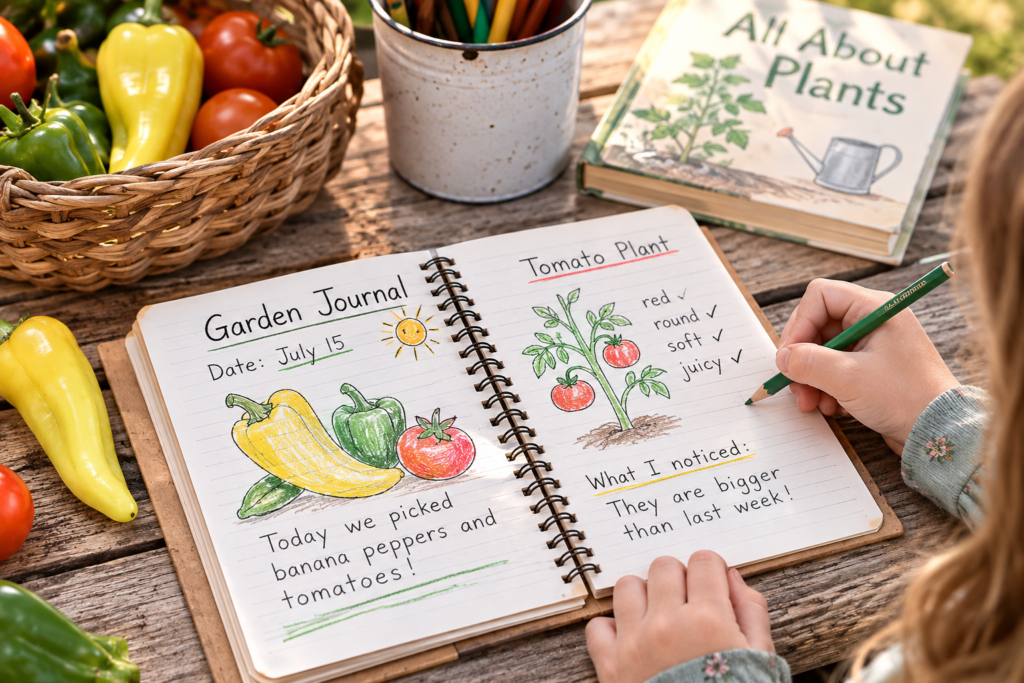
Start by giving each child a notebook or several pages stapled together. After spending time in the garden, ask the child to record one observation.
Possible journal prompts include:
- What did you harvest today?
- What color, size, shape, and texture was it?
- What changed in the garden this week?
- What did you notice about the plant?
- How did you know the vegetable was ready?
- What should you do with it next?
Kindergarten
Allow the child to draw the vegetable and dictate a sentence for you to write. The child can label simple parts such as leaf, stem, root, seed, and fruit.
A kindergarten entry might include a drawing and the sentence:
I picked a yellow pepper.
First Grade
Ask the child to write two or three sentences. Encourage the use of descriptive words and sequencing words such as first, next, and last.
For example:
First, I found a yellow pepper. Next, I twisted it off the plant. Last, I put it in the basket.
Second Grade
A second grader can write a short explanatory paragraph about how to harvest, wash, prepare, or preserve one crop. The child can also compare two vegetables or write a short report after reading a garden book.
Standards Addressed
This activity aligns with W.K.2, W.1.2, and W.2.2, which progress from drawing and dictating informative writing in kindergarten to producing increasingly developed explanatory texts in first and second grade.
It can also address W.K.7, W.1.7, and W.2.7 when children participate in shared research, such as reading about a crop and recording garden observations.
Turn Harvesting into a Reading Lesson
Pair the journal with nonfiction books about seeds, plants, insects, weather, farms, or food production.
Before reading, ask what the child already knows. While reading, look for information that connects to your garden. Afterward, return outside and see whether the child can find an example.
You could also read a recipe together. Have the child locate:
- The recipe title
- The ingredient list
- The numbered directions
- Measurement words
- Action words such as chop, stir, pour, and bake
This makes reading immediately useful rather than treating it as an isolated exercise.
2. Math: Count, Sort, Measure, and Graph the Harvest
Harvest season is filled with real math. Children can count vegetables, compare quantities, measure lengths, weigh produce, make groups, create graphs, and solve simple addition and subtraction problems.
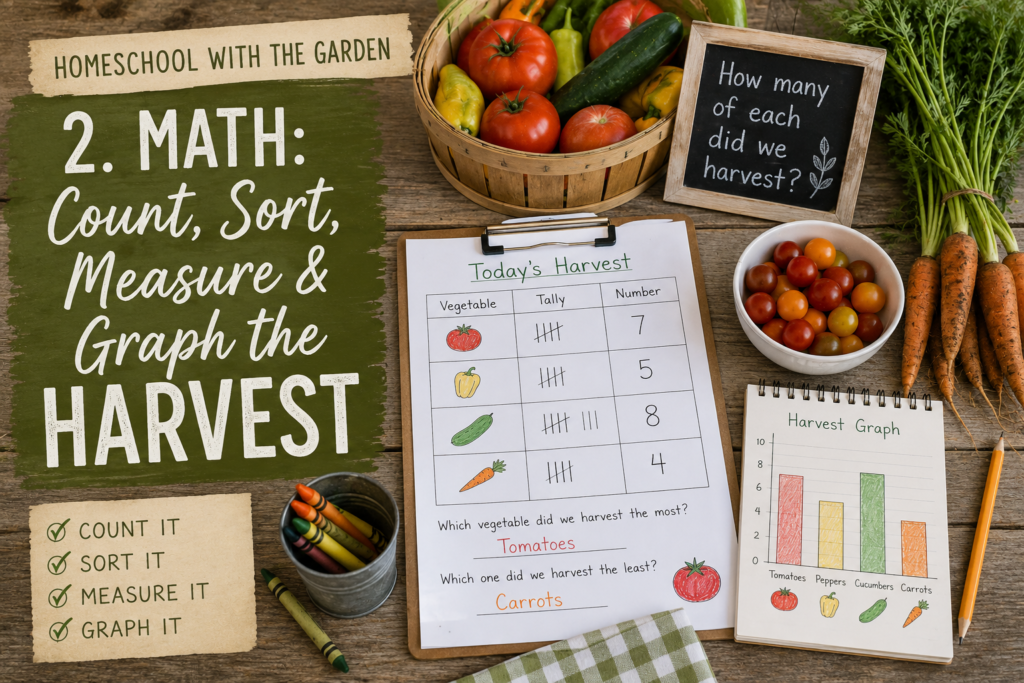
Set the day’s harvest on a table and let your child help organize it.
Count and Sort the Produce
Sort vegetables by:
- Type
- Color
- Size
- Shape
- Ripe versus unripe
- Damaged versus usable
Kindergarten
Have the child count up to 20 items, match each item to one number, and compare two groups.
Ask:
- Are there more tomatoes or peppers?
- Which group has fewer?
- Do the groups have the same number?
- Which squash is longer?
- Which pumpkin is heavier?
These activities support kindergarten standards for counting objects, comparing groups, describing measurable attributes, and classifying objects into categories.
First Grade
Use the harvest to create addition and subtraction stories within 20.
For example:
We picked eight tomatoes in the morning and five in the afternoon. How many did we pick altogether?
Or:
We harvested 14 peppers and used six in a recipe. How many are left?
This supports 1.OA.A.1, which asks children to solve addition and subtraction problems using objects, drawings, and equations.
Second Grade
Second graders can solve one- and two-step problems within 100.
For example:
We harvested 32 tomatoes. We used 12 for sauce and gave eight to a neighbor. How many remain?
Children can also arrange vegetables into equal rows, determine whether a quantity is odd or even, and begin exploring repeated addition. These activities connect with 2.OA.A.1, 2.OA.C.3, and 2.OA.C.4.
Make a Harvest Graph
Choose up to four crops and create a picture graph or bar graph showing how many of each were harvested.
Kindergartners can glue or draw one picture for each vegetable. First graders can compare categories and answer questions about how many more or fewer. Second graders can create a single-unit bar graph and solve problems using the data.
Second-grade standard 2.MD.D.10 specifically includes creating picture and bar graphs with up to four categories and answering questions based on the data.
3. Science: Study Plant Needs, Seeds, Weather, and Habitats
The garden is already a working science laboratory. Children can observe living things, collect evidence, notice patterns, test ideas, and record changes over time.
Investigate What Plants Need
Select two or three similar plants or seedlings and change only one condition.
Possible investigations include:
- One plant receives sunlight while another is placed in shade.
- One plant receives water while another temporarily receives less.
- Two plants receive different amounts of water.
- One area is mulched while another is not.
Keep the investigation short and avoid severely damaging the plants. Have children predict what will happen, observe the plants, and record changes.
Kindergarten
Focus on simple observations:
- Plants need water.
- Plants need light.
- Living things have needs.
- Weather affects the garden.
K-LS1-1 asks children to use observations to identify patterns in what plants and animals need to survive. K-ESS2-1 uses observations of local weather to describe patterns over time.
First Grade
Compare a mature plant with a younger plant of the same kind. Look for traits that are similar and traits that are different.
Compare:
- Leaf shape
- Color
- Stem thickness
- Fruit size
- Markings
- Growth habits
1-LS3-1 asks first graders to use observations as evidence that young plants and animals are similar to—but not exactly the same as—their parents.
Second Grade
Have the child help plan a fair investigation testing whether plants need sunlight or water. Change one variable while keeping the others as similar as possible.
2-LS2-1 specifically asks students to plan and conduct an investigation into whether plants need sunlight and water to grow.
Second graders can also compare the living things found in the garden, lawn, creek edge, woods, or compost area. Record which plants, insects, birds, and other animals are found in each habitat.
This connects with 2-LS4-1, which involves observing plants and animals to compare the diversity of life in different habitats.
Explore Seeds During Harvest
Cut open several mature vegetables and compare their seeds.
Good choices include:
- Tomatoes
- Peppers
- Cucumbers
- Squash
- Pumpkins
- Beans
- Peas
- Corn
Children can count seeds, compare shapes, sort them, draw them, and predict how the seeds might travel. Save a few properly mature seeds when appropriate and label them for planting experiments later.
4. Social Studies: Create a Garden Map and Harvest Market
Social studies may not seem like an obvious garden subject, but gardening connects naturally with geography, economics, community roles, history, and cultural traditions.
Draw a Map of the Garden
Walk through the garden and identify important features:
- Beds
- Paths
- Fence
- Water source
- Compost area
- Greenhouse
- Shed
- Trees
- Sunny and shady areas
Kindergartners can draw a simple picture map. First and second graders can add labels, a title, symbols, and a basic map key.
The C3 Framework standard D2.Geo.1.K-2 asks children to construct maps and other representations of familiar places. D2.Geo.2.K-2 involves using maps, graphs, and photographs to describe places and the relationships that shape them.
Discuss why certain crops were planted in particular places. Perhaps tomatoes were placed in full sun, mint was kept in a container, or pumpkins were planted where their vines had room to spread.
Set Up a Pretend Farm Stand
Let children turn part of the harvest into a pretend market.
They can:
- Arrange produce
- Make signs
- Assign simple prices
- Count pretend coins
- Take turns being the customer and seller
- Decide what to sell, eat, preserve, or share
- Discuss the work required to produce the food
The C3 economics framework for K–2 includes explaining why scarcity requires choices, identifying the benefits and costs of decisions, recognizing the knowledge needed to produce goods and services, and identifying prices in a local market. These correspond with standards including D2.Eco.1.K-2, D2.Eco.2.K-2, D2.Eco.3.K-2, and D2.Eco.5.K-2.
Ask questions such as:
- What should we do when we have only three pumpkins?
- Is it better to eat, sell, preserve, or give away the tomatoes?
- What supplies and work were needed to grow this pepper?
- Why might tomatoes cost more after a poor harvest?
- What does a customer receive in exchange for money?
Study Harvest Traditions
Choose one crop and learn how it is grown, eaten, or celebrated in different places.
Possible topics include:
- The history of corn
- Native American agricultural practices
- Apple harvest traditions
- Pumpkin festivals
- Maple sugaring
- Wheat and breadmaking
- Rice cultivation
- Foods eaten during harvest celebrations around the world
Keep the activity concrete for young children. Read a picture book, locate the place on a map, prepare a simple food, and discuss similarities and differences.
5. Art: Make Botanical Drawings and Vegetable Prints
The colors, lines, shapes, and textures found in a garden provide plenty of art inspiration.
Create a Harvest Still Life
Place several vegetables in a basket or on a table. Ask children to look closely before drawing.
Encourage them to notice:
- The curve of a pepper
- Lines on a pumpkin
- Different shades of green
- Light and shadow
- Uneven shapes
- Leaf veins
- Spots and blemishes
Kindergartners can explore the materials and shapes freely. First graders can use close observation before creating. Second graders can select different tools and materials to communicate an idea.
These activities connect with National Core Arts Standards including VA:Cr1.2.Ka, collaborative creative art-making; VA:Cr1.2.1a, using observation and investigation before making art; and VA:Cr1.2.2a, creating with different materials and tools to explore interests and questions.
Make Vegetable Prints
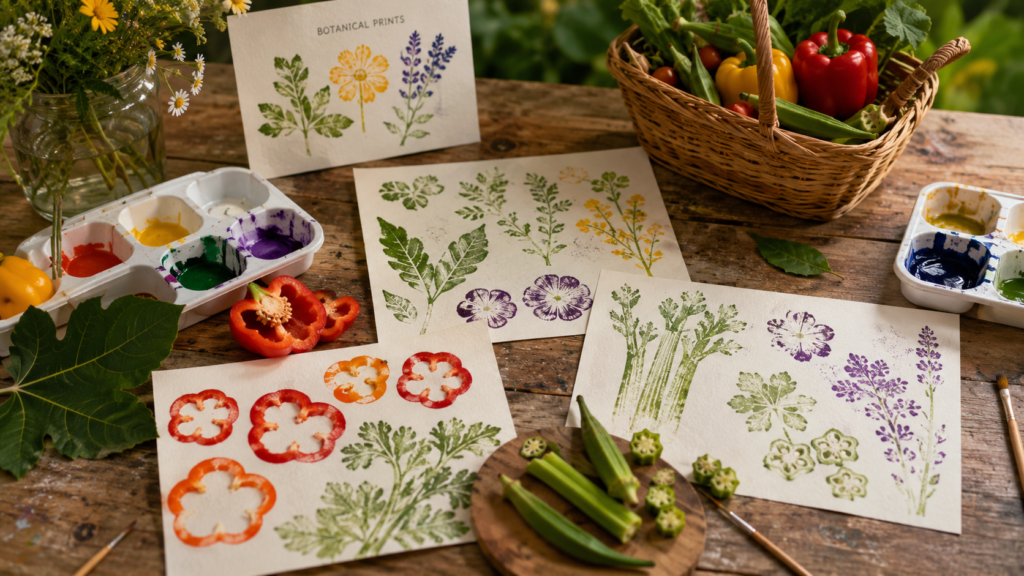
Cut vegetables such as okra, peppers, potatoes, celery, or corn and dip them lightly in washable paint.
Use the prints to make:
- Harvest cards
- Wrapping paper
- Repeating patterns
- Garden journal covers
- Produce signs
- A seasonal banner
This activity also reinforces shapes, patterns, fine-motor coordination, and creative planning.
6. Music: Create a Harvest Rhythm
Music can be added without buying a curriculum or an instrument.
Choose garden words and clap their syllables:
- Corn
- Pepper
- Tomato
- Cucumber
- Zucchini
- Watermelon
Arrange the words into rhythmic patterns. Children can clap, stomp, tap wooden spoons, shake dried beans in a sealed container, or drum gently on an upside-down bucket.
Try a call-and-response:
Adult: “What did we pick?”
Child: “Tomatoes and peppers!”
Kindergartners can explore beat and movement. First graders can create a musical answer to a question. Second graders can improvise short rhythmic patterns for a particular purpose.
These activities align with MU:Cr1.1.Ka, exploring beat and melodic ideas with guidance; MU:Cr1.1.1a, creating musical ideas for a purpose; and MU:Cr1.1.2a, improvising rhythmic or melodic patterns.
Children could finish by creating a short harvest song using a familiar melody.
7. Health and Physical Education: Garden Work and Kitchen Safety
Gardening provides real physical activity. Carrying a small watering can, digging, pulling weeds, pushing a child-sized wheelbarrow, squatting to harvest vegetables, and walking between beds all require movement and coordination.
Create a Garden Movement Circuit
Set up several short stations:
- Carry a small watering can to a marked spot.
- Squat and place pretend vegetables in a basket.
- Push an empty wheelbarrow or wagon along a safe path.
- Step over garden-row markers.
- Toss beanbags into harvest baskets.
- Stretch tall like a sunflower and curl small like a seed.
Emphasize safe movement, balance, coordination, taking turns, and recognizing when the body needs water or rest.
SHAPE America’s current K–2 physical education indicators include recognizing movement as a way to support health, identifying preferred physical activities, and setting simple observable goals.
Teach Harvest and Food-Safety Habits
Children can practice:
- Washing hands before handling food
- Washing produce under running water
- Keeping harvested food away from dirty tools
- Asking an adult before tasting an unfamiliar plant
- Using child-safe kitchen tools appropriately
- Recognizing when adult help is required
- Drinking water and resting during hot weather
These lessons connect with SHAPE America’s K–2 health indicators 7.2.1 and 7.2.2, which focus on identifying and demonstrating behaviors that support health and well-being. Communication and help-seeking can also address 3.2.2 and 4.2.1–4.2.2.
A Simple One-Week Garden Unit for K–2
You do not need to complete every activity in one day. Spread the lessons across a week.
Monday: Observe and Read
Walk through the garden, read a book about plants, and start a harvest journal entry.
Tuesday: Harvest Math
Pick, count, sort, measure, and graph several vegetables.
Wednesday: Garden Science
Examine seeds, conduct a sunlight or water investigation, and record the weather.
Thursday: Community and Creativity
Draw a garden map, create farm-stand signs, make vegetable prints, and practice a harvest rhythm.
Friday: From Garden to Table
Read a recipe, measure ingredients, prepare a simple dish, discuss kitchen safety, and write or draw the steps.
By the end of the week, children will have practiced reading, writing, math, science, geography, economics, art, music, health, and movement—without needing to complete a stack of disconnected worksheets.
How to Save Work for a Homeschool Portfolio
Photograph the activities and save a few examples of the child’s work.
Possible portfolio samples include:
- A dated garden journal entry
- A harvest graph
- Photographs of a plant experiment
- A labeled garden map
- A child-written recipe
- A botanical drawing
- A farm-stand price sign
- A brief list of standards addressed
- A parent note describing what the child observed or explained
You do not need to save every page. One garden project may demonstrate progress in several subjects at once.
Final Thoughts
Harvest time is busy, but it does not have to compete with homeschooling. The work your family is already doing can become the lesson.
A basket of vegetables offers opportunities to count, compare, investigate, read, write, create, move, and solve real problems. Young children often remember these lessons because they can see why the skills matter.
Instead of stopping life to “do school,” the garden allows you to use real life as the foundation for school—and still cover meaningful K–2 educational standards along the way.
See more ideas for:


Post your Comment About This Product