
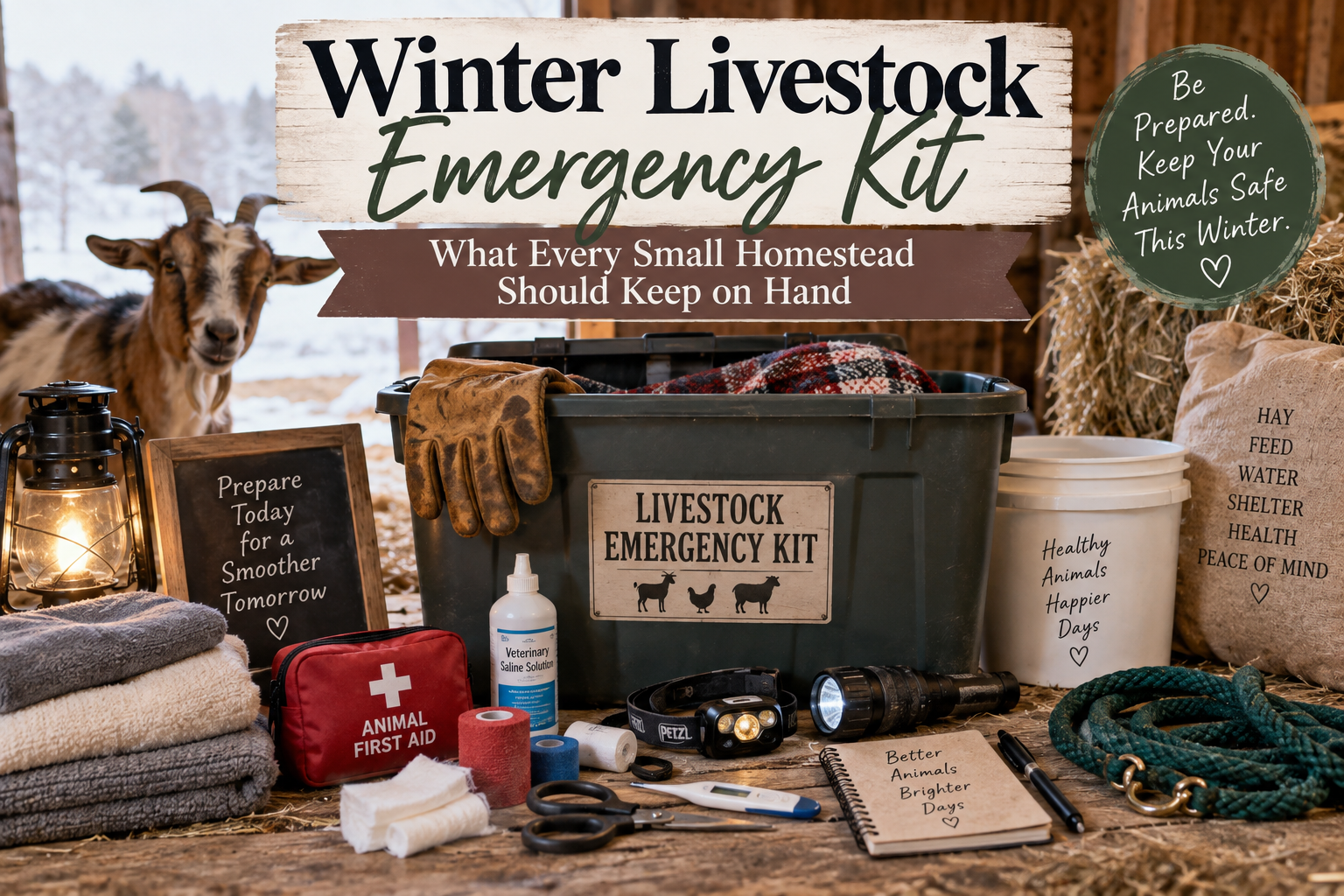
There are some farm supplies you can get away with not owning until you need them.
A winter livestock emergency kit is not one of them.
The middle of a snowstorm is a terrible time to discover that your flashlight is dead, your thermometer disappeared six months ago, your only clean towels are in the washing machine, and the halter you need is hanging on the opposite side of an icy pasture.
Ask me how I know.
Winter adds an extra layer of difficulty to almost every livestock problem.
Water freezes.
Roads get bad.
Power goes out.
Animals slip.
Barn doors freeze shut.
Feed stores close.
And a problem that might be relatively easy to manage on a sunny afternoon in June becomes much more complicated at 10 p.m. during a January snowstorm.
That is why every small homestead should have a winter livestock emergency kit that is easy to grab and kept somewhere accessible.
It doesn’t need to look like a veterinary hospital.
You don’t need $1,000 worth of supplies.
And you definitely don’t need to stockpile random livestock medications you don’t know how to use.
The goal is much simpler:
Have the basic supplies you need to safely assess an animal, contain the situation, keep yourself safe, and contact your veterinarian when necessary.
Here is what I would keep on hand before winter arrives.
Why Build a Separate Winter Livestock Emergency Kit?
You might already own most of the supplies on this list.
The problem is that farm supplies have an amazing ability to migrate.
The thermometer is in the house.
The flashlight is in the truck.
The good gloves are next to the chicken coop.
The halter is hanging somewhere in the barn.
The scissors were borrowed for a completely unrelated project and have disappeared forever.
That works right up until something happens.
A dedicated kit keeps your essential supplies together so you aren’t trying to locate them while dealing with a sick or injured animal.
Winter also creates emergencies that aren’t necessarily medical.
You may need to deal with:
- A frozen water system
- A power outage
- An animal loose during a storm
- A damaged shelter
- A gate frozen open or shut
- An animal that slips on ice
- Sudden illness
- Severe cold
- A delayed veterinarian
- Roads that make getting supplies difficult
If you’re preparing the rest of your property for winter too, my Winter Homestead Chores You Should Be Doing Now guide covers the larger barn, water, bedding, predator, and property jobs worth handling before bad weather settles in.
1. A Reliable Livestock Thermometer
A thermometer is one of the first things I want available when an animal suddenly doesn’t seem right.
Temperature doesn’t tell you exactly what is wrong.
But it gives you useful information to pass along to your veterinarian and can help you recognize that you’re dealing with more than an animal simply having an off day.
Keep a digital livestock thermometer in your kit.
Even better?
Keep two.
Thermometers are inexpensive enough that having a backup is worth it.
Store them with whatever lubricant and cleaning supplies you normally use for taking temperatures, and make sure everyone who routinely cares for your livestock knows where they are.
Goat owners should also learn what their animals look like when they are healthy versus when something is changing.
My How to Tell If Your Goat Is Sick: 10 Signs You Should Never Ignore post goes deeper into warning signs such as changes in appetite, behavior, temperature, breathing, manure, and mobility.
2. Several Pairs of Gloves
Put more gloves in your emergency kit than you think you’ll need.
I like having two different kinds.
Disposable gloves are useful when dealing with blood, wounds, bodily fluids, manure, or anything else you don’t necessarily want on your hands.
Heavy work gloves protect your hands when you’re handling fencing, broken boards, frozen gates, frightened animals, or damaged equipment.
Winter adds another problem: cold hands.
A task that is simple in July can become surprisingly difficult when your fingers are freezing.
Keep a dry pair of insulated work gloves somewhere you can grab them quickly.
3. Clean Towels
Old towels are one of the most underrated farm supplies.
Keep several clean towels in or beside your emergency kit.
They can be useful for:
- Drying an animal
- Applying pressure to bleeding
- Cleaning around an injury
- Providing temporary padding
- Wrapping a chilled newborn while getting additional help
- Protecting the floor of your vehicle during transport
- Giving yourself something clean to kneel on
Use towels you don’t mind permanently donating to farm life.
Once a bath towel enters the barn emergency kit, it probably isn’t coming back.
4. A Halter and Lead Rope
If your animals are large enough to be haltered, keep an extra halter and lead where you can reach them quickly.
Not buried in a tack trunk.
Not hanging behind six flakes of hay.
Accessible.
An injured or frightened animal may behave very differently than normal.
Having a way to safely contain or move that animal can make everything easier.
For goats and sheep, you may want appropriately sized halters or leads for the animals you are most likely to need to handle.
For horses, keep a correctly fitting halter and lead rope close to the main exit.
You may even want one set at each major livestock building.
5. Flashlight and Headlamp
A flashlight belongs in every livestock emergency kit.
A headlamp is even better.
Trying to hold a flashlight, restrain an animal, call the veterinarian, and inspect something at the same time gets ridiculous fast.
A headlamp leaves both hands free.
Keep:
- One good flashlight
- One headlamp
- Spare batteries
- Backup batteries stored somewhere dry
Check them periodically.
A flashlight with corroded batteries is just a decorative tube.
6. Basic Wound-Care Supplies
You do not need to transform your feed room into a pharmacy.
A basic first-aid section can include supplies such as:
- Sterile gauze pads
- Gauze rolls
- Vet wrap or cohesive bandage
- Clean bandaging material
- Blunt-tip or bandage scissors
- Saline or another veterinarian-approved wound-cleaning option
- Disposable gloves
- Clean towels
The point is to be able to safely protect or cover an injury while deciding what happens next.
Severe wounds, uncontrolled bleeding, punctures, suspected fractures, eye injuries, deep wounds, and other serious injuries should involve a veterinarian.
An emergency kit helps you respond.
It does not replace veterinary care.
7. Scissors
Own barn scissors.
Then hide them from everyone in your family.
I am only half joking.
A good pair of scissors can be useful for cutting bandage material, vet wrap, tape, twine, or clothing if necessary.
I prefer keeping one pair permanently inside the emergency kit.
If they leave the kit, they go directly back.
Otherwise they will inevitably become craft scissors.
And then disappear.
8. A Notebook and Pen
This one sounds boring.
It is also extremely useful.
Keep a small notebook and permanent pen in the kit.
If you’re dealing with a sick animal, write down:
- Time you first noticed the problem
- Temperature
- Appetite
- Water intake
- Manure changes
- Behavior changes
- Visible injuries
- Anything the animal may have eaten
- When symptoms changed
- What your veterinarian told you
When you’re stressed, you will not remember everything as clearly as you think you will.
The notes also give you something concrete to report if the veterinarian asks how the animal has changed over several hours.
9. Veterinarian Contact Information
Do not rely exclusively on your phone contacts.
Put your veterinarian’s information somewhere physical too.
Write down:
- Regular veterinarian
- Emergency number
- Backup livestock veterinarian if you have one
- Veterinary hospital
- Address
- Normal business hours
If you keep several species, make sure you know who will actually see them.
A veterinarian who treats horses may not treat goats.
A small-animal emergency clinic may not accept poultry.
Sort that out before the emergency.
If you are new to goats, building a relationship with a livestock veterinarian is one of the things I recommend in my Beginner’s Guide to Raising Goats on a Small Homestead.
10. Buckets
You can never have too many farm buckets.
Until you do.
Then somehow none of them are clean when you need one.
Keep at least one clean bucket available for emergencies.
Depending on your animals, you may need it for:
- Water
- Feed
- Carrying supplies
- Cleaning
- Soaking
- Temporary storage
I also like the idea of keeping one bucket designated as the emergency bucket and storing smaller supplies inside it.
Now the bucket itself becomes part of the kit.
11. Backup Water Containers
A winter emergency kit needs to account for the most predictable winter livestock emergency of all:
Frozen water.
If your animals depend on heated buckets, tank heaters, pumps, or well water, decide what happens when the electricity disappears.
Keep backup water containers somewhere accessible.
You don’t necessarily need enough stored water to supply the entire farm for two weeks.
But you should have enough containers to move water manually if necessary.
And if goats are part of your herd, remember that winter hydration goes hand-in-hand with nutrition. My Winter Goat Feeding Guide: Hay Planning, Nutrition & Zero-Waste Tips covers winter hay, water, minerals, and feed planning in much more detail.
12. Extra Feed and Hay
Your emergency supplies should extend beyond first aid.
Keep a reasonable buffer of the feeds your animals depend on.
That could include:
- Hay
- Grain
- Pelleted feed
- Rabbit feed
- Poultry feed
- Quail feed
- Loose minerals
- Salt
You do not need to stock six months of everything.
Feed can spoil, attract rodents, lose quality, or become contaminated if stored poorly.
The goal is simply to avoid reaching the bottom of the feed bin the same day a snowstorm closes the roads.
13. Electrolytes and Species-Specific Support Supplies
This is where I would get more individualized.
Rather than copying someone else’s giant farm-medication list from Pinterest, ask your veterinarian what non-prescription supportive supplies make sense for your species and your animals.
What is useful for a goat may not be appropriate for a horse.
What is safe for poultry may not be appropriate for a rabbit.
And medications that are commonly discussed online may have withdrawal times, dosing considerations, prescription requirements, interactions, or species restrictions.
Build this part of your kit with your veterinarian.
Don’t build it from TikTok.
14. A Livestock First-Aid Reference
Keep one reliable first-aid reference somewhere accessible.
That could be:
- A livestock first-aid book
- Printed veterinarian instructions
- Species-specific care sheets
- Your veterinarian’s emergency protocol
- A folder containing important animal records
Internet access is wonderful.
Until the power goes out.
Or your phone dies.
Or you are standing in a barn with terrible reception.
Paper still works in a snowstorm.
15. Animal Records
For larger or higher-value livestock, keep essential information organized.
That might include:
- Animal identification
- Birth dates
- Vaccination records
- Known medical conditions
- Current medications
- Breeding dates
- Due dates
- Recent veterinary treatments
- Microchip or registration information
You do not necessarily need every record physically inside the emergency kit.
But you should know exactly where those records are.
16. A Spare Lead, Rope, or Safe Restraint Equipment
Equipment breaks at the most inconvenient time possible.
Keep backup restraint equipment appropriate for your animals.
That may mean:
- Extra lead rope
- Spare halter
- Poultry carrier
- Dog crate
- Small livestock crate
- Horse trailer ready for use
Do not wait until you have an injured animal to discover that your livestock crate is currently being used to store extension cords.
17. An Animal Carrier or Transport Plan
Speaking of crates:
Know how you would transport an animal if necessary.
For poultry, rabbits, and quail, keep suitable carriers available.
For goats or sheep, know what vehicle or trailer you would use.
For horses, know whether your trailer is accessible, roadworthy, and positioned so you can actually move it during winter.
That last part matters.
A perfectly functional trailer parked behind three pieces of equipment and a snowbank is not much of an emergency plan.
If you keep quail through cold weather, my Raising Quail in the Winter: Tips, Tricks, and Lessons Learned goes into winter housing, frozen water, wind protection, and cold-weather management specifically for quail.
18. Emergency Lighting
A headlamp handles the immediate problem.
But what if your entire barn loses power?
Keep some backup lighting available.
Battery-powered lanterns work well because they can illuminate an entire small area without requiring you to hold them.
Keep them somewhere livestock cannot reach.
And please do not turn a power outage into a barn fire by improvising unsafe heat or lighting sources.
19. Hand Warmers
This sounds like a comfort item until you’re trying to work outside for two hours in single-digit temperatures.
Throw a few disposable hand warmers into the kit.
They’re inexpensive, don’t take much space, and can make a cold emergency much more manageable for the human dealing with it.
Your hands are one of your most important pieces of farm equipment.
Try to keep them functional.
20. Extra Bedding
A bale of straw obviously won’t fit inside your emergency tote.
But emergency bedding should still be part of the plan.
Keep enough bedding available that you can quickly create a clean, dry area for an animal that needs to be separated or sheltered.
That might mean:
- Straw
- Pine shavings
- Pelleted bedding
- Clean towels for very small animals
Dry matters enormously in winter.
Cold is hard.
Cold and wet is worse.
If your goats still need additional winter shelter, my How to Build a 3-Sided Pallet Shelter for Goats is an inexpensive option for adding a dry, wind-protected resting area.
21. A Safe Isolation Area
Your emergency kit isn’t only a box.
Your setup is part of the emergency plan too.
Think about where you would put an animal that suddenly needed to be separated.
Do you have:
- A spare stall?
- A small pen?
- A dog crate?
- A kidding pen?
- A poultry hospital cage?
- A separate rabbit cage?
You may never need it.
But when you do, you’ll be very glad you aren’t trying to build it at midnight.
22. Basic Repair Supplies
Winter emergencies love breaking things.
Keep a small collection of repair basics somewhere convenient.
Depending on your farm, that could include:
- Zip ties
- Appropriate wire
- Utility knife
- Pliers
- Screwdriver
- Hammer
- Exterior screws
- Duct tape for temporary non-animal repairs
- Fence repair supplies
These aren’t permanent solutions.
They’re get-through-the-night solutions.
The proper repair can happen when it is daylight and your eyelashes aren’t freezing together.
23. A Fire Extinguisher
Barns contain hay, bedding, dust, extension cords, heaters, equipment, and sometimes questionable decisions made by exhausted humans.
Keep an appropriate fire extinguisher accessible.
Check it according to the manufacturer’s instructions.
Make sure everyone in the household knows where it is.
And do not bury it behind feed bags.
24. A Written Power-Outage Plan
Think through what stops working when you lose electricity.
Possibilities include:
- Well pump
- Heated livestock waterers
- Tank heaters
- Barn lights
- Brooders
- Incubators
- Electric fencing
- Ventilation equipment
- Freezers
Write down your priorities.
For example:
- Restore or provide livestock water.
- Protect temperature-sensitive animals.
- Maintain safe lighting.
- Check electric fencing.
- Protect stored food or medications if applicable.
A written plan is especially helpful if someone else may need to handle chores when you aren’t home.
25. A Grab-and-Go Version of the Kit
Finally, consider separating your supplies into two levels.
Your main barn kit can contain the larger collection of supplies.
Then create a smaller grab-and-go bag with the things you’d want immediately:
- Thermometer
- Gloves
- Gauze
- Vet wrap
- Scissors
- Flashlight
- Headlamp
- Notebook
- Pen
- Halter or lead
- Veterinarian numbers
If something happens in the back pasture, you can grab one bag instead of carrying seventeen loose objects.
Which is significantly better than the traditional homestead method of stuffing everything into your coat pockets.
What I Would NOT Automatically Put in a Livestock Emergency Kit
This may be one of the most important sections of this entire list.
I would not recommend that every new homesteader go online, find a giant list of livestock drugs, buy all of them, and start treating animals based on symptoms they saw in a Facebook group.
Some medications:
- Require veterinary involvement
- Have species-specific dosing
- Have meat or milk withdrawal periods
- Can interact with other medications
- Can be dangerous if used incorrectly
- Can mask a serious condition
- May not be appropriate for the problem you’re actually treating
There is absolutely a place for keeping veterinarian-recommended medications on hand.
But that list should be built with your veterinarian for your animals.
Not copied blindly from someone else’s medicine cabinet.
Where Should You Store Your Winter Livestock Emergency Kit?
The answer is somewhere:
Dry + accessible + temperature appropriate + away from animals.
Avoid storing things where goats can chew them, chickens can knock them over, rodents can get into them, or moisture can destroy them.
A sturdy tote, cabinet, or large zippered first-aid bag can work well.
I like the idea of clearly labeling it:
LIVESTOCK EMERGENCY KIT
Not:
Random Green Tote Behind Other Random Green Tote.
Check your kit at least twice a year.
Fall is a perfect time because you’re already preparing for winter.
Then check again in spring.
Replace:
- Dead batteries
- Damaged packaging
- Used supplies
- Expired veterinarian-recommended products
- Broken equipment
- Dirty towels
- Missing tools
Because somehow the scissors will still disappear.
Quick Winter Livestock Emergency Kit Checklist
Save this list or print it for the barn:
- Thermometer
- Disposable gloves
- Insulated work gloves
- Clean towels
- Halters and lead ropes
- Flashlight
- Headlamp
- Spare batteries
- Gauze
- Bandage material
- Vet wrap
- Scissors
- Veterinarian-approved wound-cleaning supplies
- Notebook and pen
- Veterinarian phone numbers
- Clean bucket
- Backup water containers
- Feed and hay buffer
- Species-specific supportive supplies
- Animal first-aid reference
- Animal records
- Carriers or transport equipment
- Emergency lighting
- Hand warmers
- Extra bedding
- Safe isolation area
- Basic repair tools
- Fire extinguisher
- Written power-outage plan


Post your Comment About This Product